Jobs AI Will Replace
Jobs AI will replace, industry by industry. The ranking is already in.
There is no ranking of jobs cut. About 24% of jobs have some exposure. The 92 million figure is an employer survey, offset by 170 million roles.
Three numbers
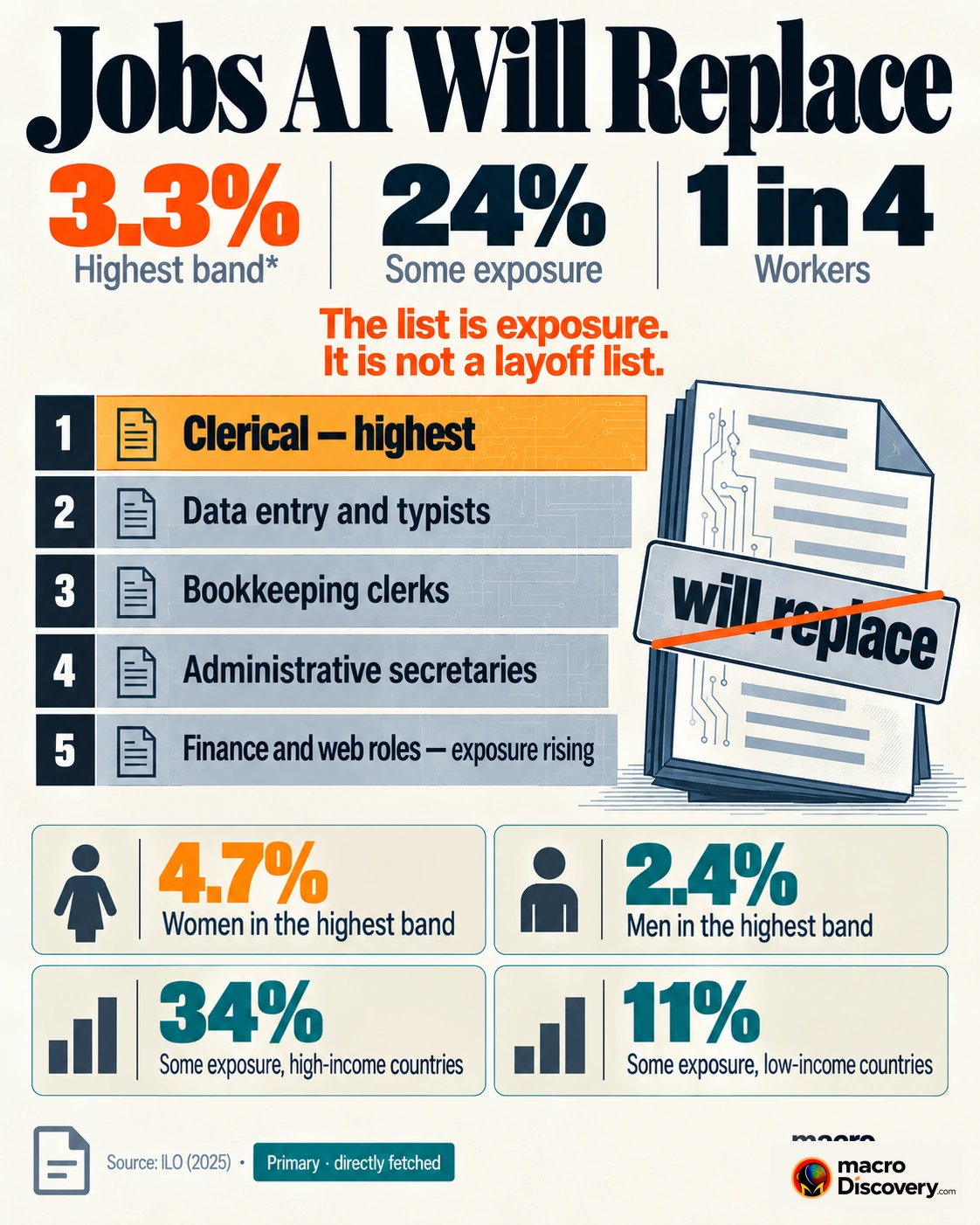
- 24% — jobs worldwide with some exposure to generative AI. One in three in high-income countries. One in ten in low-income countries. Source: ILO.
- 92 million — jobs employers expect structural change to displace from 2025 to 2030, equal to 8% of today’s total. Source: World Economic Forum.
- 170 million — roles the same survey expects to be created, equal to 14%. Net 78 million. Source: World Economic Forum.
What the data shows
A common claim is that a ranking already shows which jobs AI will replace, industry by industry. The fact is that the published number is exposure, and the displacement number is a survey. The International Labour Organization says about one in four workers, 24%, is in an occupation with some exposure to generative AI. Exposure means a share of current tasks could be done with the tool. It does not mean the job has been cut. The ILO says most occupations still contain tasks that need a person, so transformation is the more likely outcome. The most exposed titles are data-entry clerks, typists, bookkeeping clerks, and administrative secretaries. Professional roles, including financial analysts and programmers, moved up the exposure list between 2023 and 2025.
The 92 million figure is not a layoff file. The World Economic Forum’s 2025 employer survey says structural change from 2025 to 2030 could displace the equivalent of 92 million jobs, 8% of today’s total, and create the equivalent of 170 million, 14%. The net is 78 million, or 7%. The causes are broader than AI. Clerical and secretarial workers, including cashiers and administrative assistants, are the roles employers expect to shrink most in absolute numbers. Postal clerks, bank tellers, and data-entry clerks are the fastest declines in percentage terms. Forty percent of employers said they anticipate cutting staff where AI can automate tasks. That is a plan. It is not a count of people already gone.
The exposure is not even. About one in three jobs in high-income countries has some exposure, and about one in ten in low-income countries. In high-income countries, nearly 10% of women’s employment is in occupations with the highest automation potential, against 3.5% of men’s, up from 7.8% and 2.9% in 2023. An ILO study of regions found that greater exposure to emerging digital technologies was, on average, associated with employment gains, larger for prime-age workers. A ranking that lists industries as replaced has skipped the distinction the source draws between a task a model can do and a job that has ended.
The 24% exposure figure is a different series. It is not drawn here.
| Count | Figure | What it is |
|---|---|---|
| Some exposure | 24% of jobs | ILO. Not a layoff |
| High-income exposure | about 1 in 3 | Low-income about 1 in 10 |
| Displacement, survey | 92 million | 8% of jobs, 2025–2030 |
| Creation, survey | 170 million | Net 78 million |
| Employers planning cuts | 40% | Where AI can automate tasks |
How it was measured
The ILO exposure index scores occupations by how much of the task list a generative model could do. A high score is not a closed payroll. The gender split uses the share of employment in the most exposed occupations, not a count of women dismissed. The regional study compares employment rates in places with different exposure. An association with gains is not a promise.
The Forum figures extrapolate an employer survey to the world. Respondents name roles they expect to grow or shrink. The 92 million and 170 million are equivalents of today’s jobs, not filled posts. Structural change includes demographics, the green transition, and trade, not only AI.
What it means
It is settled that about 24% of jobs have some generative-AI exposure, and that a 2025 employer survey expects 92 million roles displaced and 170 million created by 2030. It is not settled that an industry ranking of replaced jobs exists. Use 24% for exposure. Use 92 million and 170 million for the survey. Use clerical titles for the most exposed list. Do not rank industries by jobs already cut.
Common misreadings
- 24% is exposure. It is not a share of jobs that have ended.
- 92 million is an employer survey through 2030. The same survey says 170 million roles are created.
- Forty percent of employers anticipating cuts is a plan. It is not a layoff file.
Where the numbers come from
How we built this
- Dataset: ILO generative-AI exposure index; World Economic Forum 2025 employer survey; ILO regional exposure study.
- Scope: Exposure and survey expectations kept apart from jobs already cut. No industry ranking invented.
- Figures: 24% is exposure. 92 million and 170 million are survey equivalents. The replacement ranking is treated as uncounted.