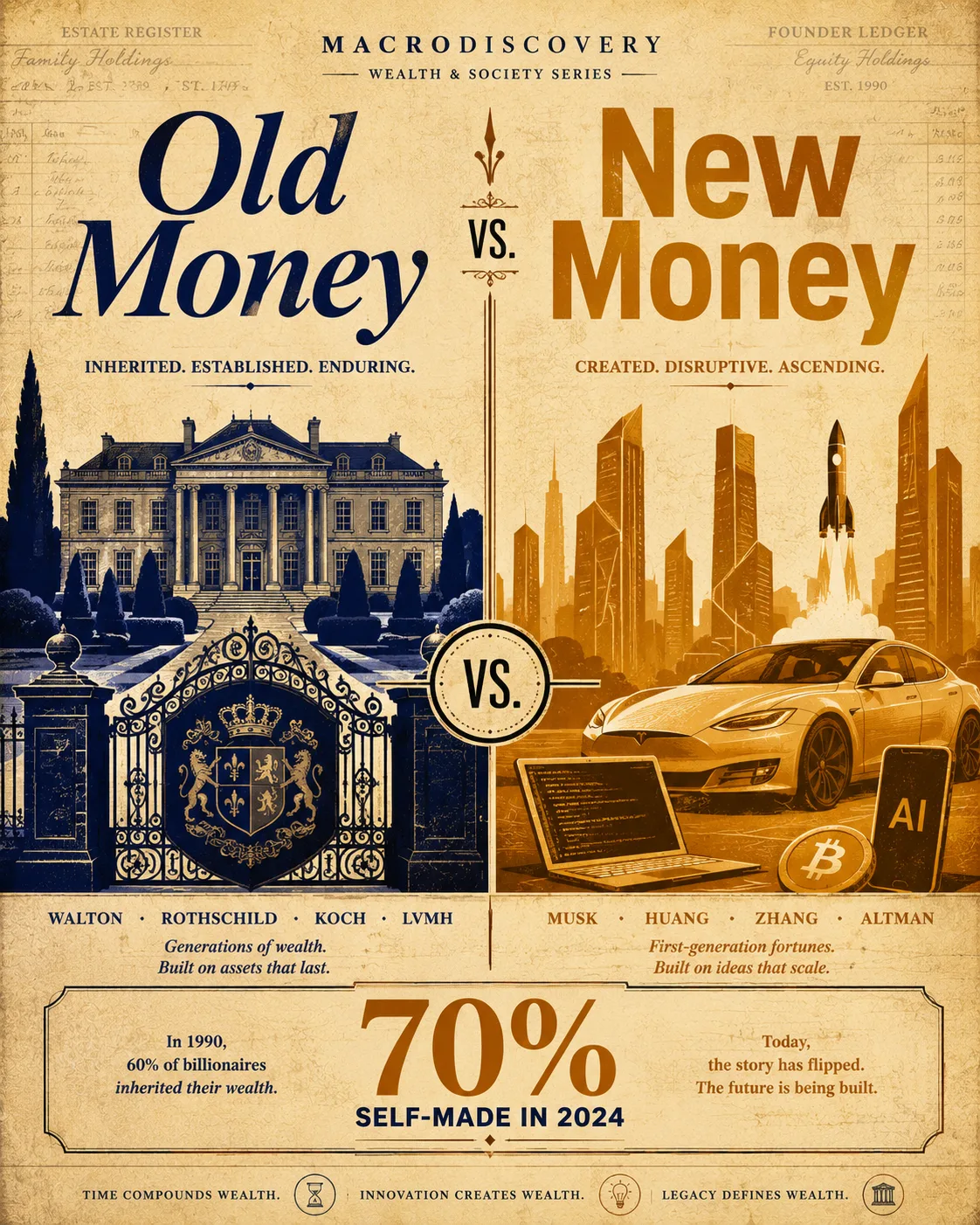
Old Money
vs. New Money
In 1990, most of the world’s wealthiest people had inherited their fortunes. By 2024, 70% are self-made. Technology rewrote the rules of wealth creation — but old money has one weapon new money cannot build: time.
Share of total billionaire wealth by origin (self-made vs. inherited) and by industry. Block size = share of total wealth pool. Source: Forbes Billionaires 2024, UBS Billionaire Ambitions Report 2024.
Share of Forbes billionaire list by wealth origin. The inversion from majority-inherited to majority-self-made is the defining wealth story of the last 40 years. Source: Forbes, UBS, Wealth-X 2024.
Share of wealth in each category from old vs. new money sources. Source: UBS Billionaire Ambitions Report 2024, Forbes 2024.
Selected profiles illustrating structural differences in how wealth is held, grown, and transferred. Source: Forbes, Bloomberg Billionaires Index 2024.
Why New Money Won — For Now
Technology compressed decades of wealth-building into years — making inheritance irrelevant as a starting point.
- Zero marginal cost scaling: Software companies reach billions of users without proportional capital. Old money built wealth by owning physical scarcity. New money built it by owning digital abundance.
- Venture capital: VC gave first-generation founders access to capital that previously required family wealth or banking relationships.
- Globalization: A founder in Beijing or Bangalore can now build a billion-dollar company without geographic proximity to old money centers.
Every major technology wave since 1990 has added a new cohort of self-made billionaires and shrunk old money’s share.
Old Money’s Actual Advantage
Speed creates wealth. Time compounds it. Old money’s edge is not origin — it is duration.
The Walton family’s fortune has grown faster than Walmart’s stock because of compounding across diversified assets, tax-efficient structures, and professional family offices managing capital across generations. Only 10% of family fortunes survive to the third generation — but those that do grow exponentially.
Today’s new money billionaires are tomorrow’s old money dynasties — if their heirs can hold it.
The $84 Trillion Transfer
The largest wealth transfer in history is underway — and it will redraw both categories.
Between 2024 and 2045, an estimated $84 trillion will transfer from Baby Boomers to Millennials and Gen Z — according to Cerulli Associates. This dwarfs any previous intergenerational transfer in history.
- $5.8 trillion will transfer within the billionaire class alone by 2030 (UBS)
- Today’s self-made tech founders will become tomorrow’s inherited-wealth dynasties
- Musk, Bezos, Zuckerberg children will be the new Waltons — inheriting tech empires instead of retail ones
The self-made era is creating the next era of old money — just with different industry labels.
AI Will Create the Next Wave of New Money
Every major technology wave mints a new cohort of billionaires — AI is the current wave.
OpenAI, Anthropic, xAI, and Mistral are creating a new generation of first-generation AI billionaires at a pace faster than any previous tech cycle. Jensen Huang went from $5B to $100B in 18 months.
The Great Transfer Will Blur the Line
$84 trillion moving from one generation to the next will redefine what “old money” means.
By 2040, the children of Bezos, Musk, and Zuckerberg will be among the wealthiest people on Earth — not self-made. The 70% self-made figure will likely reverse as the transfer accelerates.
Geography Is Shifting Too
New money is increasingly non-Western. Old money remains concentrated in Europe and the US.
India, China, and Southeast Asia are producing self-made billionaires faster than the West. India added more new billionaires per year than any country except the US from 2020–2024. The next generation of old money dynasties will be Asian.