The History of AI — 1950 to 2025The History of AI — 1950 to 2025 · MacroDiscovery
MacroDiscovery
Technology·5 min read·1950–2025
Technology & Civilization
The History of Artificial Intelligence — 1950 to 2025
From a thought experiment in a British philosophy journal to 100 million users in two months. Seventy-five years of breakthroughs, funding collapses, and comebacks — told through the 27 moments that actually changed everything.
By MacroDiscovery · Sources: Wikipedia · Britannica · Nature · PyTorch · ArXiv · Era: 1950–2025
AI did not arrive suddenly. It was built across seven decades by mathematicians, computer scientists, and engineers who were often ridiculed, defunded, and told their dream was impossible. The road from Alan Turing’s 1950 thought experiment to ChatGPT’s 100 million users ran through two full funding collapses, one chess match, one game of Go, one protein-folding problem, and one paper about attention. Here is how it actually happened.
Key Takeaways
AI has experienced two major funding collapses — the “AI Winters” of 1974–1980 and 1987–2000 — both triggered by researchers overpromising and underdelivering. A third may be forming.
The modern era began not with ChatGPT but with a 2012 image-recognition competition, where a team from Toronto cut the error rate nearly in half using a technique most researchers had abandoned.
The 2017 Transformer paper — “Attention Is All You Need” — by eight Google researchers is the single most consequential AI publication of the 21st century. Every major language model since is built on it.
ChatGPT, launched November 30, 2022, reached 100 million users in two months — faster than any consumer software product in history.
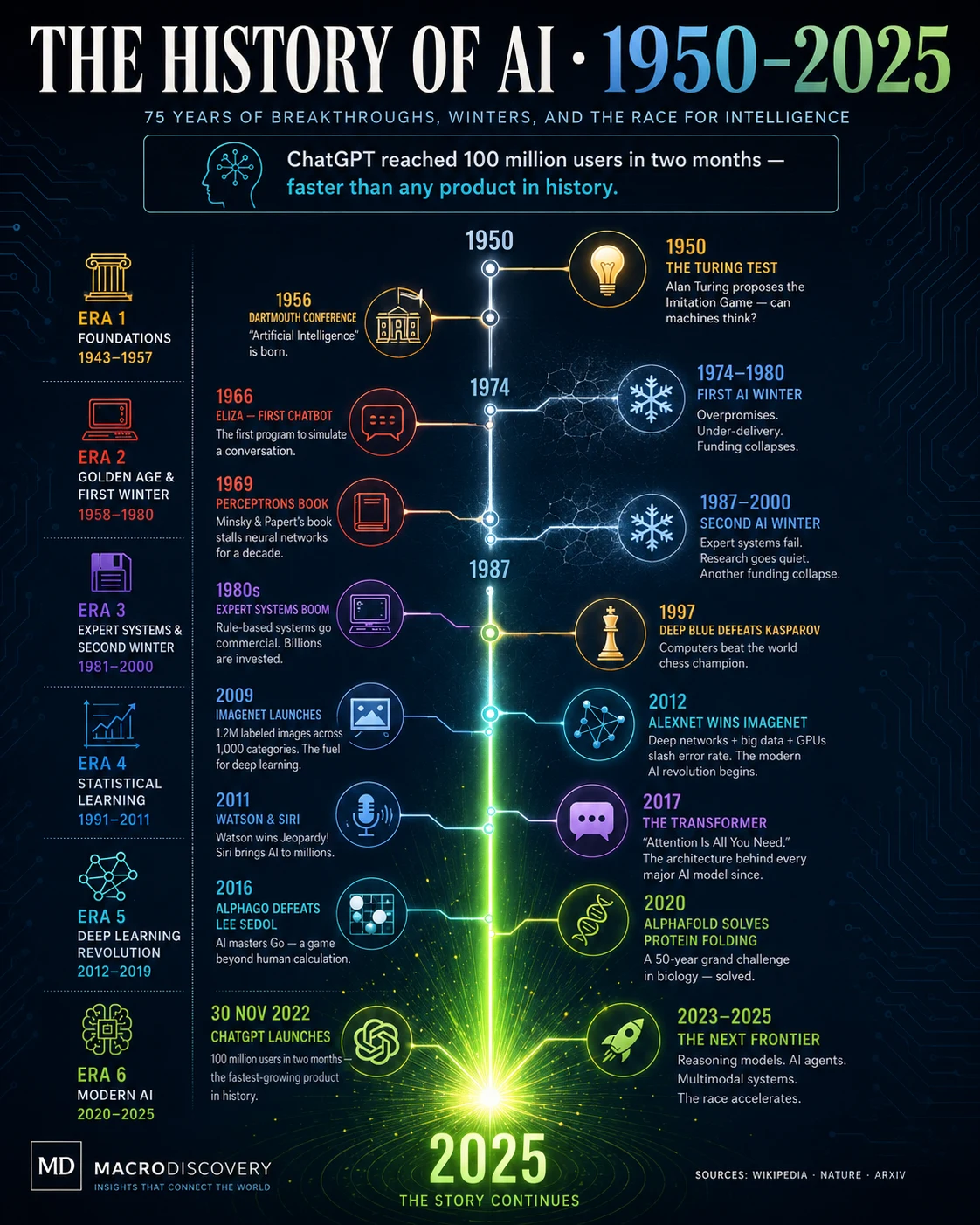
The AI Timeline — Filter by Era
Era 1 — Foundations · 1943–1957
1943
McCulloch-Pitts Neuron
Warren McCulloch and Walter Pitts publish the first mathematical model of a neuron. The idea that biology could be reduced to logic — and logic could be computed — plants the seed for everything that follows.
Foundational Paper
1950
The Turing Test
Alan Turing publishes “Computing Machinery and Intelligence” in Mind journal. He proposes the Imitation Game: if a machine can convince a human it is human, it is intelligent. The test is still debated 75 years later.
Foundational Paper
1952
Arthur Samuel’s Checkers Program
Arthur Samuel at IBM builds a checkers program that improves by playing against itself — one of the first examples of a machine learning from experience rather than explicit rules. The program gets better. Researchers notice.
First Demo
1956
Dartmouth Conference — AI Is Born
John McCarthy, Marvin Minsky, Claude Shannon, and others gather at Dartmouth College. McCarthy coins the term “Artificial Intelligence.” The field is formally founded. Researchers predict human-level machine intelligence within a generation. They are wildly optimistic.
Field Founded
1957
The Perceptron
Frank Rosenblatt builds the Perceptron — the first trainable artificial neural network. It can learn to classify simple patterns. Headlines declare that machines will soon think. The hardware of 1957 cannot possibly deliver on those promises.
Breakthrough
Era 2 — Golden Age & First Winter · 1966–1980
1966
ELIZA — The First Chatbot
Joseph Weizenbaum at MIT creates ELIZA, a program that simulates a therapist by reflecting user statements back as questions. Users form emotional attachments to it. Weizenbaum is disturbed — he built it to show the limits of machines, not to prove they have feelings.
First Chatbot
1966
ALPAC Report — First US Funding Cut
A US government report finds that machine translation has failed to deliver on a decade of promises. DARPA begins pulling back funding. The cycle of hype and disappointment — which will repeat twice more — begins its first turn.
Funding Cut
1969
Perceptrons — The Book That Stalled Neural Networks
Minsky and Papert publish Perceptrons, a mathematical proof that single-layer neural networks cannot solve many basic problems. Funding for neural network research collapses almost overnight. The book is later criticised as overstating its conclusions about multi-layer networks — but the damage is done.
Field Setback
1973
The Lighthill Report
Sir James Lighthill, commissioned by the UK Science Research Council, delivers a verdict on AI research: “In no part of the field have discoveries made so far produced the major impact that was then promised.” The British government cuts most AI funding. DARPA follows in the US. The First AI Winter begins.
Funding Collapse
1974–1980
The First AI Winter
The US and UK governments stop funding undirected AI research. Labs close. Graduate programmes shrink. Researchers start using euphemisms — “informatics,” “cognitive science” — to distance their work from a tainted brand. Many of the people who will later build the deep learning revolution survive this period doing other things.
AI Winter · 1974–1980
Era 3 — Expert Systems & Second Winter · 1980–2000
1980s
The Expert Systems Boom
Rule-based “expert systems” — programs encoding human specialist knowledge as logical rules — become commercially successful. Companies spend billions. Japan launches its Fifth Generation Computer project. The industry briefly becomes a billion-dollar enterprise. The rules are brittle. Real-world complexity breaks them.
Commercial Boom
1986
Backpropagation Revives Neural Networks
Geoffrey Hinton, David Rumelhart, and Ronald Williams publish “Learning representations by back-propagating errors” — a method for training multi-layer neural networks efficiently. Earlier formulations existed, but this paper is the one the field actually reads and acts on. Neural networks are back. Hardware is still too slow to show what they can really do.
Pivotal Paper
1987–2000
The Second AI Winter
The Lisp machine market collapses against cheaper general-purpose computers. Expert systems prove too brittle for real-world use. Investors and governments withdraw again. The term “AI” is avoided in funding applications for a second time. Research continues quietly under other names.
AI Winter · 1987–2000
Era 4 — Statistical Learning · 1991–2011
1991
The World Wide Web Goes Public
Tim Berners-Lee releases the World Wide Web in August 1991. This is not an AI event. But it creates the infrastructure for the data explosion that will fuel modern AI — billions of text documents, images, and interactions that future models will train on.
Infrastructure
May 1997
Deep Blue Defeats Kasparov
IBM’s Deep Blue defeats world chess champion Garry Kasparov in a six-game match. It is the first time a computer has beaten the reigning world champion under standard conditions. Kasparov accuses IBM of cheating. IBM declines a rematch and retires the machine. The public notices that something has changed.
Historic Demo
2009
ImageNet — The Training Data That Changed Everything
Fei-Fei Li releases ImageNet: 1.2 million labeled photographs across 1,000 categories, meticulously assembled over three years. Before ImageNet, AI models lacked a common benchmark. After it, they have fuel. The annual ImageNet competition becomes the scoreboard for the deep learning era.
Dataset Released
2011
Watson Wins Jeopardy! · Siri Launches
IBM’s Watson defeats champion humans Ken Jennings and Brad Rutter on Jeopardy!, processing natural language questions in real time. The same year, Apple launches Siri — putting a conversational AI assistant in millions of pockets. Neither system learns or adapts. But the public begins to see AI as real.
Public DemoConsumer Product
Era 5 — Deep Learning Revolution · 2012–2019
Sep 2012
AlexNet — The Big Bang of Deep Learning
Alex Krizhevsky, Ilya Sutskever, and Geoffrey Hinton enter the ImageNet competition with a deep convolutional neural network trained on GPUs. Their top-5 error rate: 15.3%. The runner-up: 26.2%. A nearly 11 percentage point gap that shocks the field. The combination — deep networks + massive data + GPU power — proves unstoppable. Every major AI company immediately pivots to deep learning.
Field-Defining Breakthrough
2014
GANs — Machines Learn to Create
Ian Goodfellow invents Generative Adversarial Networks: two neural networks compete — one generates fake data, one tries to detect it. The result is AI that can generate realistic images, audio, and video. The foundation for deepfakes, AI art, and eventually image models like DALL-E.
Breakthrough
Mar 2016
AlphaGo Defeats Lee Sedol
Google DeepMind’s AlphaGo defeats legendary Go champion Lee Sedol 4–1 in Seoul. Go has more possible board positions than atoms in the observable universe — it was considered decades away from AI mastery. AlphaGo uses reinforcement learning and neural networks, not brute-force calculation. The world watches live. Something fundamental has shifted.
Landmark Demo
2017
“Attention Is All You Need” — The Transformer
Eight researchers at Google Brain and Google Research — Vaswani, Shazeer, Parmar, Uszkoreit, Jones, Gomez, Kaiser, and Polosukhin — publish a paper introducing the Transformer architecture. It uses a “self-attention” mechanism that allows models to weigh the relevance of every word to every other word in a sequence. Every major language model since — GPT, BERT, Gemini, Claude — is built on this architecture. The paper title, a play on a movie tagline, understates what it started.
Most Consequential Paper of the Era
2018
GPT-1 — The First Generative Pre-trained Transformer
OpenAI releases GPT-1, applying the Transformer architecture to language generation at scale. The model is trained on a large corpus of internet text and fine-tuned for specific tasks. The concept of “pre-training then fine-tuning” becomes the dominant paradigm. GPT-1 is modest. What follows is not.
Model Released
Era 6 — Modern AI · 2020–2025
2020
GPT-3 — Language at Scale
OpenAI releases GPT-3 with 175 billion parameters — at the time the largest language model ever built. It writes coherent essays, generates code, answers questions, and translates languages without any task-specific training. The Wikipedia article on AI history marks this as the beginning of the new AI era. Developers build hundreds of products on the API within months.
Model Released
Dec 2020
AlphaFold Solves Protein Folding
DeepMind’s AlphaFold2 achieves results at the CASP14 protein-structure prediction competition that the scientific community describes as having “solved” a 50-year-old grand challenge in biology. Nobel Laureate Venki Ramakrishnan calls it “a stunning advance.” Proteins fold into specific 3D shapes that determine their function — predicting those shapes from amino acid sequences had resisted biology for half a century. AlphaFold does it in minutes.
Scientific Breakthrough
2021
DALL-E — Machines Learn to Draw
OpenAI releases DALL-E, a model that generates images from text descriptions. Type a sentence — get a picture. The name combines WALL-E and Salvador Dalí. The capability was theorised but not demonstrated at this quality before. Generative AI expands from language into vision.
Model Released
30 Nov 2022
ChatGPT — 100 Million Users in Two Months
OpenAI releases ChatGPT. It reaches 100 million users within two months — the fastest-growing consumer software application in history. For most people on Earth, this is the first time they interact directly with a capable AI system. The conversation about what AI is, what it can do, and what it means becomes impossible to avoid.
Mass Market ProductAI Boom
2023
GPT-4 · The Pause Letter · The Race Begins
OpenAI releases GPT-4 — multimodal, more capable, and integrated into Microsoft’s products. The Future of Life Institute publishes an open letter signed by more than 1,000 researchers and technologists calling for a six-month pause on frontier AI development. The letter is not acted on. Google, Meta, Anthropic, Mistral, and dozens of others accelerate. The race is publicly acknowledged.
Model ReleasedSafety Concern
2024–2025
Reasoning, Agents, and the Question of What Comes Next
Models gain reasoning capabilities — working through problems step by step rather than pattern-matching to answers. AI agents begin executing multi-step tasks autonomously. Multimodal systems handle text, image, audio, and video simultaneously. Investment in AI infrastructure — data centres, chips, energy — reaches scales that dwarf previous technology booms. Debate intensifies: is the current trajectory sustainable, or is a third AI Winter approaching?
AI Boom · 2022–present
Sources: Wikipedia “History of artificial intelligence” (May 2026, directly fetched) · Wikipedia “AI winter” · Britannica “History of AI” · PyTorch (AlexNet error rates, primary) · Nature (AlphaFold, 2021) · ArXiv (“Attention Is All You Need”, 2017) · Coursera “History of AI” (2026)
Why AI Has Failed Twice — and Recovered Both Times
The pattern is consistent. Researchers make bold claims. Governments and investors provide funding. Progress is real but slower than promised. A commission or market event exposes the gap between promise and reality. Funding collapses. Researchers scatter. A decade later, new hardware, new data, or a new algorithmic idea restarts the cycle.
The first winter (1974–1980) was triggered by the Lighthill Report and the failure of machine translation. The second (1987–2000) followed the collapse of the expert systems market. Both times, the researchers who survived continued working. Hinton kept developing backpropagation through the 1980s and 1990s when almost no one cared. The people who built the 2012 deep learning revolution were largely the same people who had been ignored for twenty years.
Whether a third winter is approaching is a genuine question. The current boom is larger than anything before it — investments measured in hundreds of billions of dollars, not millions. The stakes of another overpromise-and-disappoint cycle are correspondingly larger.
The 2017 Paper That Built the Modern World
“Attention Is All You Need” was published at NeurIPS 2017 by eight researchers at Google. Its core innovation — the Transformer architecture — replaced the recurrent neural networks that had dominated language processing with a mechanism that could attend to every part of an input sequence simultaneously. Training became dramatically faster. Models became dramatically larger. The results improved in ways that surprised even the authors.
Every significant language model since — GPT-2, GPT-3, GPT-4, BERT, LLaMA, Gemini, Claude — is a Transformer. The entire generative AI industry, valued at hundreds of billions of dollars in 2025, descends directly from this single paper. Its title, borrowed from a 1994 film tagline, has become one of the most-cited phrases in the history of computer science. The eight authors have since scattered to found or lead most of the major AI labs in the world.
AlphaFold: The Moment AI Became a Scientific Tool
For 50 years, determining how a protein folds from its amino acid sequence into a specific 3D shape was one of biology’s hardest problems. The shape of a protein determines its function — and therefore its role in disease, medicine, and life itself. Experimental methods like X-ray crystallography could solve structures, but took months or years per protein. Predicting structure computationally had resisted the field since 1972.
In December 2020, DeepMind’s AlphaFold2 entered the CASP14 competition — the biennial benchmark for protein structure prediction. Its scores were so far above any previous system that the competition organisers initially thought there had been an error. Nobel Laureate Venki Ramakrishnan called it “a stunning advance on a 50-year-old grand challenge in biology.” By 2022, AlphaFold had predicted structures for over 200 million proteins — nearly every protein known to science. This is what AI looks like when it escapes the lab.
ChatGPT and the Fastest Product Launch in History
OpenAI released ChatGPT on November 30, 2022 — a Saturday. It was not heavily marketed. Within a week, it was being discussed in every major media outlet on Earth. Within two months, it had 100 million users — a milestone that took Instagram two and a half years, and Facebook four and a half years, to reach. It became the fastest-growing consumer software application in recorded history.
What made ChatGPT different from the GPT-3 API — which had been available for two years — was the interface. A chat window. Anyone could use it. For most people on Earth, it was the first time they had a fluent conversation with a machine. The months that followed changed the competitive landscape of every major technology company, triggered an AI investment boom measured in hundreds of billions of dollars, and restarted a public debate about intelligence, creativity, and what machines can and cannot do — a debate that began in a British philosophy journal in 1950.
Sukh Dhaliwal is the founder of Macro Discovery, an independent digital publication covering AI, technology, science, future trends, and global innovation through visual storytelling and data-driven analysis.