Which G20 Members Grow Fastest This Decade
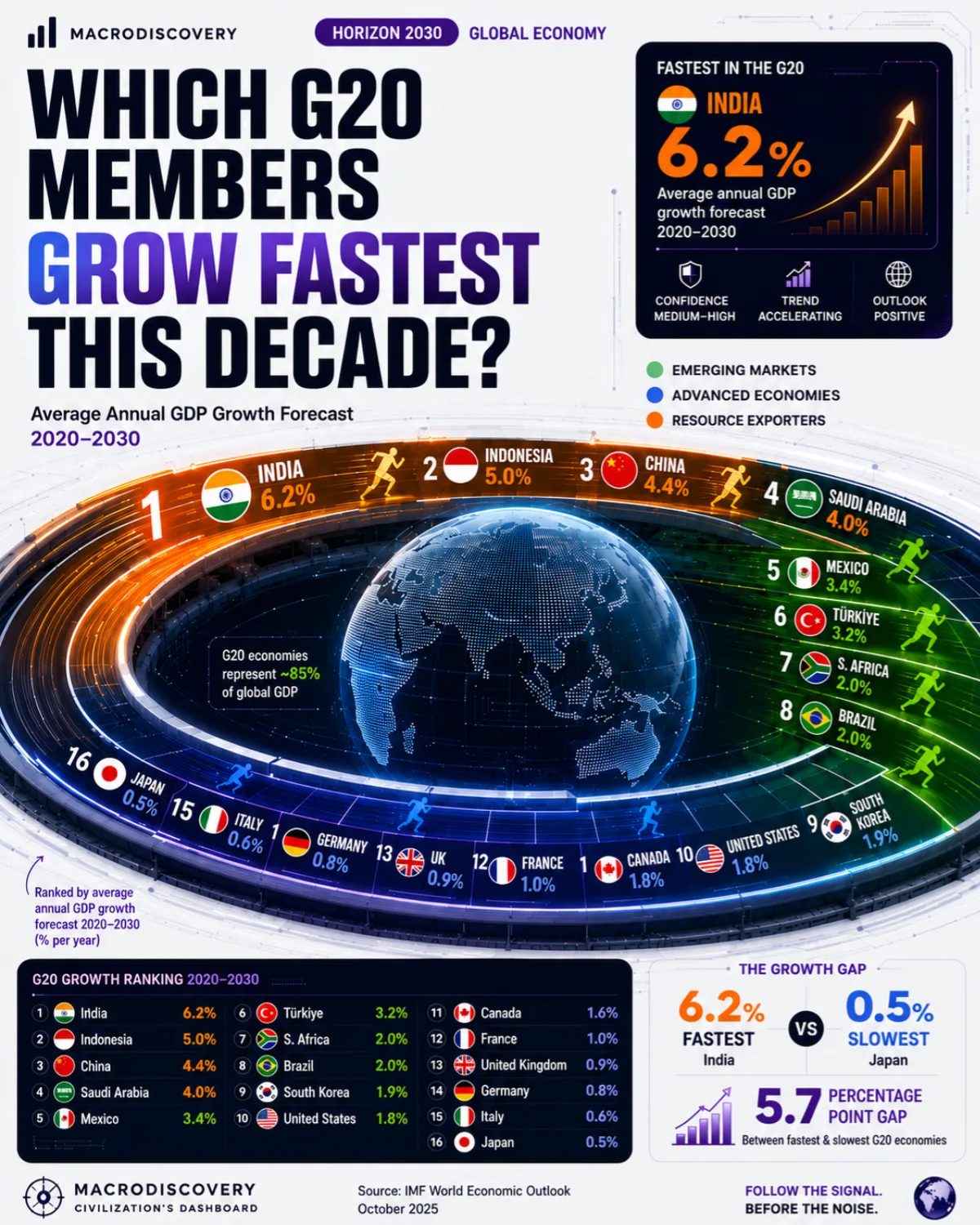
India leads every G20 economy in growth for a third straight year. Three G7 members won’t even clear 1%. The gap between the two groups is the real story.
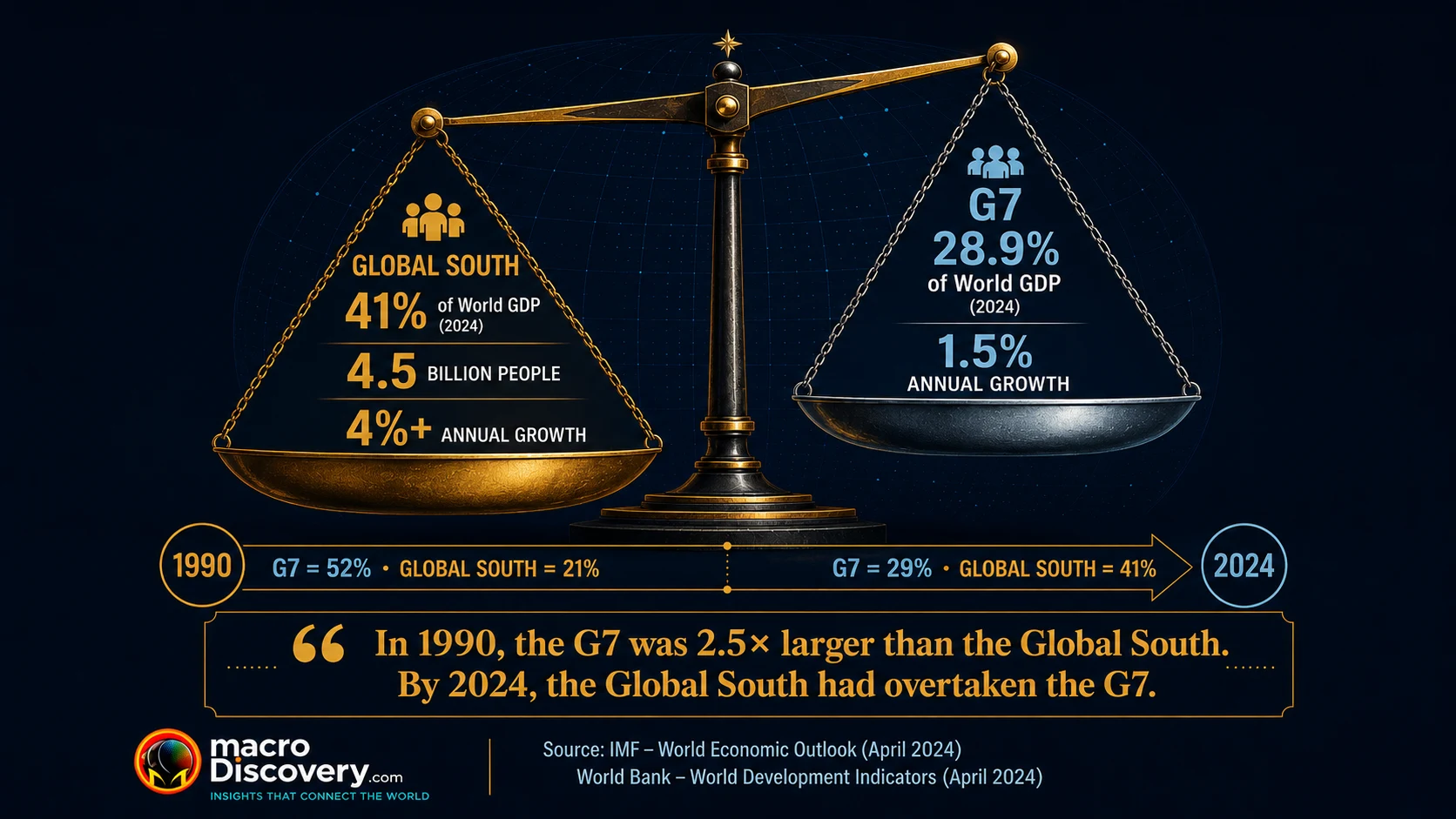
The G20 produces roughly 85% of the world’s economic output, which means its internal growth ranking is close to a proxy for the global one. And that ranking has split cleanly into two tiers — fast-growing emerging economies at the top, slow-growing advanced economies clustered at the bottom — with almost nothing in between.
Known — the IMF’s October 2025 World Economic Outlook projects India’s 2026 real GDP growth at 6.2%, the fastest of any G20 member, extending a streak that includes 6.7% growth in 2025.
Projected — Indonesia (5.0%) and China (4.4%) round out the next tier, while Japan, Italy, and Germany are each forecast to grow under 1% — meaning the gap between the G20’s fastest and slowest members now exceeds 5 percentage points.
Speculative — whether this split is a durable structural divide between emerging and advanced economies, or a temporary phase tied to this cycle’s specific inflation and rate environment, isn’t settled by a single year of data.
The Gap Has a Shape, Not Just a Size
What stands out in the IMF’s 2026 G20 projections isn’t just that growth rates vary — that’s always true — it’s how cleanly the ranking sorts by economic stage. Every developing/emerging economy in the G20 is projected to grow faster than every advanced economy except a small cluster of outliers. India tops the list at 6.2%, followed by Indonesia at 5.0%, leaning on a young workforce and commodity exports. China, despite a well-documented structural slowdown, still projects 4.4% growth for 2026 — down from 5.0% in 2025, but still comfortably ahead of every advanced G20 economy. Saudi Arabia follows at 4.0%, helped by oil revenue and its Vision 2030 diversification push.
At the other end, Japan, Italy, and Germany are each forecast to grow under 1% in 2026 — a trio of advanced economies facing the same headwinds from different angles: demographic stagnation, energy cost exposure, and years of underinvestment in productivity-driving sectors.
The growth-momentum concentration has a second layer worth noting: it’s not evenly distributed even within the “fast” tier. Korea posted the largest upward revision to its 2026 forecast of any G20 economy in recent weeks, while Canada and Saudi Arabia saw the steepest downgrades — a reminder that these rankings shift continuously and shouldn’t be read as locked-in outcomes three or four years out.
What This Actually Tells You
A G20 growth ranking is less interesting as a list than as a map of where global growth is actually concentrated. Right now, that concentration sits almost entirely with emerging markets — India, Indonesia, China, Saudi Arabia — while several of the world’s largest advanced economies are barely growing at all. That’s a meaningfully different story than “the global economy is growing at 2.5%” suggests on its own: the average obscures just how lopsided the contribution to that average really is.