The Three Paths for Global Trade Blocs
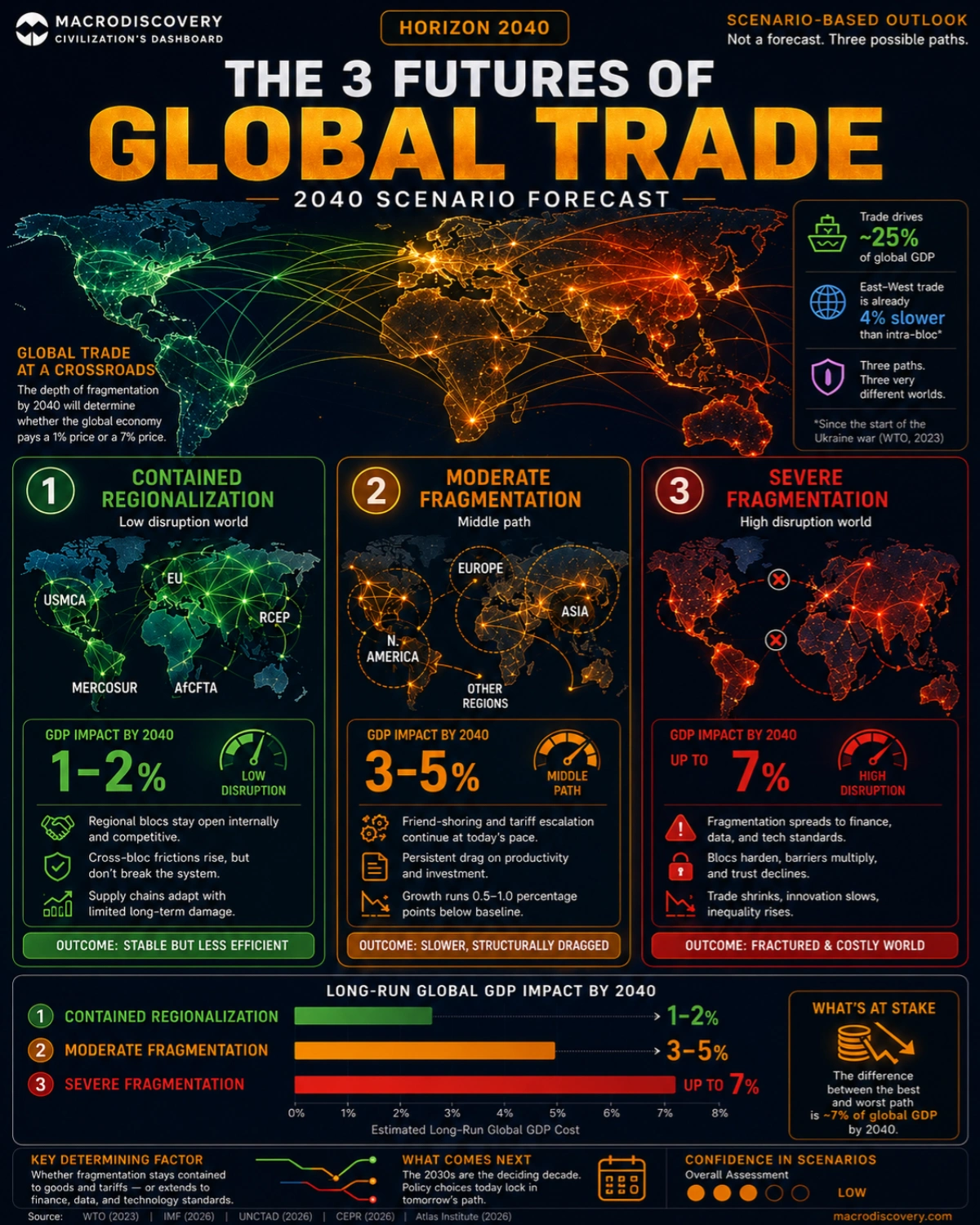
A 2026 model puts the cost of full trade fragmentation as high as 7% of global GDP. The actual outcome depends entirely on which of three scenarios plays out — and none of them is the default.
Most “future of trade” forecasts present a single number, which is exactly the kind of false precision the 2040 horizon is built to reject. The honest version of this story is that global trade is currently moving down one of three distinct paths, and which one wins out by 2040 will swing the global growth impact by a factor of seven.
Known — trade between hypothetical East and West blocs has already grown roughly 4% slower than trade within blocs since the start of the war in Ukraine, per WTO research — early but real evidence of geopolitically-aligned trade patterns.
Projected — under contained regionalization, the long-run global GDP cost stays in the 1-2% range; under moderate fragmentation, growth runs persistently 0.5-1.0 percentage points lower; under severe fragmentation, the IMF’s own modeling puts the cost as high as 7% of global GDP.
Speculative — which of the three paths the world is actually on right now is genuinely contested — the same underlying data supports a “fragmentation is accelerating” reading and a “regionalization without real fragmentation” reading, depending on which indicators you weight.
The Evidence Doesn’t Pick a Winner Yet
This is the part most coverage glosses over: the data on whether trade fragmentation is actually happening is itself split. WTO research focused specifically on this question found early evidence of geopolitically-aligned trade patterns — the East-West bloc slowdown noted above — but explicitly found no evidence of broader regionalization of world trade since either the COVID-19 pandemic or the war in Ukraine, and concluded that near-shoring strategies have not had a large measurable impact on overall trade flows. In other words: the friend-shoring narrative is directionally real in specific bilateral relationships, particularly U.S.-China, but hasn’t yet shown up as a global structural shift.
Meanwhile, more recent 2026 analysis describes an accelerating picture — tariff escalation becoming a permanent feature of trade policy, regional blocs like the EU, ASEAN, and Mercosur actively repositioning within overlapping preferential agreements, and the WTO’s own dispute-settlement legitimacy under sustained strain.
The deciding variable across all three scenarios isn’t tariff policy alone — it’s whether fragmentation stays contained to goods trade or extends into financial flows, data localization, and technology standards. The IMF’s most severe scenario assumes that broader extension; the contained-regionalization scenario assumes it doesn’t happen. That single branch point is doing more work in determining the 2040 outcome than any individual country’s trade policy.
What This Actually Tells You
There is no single “future of trade” to forecast here — only three named paths with a roughly seven-fold range in economic cost between the mildest and most severe. The evidence so far supports real but bounded change: bilateral relationships fraying in specific, identifiable ways (U.S.-China above all) without yet adding up to a wholesale collapse of globalization. Which scenario the world ends up in by 2040 depends on a single branch point — whether fragmentation stays contained to goods and tariffs, or extends into finance, data, and technology standards — that hasn’t been decided yet.