The Next Trillion-Dollar Economy
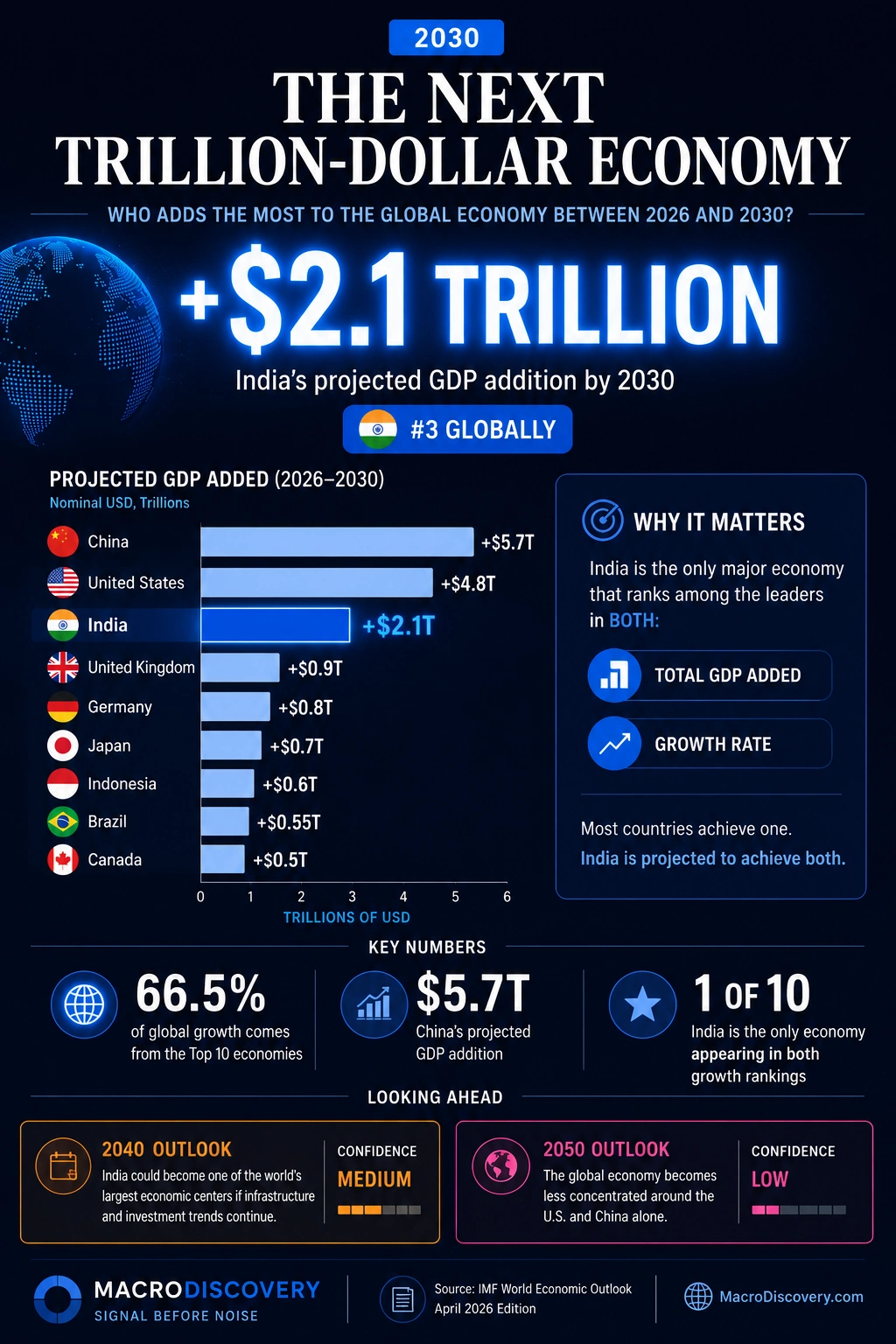
India is about to add $2.1 trillion to its economy by 2030 — more than any country besides China and the U.S. Here’s why that single number reshapes more forecasts than it should.
Trillion-dollar GDP milestones used to be rare enough to make headlines on their own. By 2030 they won’t be — what matters instead is who’s adding the most, fastest, and what that compounding edge buys them in influence, capital flows, and leverage over the next horizon.
Known — the IMF’s April 2026 projections show the top 10 economies accounting for 66.5% of all global GDP added through 2030, with China, the U.S., and India driving nearly half of that growth combined.
Projected — India is on pace to add $2.1 trillion — the only economy that ranks in the top 10 for both total dollar gains and percentage growth, a combination none of the other large economies match.
Speculative — whether that growth translates into proportional geopolitical or market influence by 2030 is a separate, far less certain claim than the GDP arithmetic itself.
Size Still Beats Speed — For Now
Nominal GDP gains skew overwhelmingly toward economies that are already large. China is projected to add $5.7 trillion between 2026 and 2030 — more than the next several countries on the list combined — even as its percentage growth rate keeps slowing. The U.S. adds a similarly outsized dollar figure despite modest percentage growth, simply because a smaller percentage of a much bigger base still outweighs faster growth on a smaller one. That’s the quiet asymmetry behind most “fastest growing economy” headlines: the countries growing fastest in percentage terms — Suriname, Malawi, Ethiopia — barely move the needle on the global total.
India Is the Only Economy That Shows Up Twice
India’s distinction isn’t that it grows fastest, or that it adds the most — it’s that it’s the only country in the top 10 for both. A $2.1 trillion projected addition ranks third globally in absolute terms, behind only China and the U.S., while its percentage growth rate keeps it inside the fastest-growing cohort as well. Most economies trade one of those for the other. India is forecast to do both at once through 2030, which is the more durable signal than either number in isolation.
Beyond the top three, the list broadens into a familiar set of mid-sized economies — the UK, Germany, Japan, Indonesia, Brazil, and Canada — each contributing meaningfully but none individually reshaping the global total the way the top three do. Collectively, these ten countries account for two-thirds of all projected global GDP growth through 2030, meaning the rest of the world — more than 180 economies — splits the remaining third.
What This Actually Tells You
The “next trillion-dollar economy” framing undersells what’s actually happening — most of the candidates already cleared that bar years ago. The more useful read is concentration: a handful of economies are set to capture the overwhelming majority of global growth through 2030, and within that group, India is the one outlier showing up on both the size and speed leaderboards simultaneously. That dual position is what’s worth tracking, not any single GDP figure on its own.