Visualized: The Future of
Artificial Intelligence
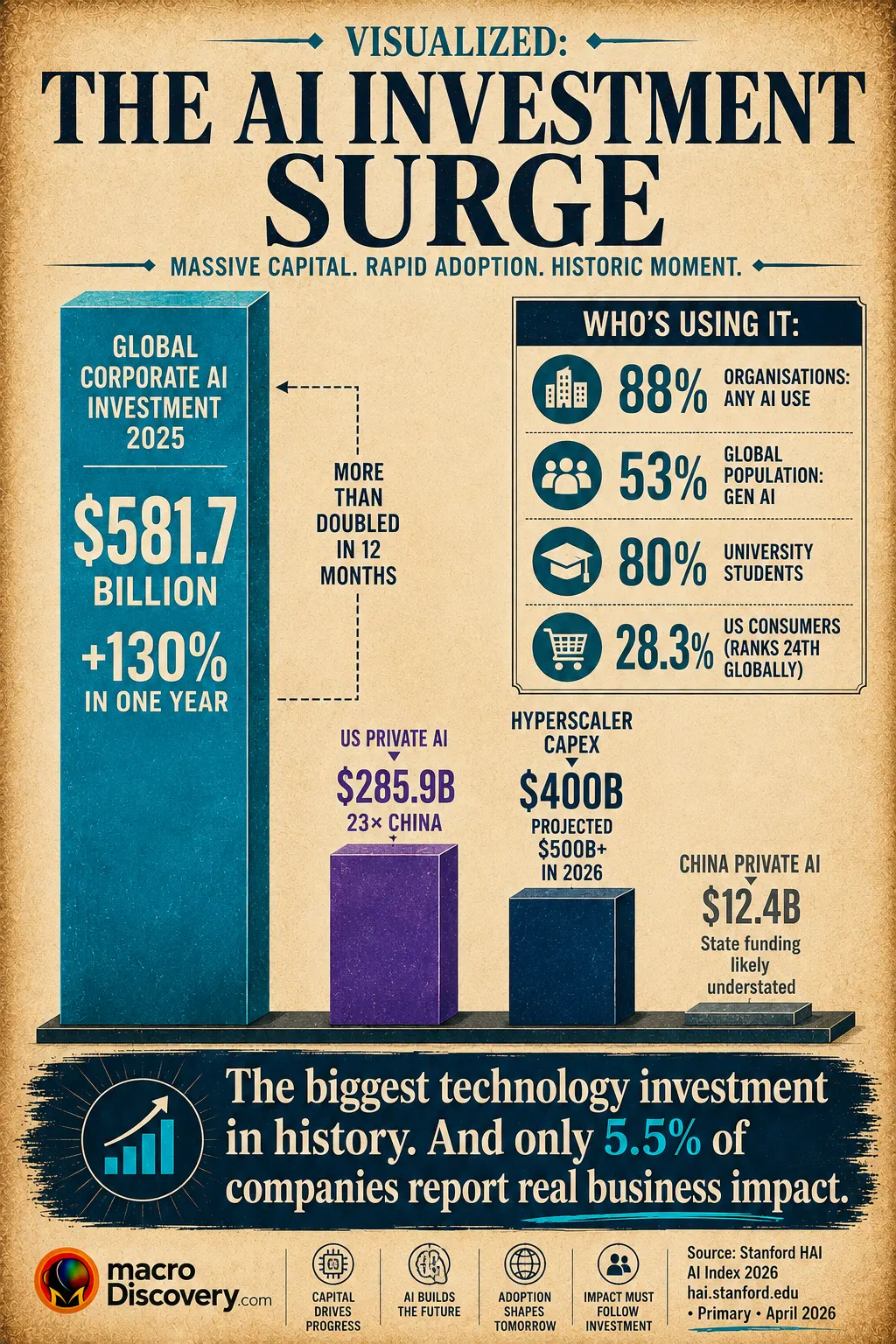
Global corporate AI investment hit $581.7 billion in 2025 — doubling in one year. 88% of organisations now use AI. ChatGPT has 900 million weekly users. And yet the same AI that wins gold medal mathematics reads an analog clock correctly only 50% of the time. Here is where AI actually stands.
AI investment figures 2025. Bars scaled to total global corporate AI investment of $581.7B. Source: Stanford HAI AI Index 2026 (primary · hai.stanford.edu · April 13, 2026) · Goldman Sachs · NVIDIA official results · Microsoft earnings.
From a research curiosity to a $581 billion industry in under four years. Each milestone reset what people thought was possible. Source: Stanford HAI AI Index 2026 (primary) · WEF · NVIDIA official results.
The numbers are extraordinary. The investment is real. The adoption is real. But the Stanford HAI AI Index 2026 — the most rigorous annual accounting of the field — makes something else equally clear: AI is simultaneously more capable than most people realise, and less reliable than most headlines suggest. Both things are true at the same time. That tension is where the actual story lives.
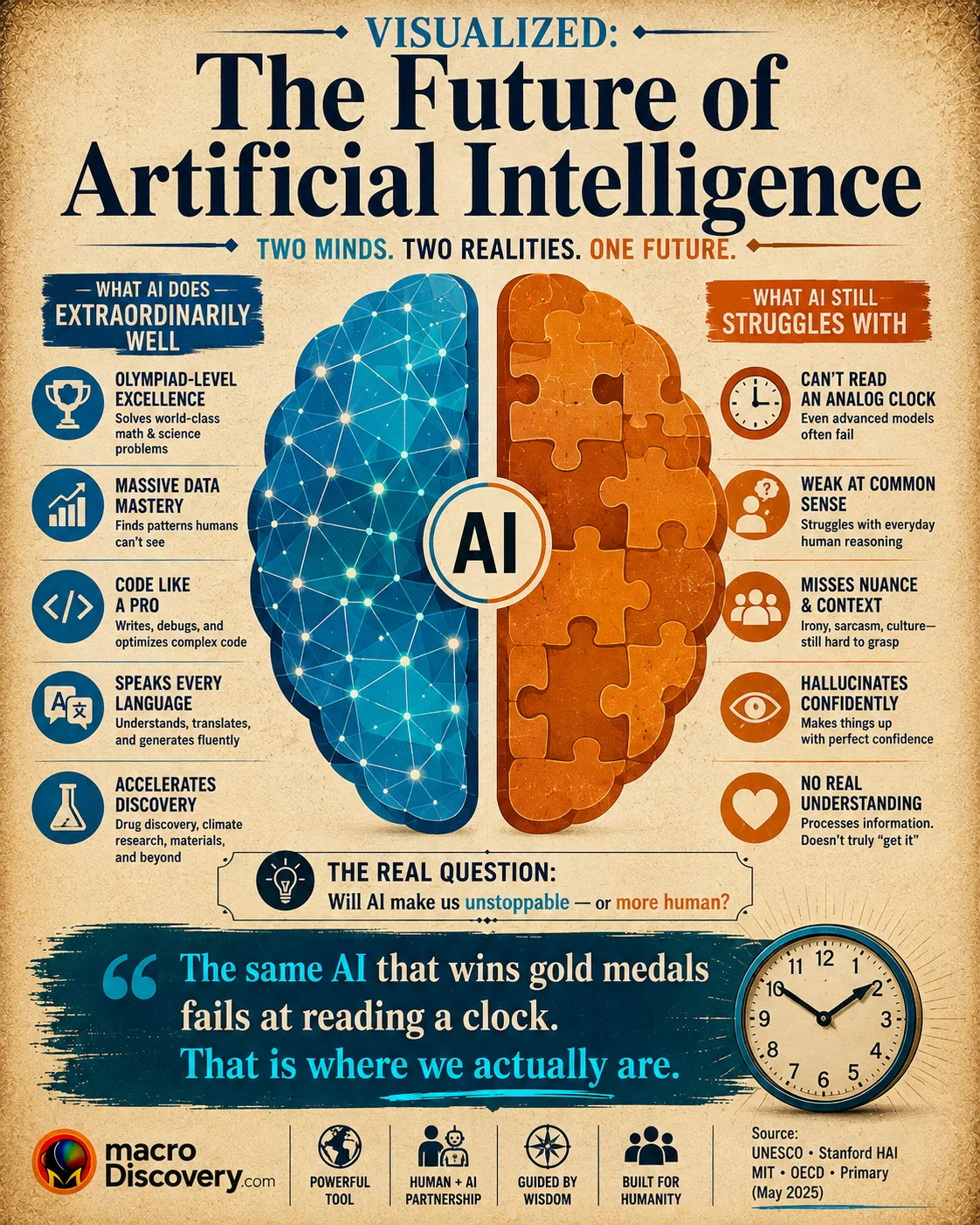
“The same AI that wins a gold medal at the International Mathematical Olympiad reads an analog clock correctly only 50% of the time. That is where we actually are.”
The “Jagged Frontier” — AI Is Brilliant and Broken at the Same Time
Stanford HAI 2026 introduced the concept of the “jagged frontier.” The same top AI model that can win a gold medal at the International Mathematical Olympiad reads an analog clock correctly only 50.1% of the time. It struggles with multi-step planning, video generation, and certain expert-level exams. 88% of organisations use AI. But only 39% report any measurable business impact. And just 5.5% qualify as genuine AI “high performers” with more than 5% EBIT improvement. The gap between adoption and actual value is enormous.
Jobs: Who Gets Helped and Who Gets Hurt
The WEF Future of Jobs Report 2025 (primary) projects 170 million new jobs created and 92 million displaced by 2030. Net: +78 million jobs. But these are not the same people. The 92 million displaced are mostly clerical and administrative workers. The 170 million created skew toward technical roles requiring advanced training. Entry-level software developer employment for workers aged 22–25 already fell nearly 20% since 2024 (Stanford HAI 2026). AI-skilled workers earn a 56% wage premium. The gap between AI winners and AI losers is growing fast.
The US vs China — Two Different Races
The US leads decisively in AI software, models, and private investment. US private AI investment in 2025 was $285.9 billion — 23 times China’s $12.4 billion. But China leads in industrial robots: it installed 295,000 in 2024, versus 34,200 in the US. And PwC projects China gains more GDP from AI (+26%) than North America (+14.5%) — because it has more automatable labour. The US is winning the software race. China is winning the robots race. Both matter enormously.