The Rise of India , The Rise of India — GDP, Growth & Digital Economy , India economy growth , Rise of India GDP , what is India’s GDP and world rank 2025 2026 economy size , when did India overtake Japan to become the 4th largest economy , how fast is India’s economy growing compared to China and US 2026 , what is UPI , what is UPI and why is it the world’s largest digital payment system , what is world’s largest digital payment system , what is India’s income per person GDP per capita 2026 , What is India’s GDP and what rank is it globally? , How fast is India’s economy growing? , What is UPI and why does it matter? , When will India become the world’s 3rd largest economy? , What is India’s income per person? ,
Charted: The Rise
of India
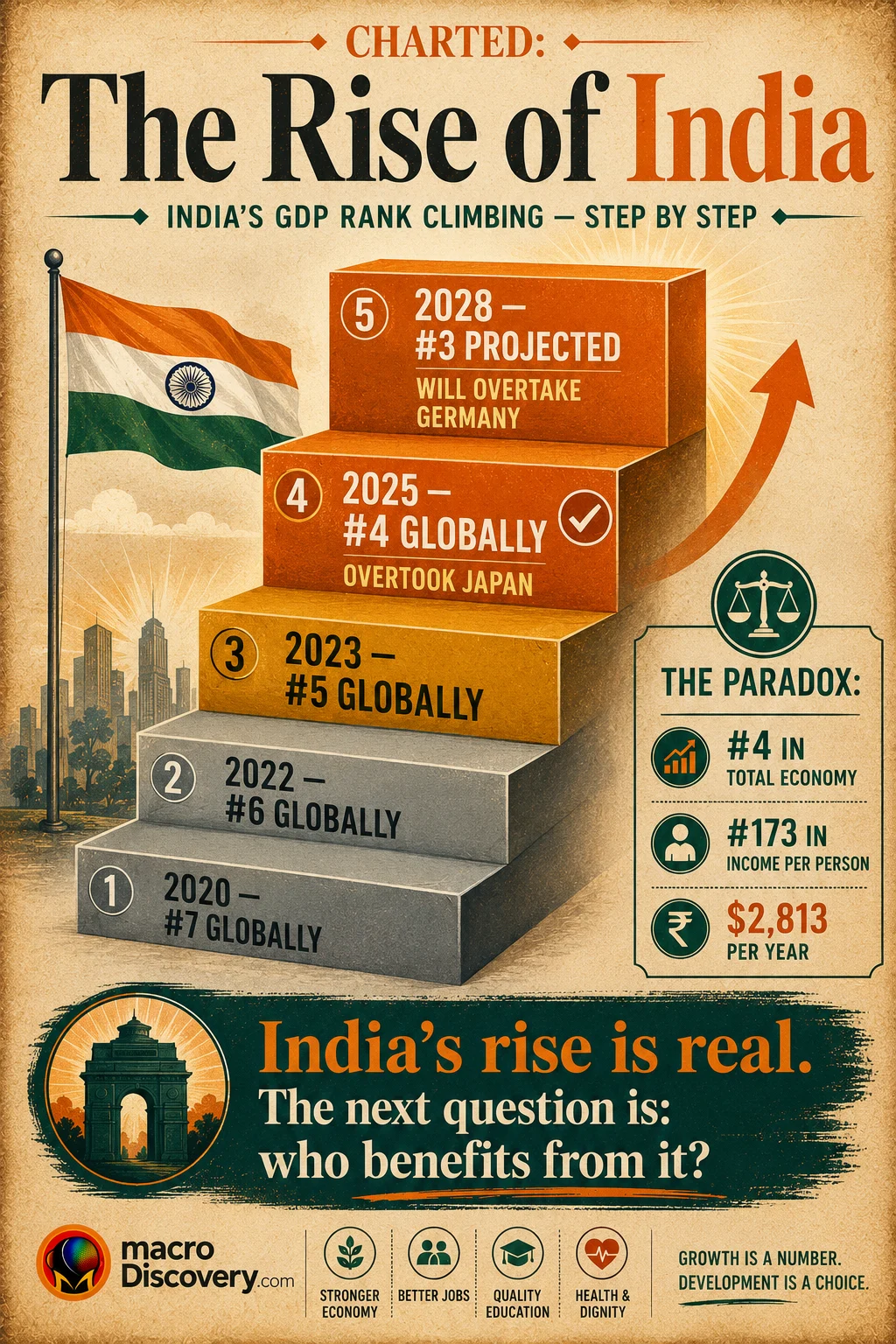
In 2025, India overtook Japan to become the world’s 4th largest economy. It is the fastest-growing major economy on earth. Its digital payment system processes nearly half of all global real-time transactions. And yet India ranks 173rd in income per person. Here is what the data actually shows.
Real GDP growth rates, 2026 projections (calendar year). Bars scaled to India’s 6.5%. Source: IMF World Economic Outlook April 2026 (primary · imf.org).
From a closed, slow-growth economy in 1991 to the world’s 4th largest in 2025. Each step was a deliberate policy choice — or a technology leap. Source: IMF · World Bank · Government of India · NPCI.
India’s rise is real. The data confirms it — from the IMF, the World Bank, and India’s own national statistics office. But it is a specific kind of rise. India is a very large economy with a very low income per person. Understanding that distinction is the key to understanding everything else about India’s story.
“India is the world’s 4th largest economy — and 173rd in income per person. That gap is the story of where India is now, and where it has yet to go.”
UPI: India Built the World’s Largest Real-Time Payment System in 10 Years
In 2016, India had almost no digital payment infrastructure. Cash dominated. Banks were inaccessible for hundreds of millions. Then UPI launched — a free, instant, interoperable payment system built on government infrastructure. In FY2025-26, it processed 241.62 billion transactions worth $3.57 trillion. The IMF calls it the world’s largest real-time payment system. It processes roughly half of all global real-time transactions. It was built in ten years. Almost from nothing.
The Manufacturing Shift — From “Made in China” to “Made in India”
In 2014, India imported 74% of its mobile phones. By 2025, 48% were made domestically. Apple shifted significant iPhone production to India. Twelve semiconductor projects have been approved. India is positioning itself as the key beneficiary of global supply chains diversifying away from China. This is not yet a manufacturing revolution. But it is a meaningful and accelerating shift.
The Challenge: Growth That Reaches Everyone
India’s growth rate is real. Its digital revolution is real. Its demographic advantage is real. But India’s informal economy remains enormous — estimated at over a quarter of total economic activity. Hundreds of millions of workers are outside formal employment. Infrastructure gaps are significant. Agriculture employs roughly 40% of the workforce but generates a fraction of GDP. The question for the next decade is not whether India grows — it will. The question is who benefits.