Economics of Longevity , Which country has the highest life expectancy in the world? , What is the economic impact of an aging population? , Which country is aging the fastest? , What is the longevity economy? , Why does the US spend more on healthcare but have a lower life expectancy than Japan? , economics of longevity aging population life expectancy statistics 2025 2026 , aging population economic impact fiscal pressure OECD pension healthcare cost statistics , life expectancy by country 2025 ranking Japan US Korea Spain highest WHO UN primary data comparison , longevity economy market size healthcare aging spending 2025 2034 growth investment opportunity , hat country has the highest life expectancy in the world 2025 2026 , what is the economic impact of an aging population on government spending pensions healthcare 2060 , which country is aging the fastest dependency ratio Korea Japan 2060 , what is the longevity economy and how big is it 2025 2034 market size , why does the US spend more on healthcare but have lower life expectancy than Japan Spain ,
Visualized: The Economics
of Longevity
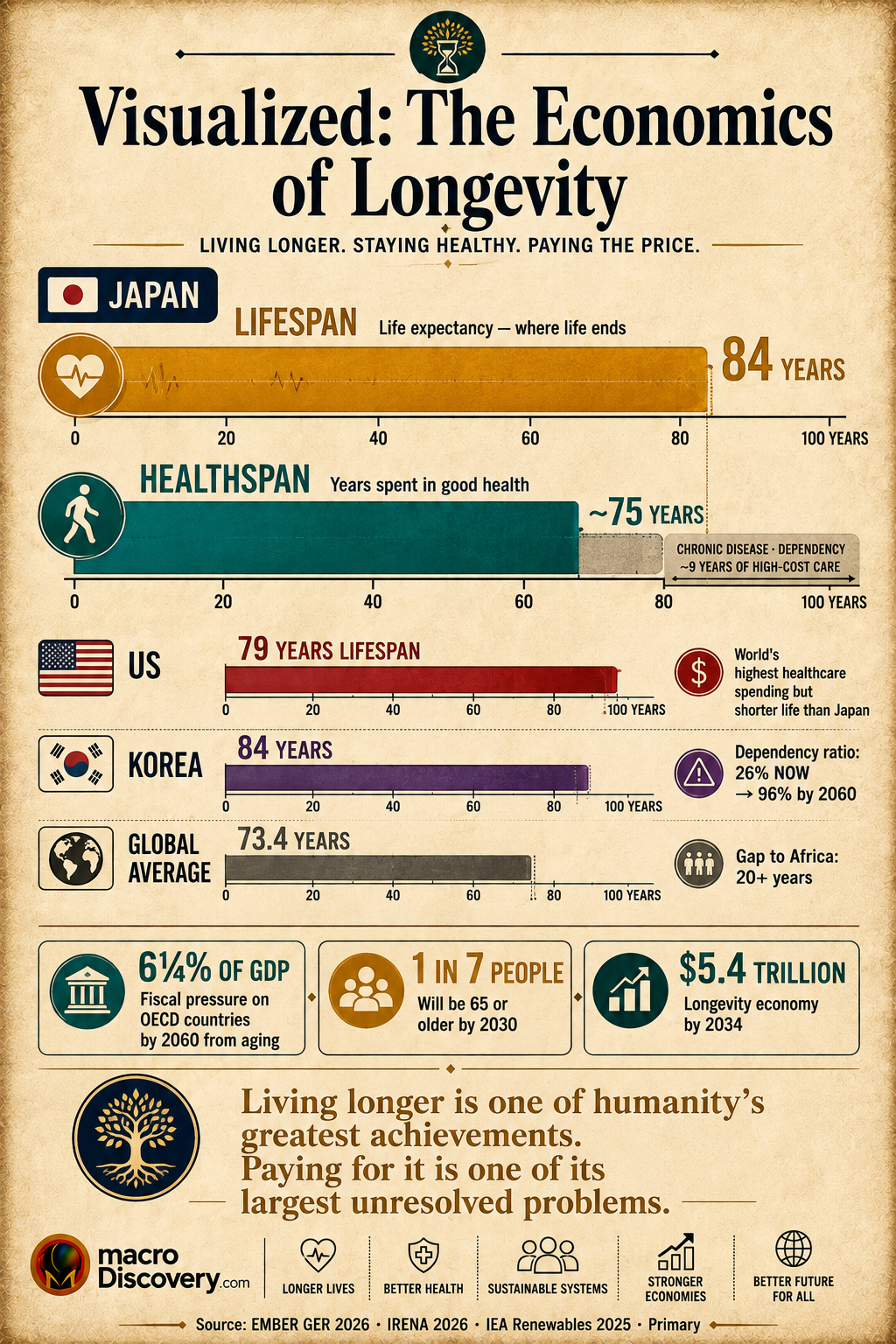
We are living longer. That is one of humanity’s greatest achievements. It is also one of its largest unresolved financial problems. By 2030, one in seven people on Earth will be 65 or older. OECD governments face fiscal pressure equivalent to 6¼ percentage points of GDP by 2060 — just from aging. South Korea’s old-age dependency ratio will nearly quadruple. Half of people over 75 are already on five or more medications. The economics of longevity, visualized.
Life expectancy at birth, 2025 projections. Bar width scaled to Monaco’s 87 years. The key finding across all data: it is not how much a country spends on healthcare that determines lifespan — it is how well the system is designed and how healthy populations live. Sources: UN World Population Prospects 2024 (PRIMARY · un.org) · OECD Health at a Glance 2025 (PRIMARY · oecd.org · November 13, 2025) · WHO/UN global average 2025.
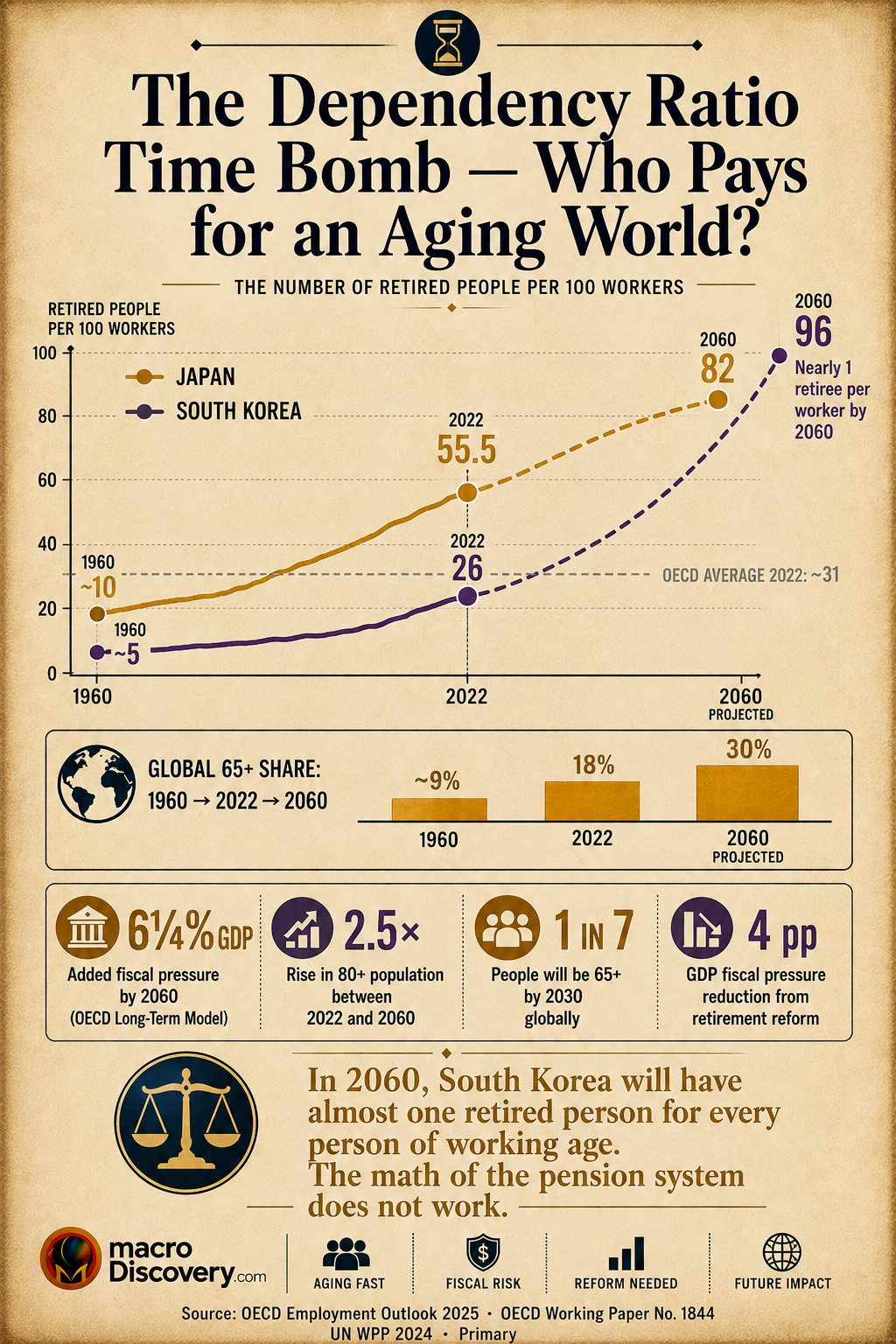
The fiscal consequences of longevity build slowly, then accelerate. Each milestone below represents a threshold at which the economics of aging shift from gradual to urgent. Sources: OECD Working Paper No. 1844 (primary · Koutsogeorgopoulou & Morgavi · November 2025) · OECD Employment Outlook 2025 (primary) · OECD Health at a Glance 2025 (primary) · UN World Population Prospects 2024 (primary).
Living longer is one of humanity’s most consistent achievements. Over the past century, global life expectancy roughly doubled. We eliminated diseases that once killed in childhood. We built healthcare systems that extend the middle years. We made death from infection unusual in rich countries. This is extraordinary. The economics of paying for those extra decades — in a world where populations are aging faster than fiscal systems can adapt — is the defining public finance challenge of the coming generation.
“Defined-benefit, pay-as-you-go pension systems are particularly vulnerable, as contribution rates struggle to keep up with growing retirement cohorts and longer benefit durations.”
— OECD Working Paper No. 1844 (Koutsogeorgopoulou & Morgavi, 2025) · oecdecoscope.blog (primary · directly fetched)The Healthspan Gap — Living Longer Is Not the Same as Living Well
The most important distinction in the economics of longevity is between lifespan and healthspan. Lifespan is how long you live. Healthspan is how many of those years you spend in good health. The OECD’s 2025 research on healthy ageing found that while life expectancy has been rising, healthy life expectancy has been stagnating across OECD countries. The extra years we are gaining are disproportionately years of chronic illness, cognitive decline, and dependency. This is not just a personal tragedy. It is the primary economic mechanism through which aging creates fiscal pressure. A person living to 84 who is healthy until 82 costs far less to support than one who needs intensive care from 72. The gap between those two scenarios — multiplied across entire populations — is what the OECD’s 6¼ percentage points of GDP represents.
The Longevity Economy — $3 Trillion Now, $5.4 Trillion by 2034
There is another side to the economics of longevity. Older populations are not just a cost. They are a market. The Bank of Singapore’s 2026 Supertrends analysis valued the global longevity economy at $3 trillion in 2025 — comparable, it notes, to the top 10 nominal GDPs in the world — growing at a CAGR of 6 to 7% toward $5.4 trillion by 2034. The four growth sectors are healthcare, nutrition, financial services, and travel and leisure. Robotics and AI are identified as key enablers — both helping aging workforces maintain productivity and unlocking new care models. The fiscal challenge of longevity and the commercial opportunity of longevity are two sides of the same demographic shift. The societies that navigate it best will be those that invest in healthy aging rather than just paying for sick aging.