Home AI Technology Gaming Future Automobile Geography Top 10 Trending How To Discover
---Advertisement---

Mapped: The Global Semiconductor Race

Macro Discovery
On: August 13, 2026 6:28 AM
Follow Us:
---Advertisement---
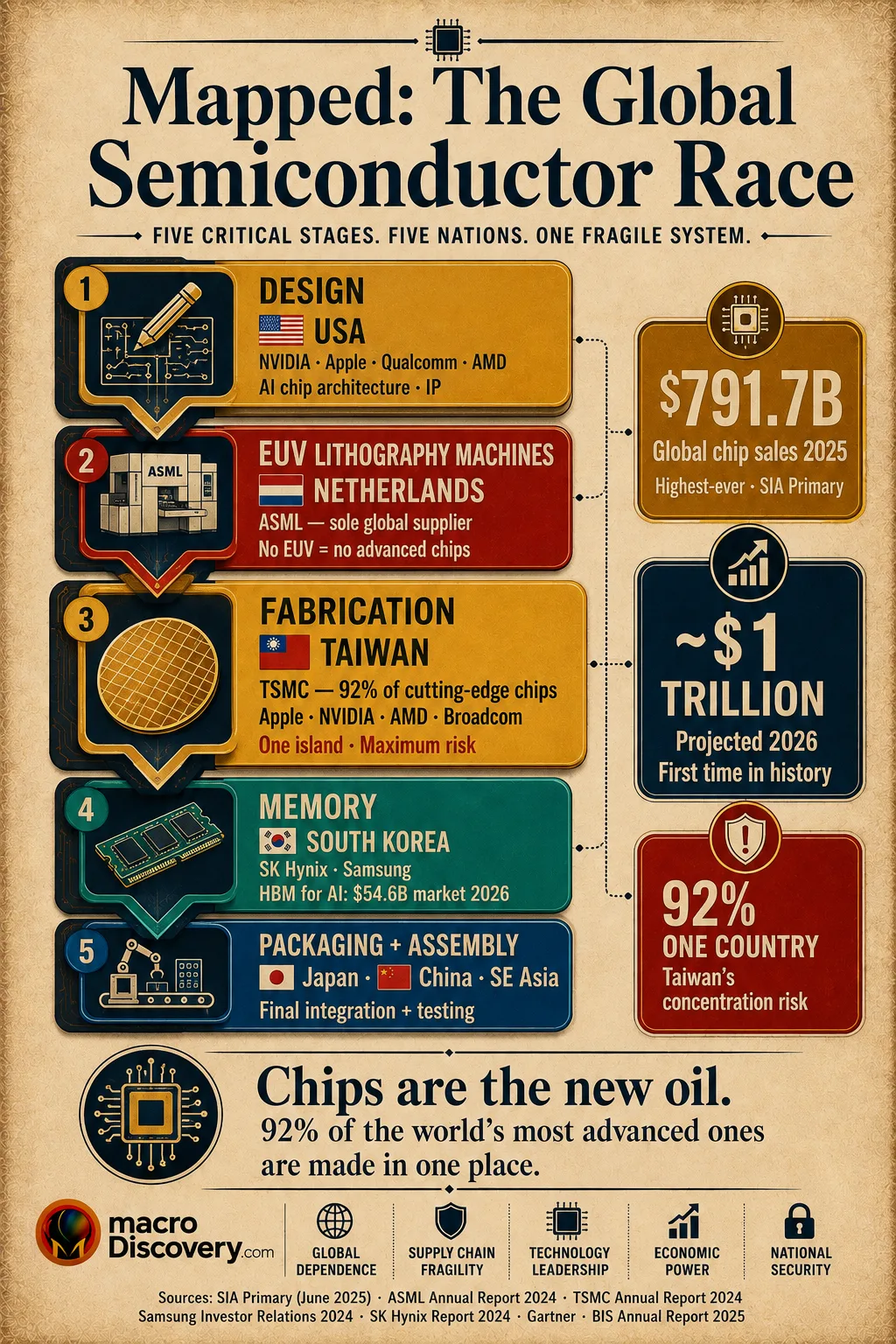
Premium editorial infographic showing
the global semiconductor supply chain
as a vertical pipeline with five
stages, each colour-coded by dominant
country. From top to bottom: Design
(USA — NVIDIA, Apple, Qualcomm, AMD),
EUV Lithography Machines (Netherlands
— ASML, sole global supplier), Fab-
rication (Taiwan — TSMC, 92% of
cutting-edge chips, for Apple, NVIDIA,
AMD, and Broadcom), Memory (South
Korea — SK Hynix and Samsung, HBM
market $54.6 billion in 2026), and
Packaging/Assembly (Japan, China, and
Southeast Asia). Three callout boxes
on the right highlight: global chip
sales of $791.7 billion in 2025
(record, SIA primary), the $1 trillion
projection for 2026 (first in history),
and Taiwan's 92% concentration risk.
Based on SIA primary data
(semiconductors.org) and TSMC's SEC
6-K filing (March 4, 2025). Global Semiconductor Race.
Global Semiconductor Race
Global Semiconductor Race , What is the size of the global semiconductor market in 2025 and 2026? , Why does Taiwan make most of the world’s advanced chips? , What is the US CHIPS Act and is it working? , Why does the Netherlands control the global chip industry? , Why is there a semiconductor shortage and when will it end? , Global Semiconductor Race 2025-2026: $1T Market, TSMC, CHIPS Act Data , global semiconductor market 2025 2026 size revenue TSMC chips shortage data , semiconductor shortage 2025 2026 when will it end chip supply AI data center NVIDIA TSMC primary , TSMC Taiwan chip concentration risk 92 percent advanced logic CHIPS Act US manufacturing 2026 , global semiconductor race countries USA Taiwan South Korea Netherlands China ranking supply chain data , how big is the global semiconductor market in 2025 and 2026 revenue , why does Taiwan make most of the world’s most advanced computer chips , what is the CHIPS Act and is it working 2025 2026 status delays , why does the Netherlands control chip manufacturing ASML EUV machine , when will the semiconductor chip shortage end AI supply 2025 2026 ,
Mapped: The Global Semiconductor Race — MacroDiscovery
MacroDiscovery
Technology & Geopolitics · 5 min read · SIA Primary · TSMC SEC 6-K · CHIPS Act · 2026
SIA — Semiconductor Industry Association (PRIMARY · semiconductors.org · ×5 press releases · Feb–May 2026) · TSMC 6-K SEC Filing (PRIMARY · sec.gov · March 4, 2025) · CHIPS Program Office · Axis Intelligence (live-verified June 14, 2026 · citing SIA/WSTS/SEC)
Semiconductors · Global Tech Race

Mapped: The Global
Semiconductor Race

Chips are the oil of the 21st century. Global semiconductor sales hit a record $791.7 billion in 2025 — and are on track to cross $1 trillion in 2026 for the first time in history. One island manufactures 92% of the world’s most advanced chips. One company’s data center revenue surpassed the entire semiconductor market’s size just a decade ago. Here is where the race stands.

By MacroDiscovery
Source: SIA primary (semiconductors.org · ×5 press releases · Feb–May 2026)
Record: 2025 = $791.7B · “highest-ever annual sales” · SIA CEO
$791.7B
global chip sales 2025 · record · “highest-ever annual” · SIA primary · Feb 6 2026
~$1T
2026 projection · “on track to reach $1 trillion” · SIA CEO John Neuffer · May 4 2026
92%
of world’s cutting-edge chips made by TSMC in Taiwan · Stimson Center Dec 2025
$165B
TSMC total US investment · 3 fabs Arizona · “largest single FDI in US history” · SEC 6-K
Visualization 01 — The Global Chip Power Map
Who Controls What in the Semiconductor Supply Chain

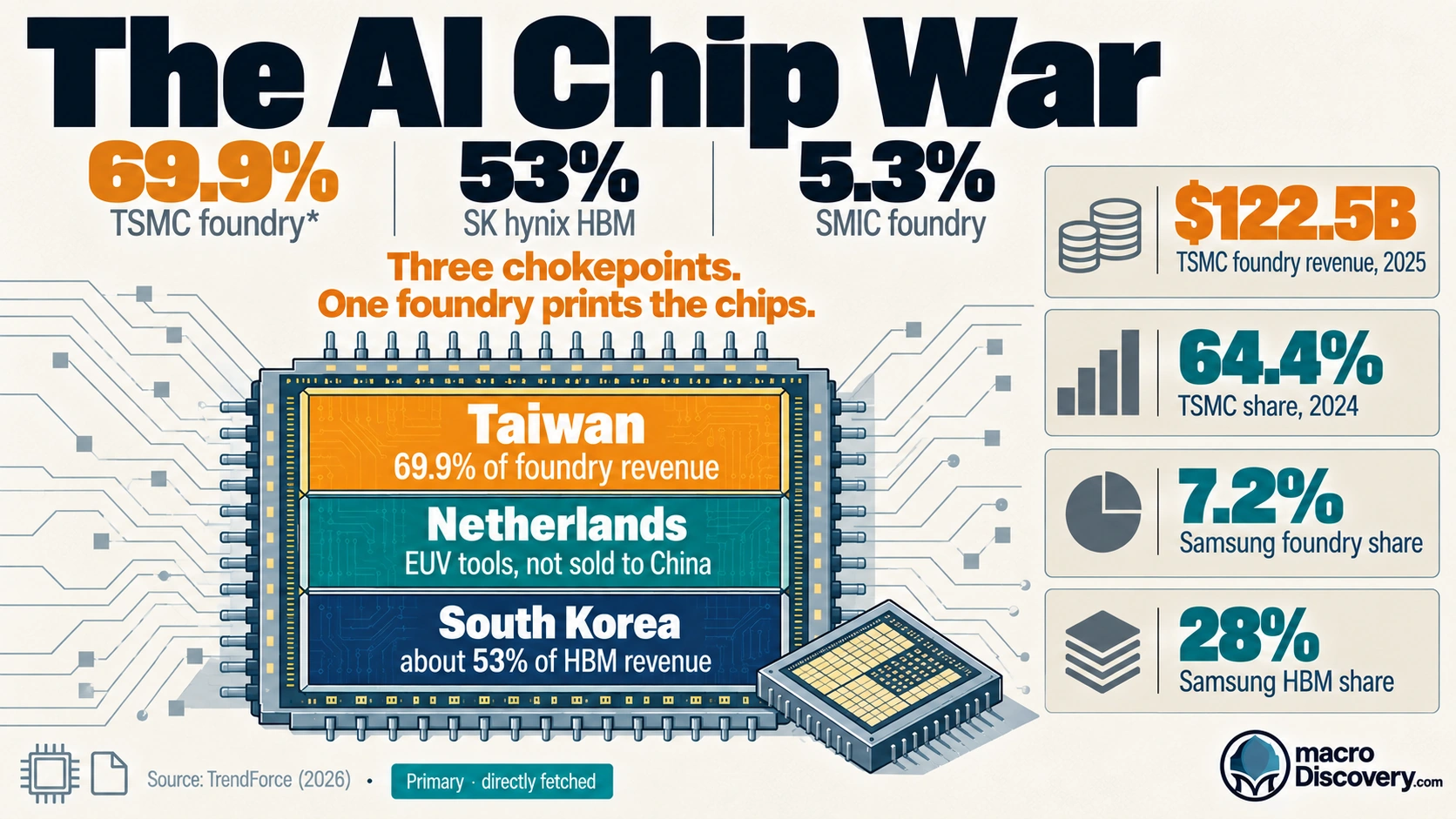
The semiconductor supply chain spans every continent — but critical chokepoints are concentrated in just a few countries. No single nation controls everything. The US dominates design and AI. Taiwan fabricates the most advanced chips. South Korea leads memory. The Netherlands makes the only machines that can make sub-7nm chips. Tap each country for detail. Sources: SIA (primary · semiconductors.org) · TSMC SEC 6-K (primary · March 4, 2025) · CHIPS Program Office · Axis Intelligence (June 2026) · Stimson Center (December 2025).
🇹🇼
Taiwan
Advanced Fabrication · The Critical Chokepoint
92% of cutting-edge chips TSMC: $52-56B capex 2026
Advanced chip share
92% of world’s most advanced logic chips
TSMC fabricates for Apple, NVIDIA, AMD, Broadcom, Google, Qualcomm — all on contract from Taiwan
TSMC 2026 capex
$52–56 billion (+32% YoY)
Record investment — supply side racing to meet AI demand; Fab 21 Arizona Phase 1 already in volume production
Process nodes available
3nm · 4nm · 5nm · 7nm in production
2nm (N2) entering production 2025; A16 (1.6nm) targeting 2026-2027; most advanced in the world
Geopolitical risk
Maximum concentration risk
If Taiwan’s fabs were disrupted, the global supply of advanced AI chips, smartphones, and data center processors would halt within months
🇺🇸
United States
Design Leader · AI Chip Architect · Policy Investor
NVIDIA: $193.7B DC revenue FY26 CHIPS Act: $52.7B
Design supremacy
NVIDIA · AMD · Qualcomm · Broadcom · Intel
US companies design the chips that define every major category: AI accelerators, mobile SoCs, data centre CPUs, networking chips
CHIPS Act awards
$33.7B finalized of $52.7B total
Intel: $8.5B direct + $11B tax credits · TSMC AZ: $6.6B · Samsung TX: $4.7B · Micron: $5.5B · GlobalFoundries: $3.1B
TSMC Arizona progress
Fab 1 (4nm): volume production 2025
Fab 2 (3nm/2nm): equipment install Q3 2026, production 2027 · Fab 3 (2nm/A16): end of decade · total: $165B investment
Challenge: workforce gap
~70,000 engineers needed by 2030
40% of CHIPS Act projects reported delayed as of mid-2024 · “replicating Asia’s ecosystem is slower and more expensive” · Intel Ohio pushed to 2030
🇰🇷
South Korea
Memory King · AI Infrastructure Backbone
SK Hynix HBM 2026: $54.6B Samsung semi: ~$72B
SK Hynix HBM dominance
$54.6B HBM market 2026 (+58% YoY)
70% share of HBM4 (High Bandwidth Memory) — the ultra-fast memory that AI chips require · fully booked through 2025 and into 2026
Samsung Electronics
~$72B semiconductor revenue
Vertically integrated across memory and logic · $4.7B CHIPS Act award for Taylor, Texas fab · competing with TSMC in advanced foundry
Memory 2025
$223.1B global memory sales (+34.8%)
South Korea dominates global DRAM and NAND production · AI training requires vast memory bandwidth — South Korea supplies it
AI infrastructure role
Indispensable — no HBM = no AI
NVIDIA’s H100 and H200 GPUs each require stacks of HBM memory · without South Korean memory, the entire AI compute stack stalls
🇳🇱
Netherlands
EUV Monopoly · The Invisible Chokepoint
ASML: sole EUV supplier globally China: banned from EUV
ASML monopoly
Only company making EUV machines
Extreme Ultraviolet lithography is the only technology that can print circuits below ~7nm · ASML has 100% global market share · no viable competitor
Why it matters
No EUV = no advanced chips
Every cutting-edge chip from TSMC, Samsung, and Intel uses ASML EUV machines · a single EUV tool costs ~$380 million · ASML makes ~50/year
Export controls
China banned from EUV since 2019
The Dutch government — under US pressure — has banned ASML from shipping EUV machines to China · this is the single most consequential export control in tech
ASML scale
~€28B revenue 2025
Back-order booked for years · SEMI equipment billings hit record $135.1B globally in 2025 (+15%) driven partly by EUV demand from AI chip expansion
🇨🇳
China
Volume Consumer · Rising Producer · Export-Controlled
$177B chip exports H1 2026 Banned: AI chips below 7nm
Export controls (US, Oct 2023)
AI chips (7nm and below) banned to China
Updated Dec 2024 · restricts NVIDIA H100, H200, and successors · applies to all CHIPS-funded fabs regardless of nationality · China cannot access most advanced AI compute
China’s response
Huawei Ascend + SMIC advancement
Huawei’s Mate 60 Pro (2023) used a 7nm SMIC chip — surprising Western intelligence · Huawei’s Ascend AI chips now challenging NVIDIA within China
China chip exports
~$177B in first half of 2026
Memory prices surged; mature-node and memory chip exports nearly doubled YoY · China is a major player in non-advanced chip production
Constraint
Stuck at ~7nm without EUV
SMIC cannot access ASML EUV · cannot manufacture at 5nm or below at scale · AI chip gap vs NVIDIA/AMD remains wide but Huawei is narrowing it domestically
🇯🇵
Japan
Upstream Materials · TSMC Host · Specialty Chemicals
Critical materials supplier TSMC Kumamoto fab: operational
Upstream role
Specialty chemicals + silicon wafers
Japan supplies ~50% of the world’s photoresists (critical chemicals for chip patterning) · also dominant in silicon wafer production and specialty gases
TSMC Kumamoto
Fab 1 (12/16nm): operational 2024
TSMC’s first Japan fab opened with Japanese government support · Fab 2 targeting 6nm+ by 2027 · Japan subsidising semiconductor manufacturing return
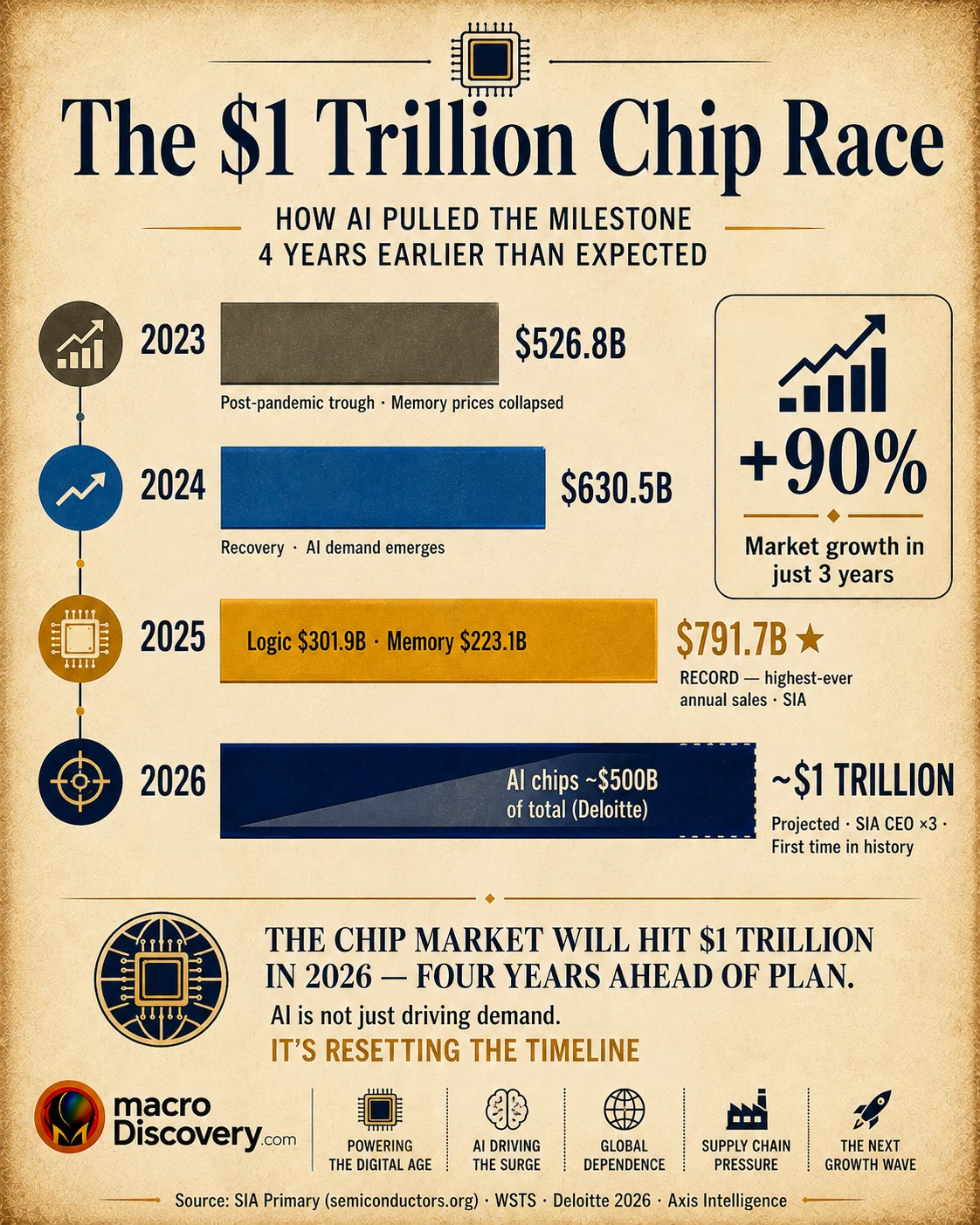
Premium editorial infographic showing four horizontal bars representing global semiconductor market size from 2023 to 2026. The 2023 bar (grey) shows $526.8 billion — the post- pandemic trough. The 2024 bar (blue) shows $630.5 billion as AI demand emerges. The 2025 bar (chip-gold, marked with a star as "RECORD — highest-ever annual sales per SIA") shows $791.7 billion, with Logic at $301.9 billion and Memory at $223.1 billion noted inside. The 2026 bar (deep navy, with dashed right edge for projection) extends to approximately $1 trillion — the first trillion-dollar year in semiconductor history — with a shaded wedge showing AI chips accounting for roughly $500 billion of that total (Deloitte estimate). A callout shows the market grew +90% in just three years. Based on SIA primary data (semiconductors.org).
Global Semiconductor Race
Visualization 02 — The $1 Trillion Race · 2023 to 2026
From $526 Billion to $1 Trillion in Three Years — the AI Supercycle Arrives

The semiconductor market’s path to its first $1 trillion year — and what is driving it. Source: SIA (Semiconductor Industry Association, PRIMARY · semiconductors.org) · WSTS (World Semiconductor Trade Statistics) · Deloitte 2026 Outlook · Axis Intelligence (June 2026, citing SIA/WSTS/SEC filings).

2023
Trough
$526.8 Billion — The Post-Pandemic Downturn. Memory Prices Collapse. Inventory Glut.
After the pandemic-era chip shortage sent the industry into a frenzy of over-ordering, 2023 became the correction year. Memory prices collapsed. Chip inventories piled up at manufacturers and distributors. Samsung, SK Hynix, and Micron cut production. The AI revolution was beginning — NVIDIA’s H100 GPU was shipping — but its full impact on the market had not yet registered in the revenue numbers.
$526.8B · SIAMemory glut · prices fellH100 shipping · AI igniting
2024
Recovery
$630.5 Billion — AI Demand Breaks the Inventory Cycle. Memory Rebounds. NVIDIA Becomes the World’s Most Valuable Company.
The recovery was faster than any previous cycle — and the driver was unlike anything before. AI data centre investment overrode the normal inventory correction. Hyperscalers — Amazon, Microsoft, Google, Meta — committed hundreds of billions to AI infrastructure, all requiring NVIDIA GPUs and high-bandwidth memory. Memory prices reversed sharply as HBM demand from AI outpaced supply. NVIDIA briefly surpassed Apple and Microsoft to become the world’s most valuable company in 2024.
$630.5B · SIAAI demand overrides cycleNVIDIA: most valuable company
2025
Record
$791.7 Billion — “Highest-Ever Annual Sales.” Logic Crosses $300B. Memory Rebounds to $223B. Q4 Up 37%.
The semiconductor industry posted its highest-ever annual sales in 2025 — $791.7 billion, up 25.6% from 2024. Logic chips (including AI processors) reached $301.9 billion — the largest single product category. Memory rebounded to $223.1 billion. Q4 2025 alone hit $236.6 billion, up 37.1% year-on-year. SEMI reported record equipment spending of $135.1 billion — the supply side racing to meet AI demand. TSMC announced it would bring $165 billion to Arizona — the largest foreign direct investment in US history.
$791.7B · record · SIA primaryLogic: $301.9B #1 categoryTSMC: $165B US investment
2026
$1T
~$1 Trillion Projected — First Time in History. Q1 2026 Already at $298.5B. AI Chips ~$500B of That Total.
Q1 2026 reached $298.5 billion — 25% above Q4 2025 — putting the industry on an annualised run rate of roughly $1.2 trillion. The SIA CEO has now confirmed the $1 trillion projection in three separate press releases. Deloitte estimates AI chips alone will account for roughly $500 billion of 2026’s total. That means AI has gone from a curiosity to roughly half the world’s chip market in three years. The $1 trillion milestone was once expected around 2030. AI pulled it forward by four years.
~$1T projected · SIA CEO ×3AI chips: ~$500B (Deloitte)Q1 2026: $298.5B · on track

Semiconductors are not a technology industry. They are the foundation of every technology industry. Every smartphone, every data centre server, every car with driver-assist features, every weapon system, every medical scanner runs on chips. The country that controls chip production controls the 21st century’s most important resource. That is why governments are spending tens of billions to reshape a supply chain that took 50 years to build in Asia.

SIA — Semiconductor Industry Association · Primary · semiconductors.org · February 6, 2026
$791.7B
“The global semiconductor industry posted its highest-ever annual sales in 2025, nearly hitting $800 billion, and global sales in 2026 are projected to reach roughly $1 trillion.” — John Neuffer, SIA President & CEO
This verbatim quote from the SIA’s February 6, 2026 press release captures the scale of what the industry achieved in 2025 — and where it is heading. Logic chips (AI processors, CPUs, GPUs) led with $301.9 billion. Memory followed at $223.1 billion. The SIA CEO has confirmed the $1 trillion 2026 projection in three separate official releases. The $1 trillion milestone was previously not expected until 2030. The AI supercycle pulled it forward by four years.
Source: SIA — “Global Annual Semiconductor Sales Increase 25.6% to $791.7 Billion in 2025” (PRIMARY · semiconductors.org · February 6, 2026) + SIA Q1 2026 release (PRIMARY · May 4, 2026) + SIA January 2026 release (March 6, 2026) · “SIA represents 99% of the U.S. semiconductor industry by revenue and nearly two-thirds of non-U.S. chip firms” ✓

“Global chip sales remain on track to reach $1 trillion in 2026, with Q1 sales significantly exceeding sales in Q4 2025.”

— John Neuffer, SIA President & CEO · May 4, 2026 · semiconductors.org (primary)

The Taiwan Problem — One Island, 92% of the World’s Most Advanced Chips

There is no polite way to say this. The entire global supply of advanced chips — the ones inside every flagship smartphone, AI server, and high-performance computer — flows through a single company on a single island in the Taiwan Strait. TSMC does not just lead in advanced chip manufacturing. It has an effective monopoly at the cutting edge. Its customers include Apple, NVIDIA, AMD, Broadcom, Google, and Qualcomm — every company that defines the AI era. If something disrupted TSMC’s fabs, there is no backup. That is what the CHIPS Act is trying to change — with partial success and significant delays.

Why it matters: the Taiwan Strait is one of the world’s most contested waterways. Advanced chip production being concentrated there is the single largest structural vulnerability in the global technology supply chain.
TSMC SEC 6-K Filing · PRIMARY · sec.gov · March 4, 2025 + Stimson Center December 2025
92%
TSMC fabricates 92% of the world’s cutting-edge semiconductors under contract — for Apple, NVIDIA, AMD, Broadcom, Google, and Qualcomm. Its $165B US investment is the largest single foreign direct investment in American history.
TSMC’s SEC 6-K filing of March 4, 2025 confirmed its $165 billion total US investment commitment — expanding from $65 billion to $165 billion — encompassing three fabrication plants, two advanced packaging facilities, and an R&D centre in Phoenix, Arizona. TSMC’s chairman described this as a move made possible by “President Trump’s vision and support.” Fab 1 (4nm) is already in volume production. Fab 2 (3nm/2nm) is scheduled for 2027. The US is building a partial hedge against Taiwan concentration — but it will take most of a decade to matter.
Source: TSMC — Form 6-K SEC Filing (PRIMARY · sec.gov/Archives/edgar/data/1046179 · March 4, 2025 · “TSMC’s total investment in the U.S. is expected to reach US$165 billion” · “largest single foreign direct investment in U.S. history”) · Stimson Center (December 2025 · “fabricates 92% of the world’s cutting-edge semiconductors under contract”)

The CHIPS Act — $52.7 Billion Committed, 40% of Projects Delayed, 70,000 Workers Still Needed

The US CHIPS and Science Act authorised $52.7 billion to rebuild American semiconductor manufacturing. It is the most significant industrial policy the US government has passed in decades. The Commerce Department has finalized more than $33 billion in direct funding across 20 awards. But the execution reality is sobering. As of mid-2024, 40% of the largest manufacturing projects funded under the Act were reported as delayed. Intel’s Ohio “Silicon Heartland” — once the flagship of American chip resurgence — has been pushed to 2030. Building fabs outside Asia’s optimised ecosystem costs more and takes longer than the announcements suggested. The chip industry also faces a projected shortage of roughly 70,000 engineers and technicians by 2030 — workers that no amount of government money can instantly create.
Why it matters: the gap between announcing chip factory investment and actually producing chips is measured in years and billions. The race is real — but the timeline for meaningful US domestic supply independence is still measured in decades, not years.
Axis Intelligence (June 14, 2026) · Citing SEC 10-K · SIA/WSTS · AI Silicon Concentration Index
1 in 4
Roughly one in every four dollars of global semiconductor revenue now flows through just two companies’ AI-accelerator divisions — NVIDIA and AMD. NVIDIA’s data centre revenue alone hit $193.7 billion in FY2026.
Axis Intelligence’s AI Silicon Concentration Index — derived from NVIDIA and AMD SEC filings against SIA’s global totals — calculated that NVIDIA and AMD’s AI-accelerator divisions together account for approximately 26.6% of all global semiconductor revenue. NVIDIA’s FY2026 data centre revenue of $193.7 billion (+68% year-on-year) exceeded the entire global semiconductor market just a decade ago. Q1 FY2027 data centre revenue alone reached $75.2 billion (+92%). The AI supercycle has concentrated chip revenue faster than any previous technology transition.
Source: Axis Intelligence — “Semiconductor Statistics 2026” (June 14, 2026 · “live-verified via direct source retrieval” · citing NVIDIA 10-K SEC filing FY2026 and AMD 10-K FY2025 against SIA/WSTS global totals · “26.6% AI Silicon Concentration Index” · NVIDIA FY2026 DC: $193.7B +68% · Q1 FY2027 DC: $75.2B +92%)
Key Numbers at a Glance
Market · 2025 Record
$791.7B
Global chip sales in 2025 — the highest-ever annual total. Logic led at $301.9B. Memory at $223.1B. Up 25.6% from 2024’s $630.5B.
SIA — semiconductors.org (primary)
Market · 2026 Projection
~$1T
2026 is projected to cross $1 trillion in chip sales for the first time in history. Q1 2026 alone reached $298.5B. AI pulled the milestone forward by 4 years.
SIA primary · WSTS forecast
Taiwan · Concentration
92%
TSMC’s share of the world’s cutting-edge chip production — made in Taiwan, for Apple, NVIDIA, AMD, Broadcom, Google, and Qualcomm.
Stimson Center (citing TSMC) · Dec 2025
CHIPS Act · US Policy
$52.7B
Total US CHIPS Act funding authorised. $33.7B finalized. Intel, TSMC, Samsung, Micron the biggest recipients. 40% of projects reported delayed.
CHIPS Program Office / Commerce Dept
Frequently Asked Questions
What is the size of the global semiconductor market in 2025 and 2026?
2025: $791.7 billion — the highest-ever annual total, up 25.6% from 2024’s $630.5 billion. The Semiconductor Industry Association (SIA) confirmed this on February 6, 2026, calling it the industry’s “highest-ever annual sales.” 2026: projected to reach roughly $1 trillion — the SIA’s president and CEO confirmed this projection in three separate official press releases (February, March, and May 2026). Q1 2026 alone reached $298.5 billion. Source: SIA — semiconductors.org (primary).
Why does Taiwan make most of the world’s advanced chips?
Because TSMC — founded in Taiwan in 1987 — built a 35-year lead in advanced chip fabrication that no other company has matched. TSMC now fabricates 92% of the world’s cutting-edge semiconductors under contract, for Apple, NVIDIA, AMD, Broadcom, Google, and Qualcomm. TSMC’s combination of process technology, yield rates, and scale is decades ahead of competitors. Its 2026 capital expenditure alone is $52–56 billion. Source: TSMC SEC 6-K (primary · March 4, 2025) · Stimson Center December 2025.
What is the US CHIPS Act and is it working?
The CHIPS and Science Act (August 2022) authorised $52.7 billion to rebuild US semiconductor manufacturing. The Commerce Department has finalized more than $33.7 billion across 20 awards — the largest to Intel ($8.5B), TSMC Arizona ($6.6B), Samsung Texas ($4.7B), and Micron ($5.5B). TSMC’s Arizona Fab 1 (4nm) is already in volume production. But as of mid-2024, 40% of the largest projects were reported as delayed, Intel’s Ohio fab was pushed to 2030, and the industry faces a projected shortage of ~70,000 engineers by 2030. It is working — but slowly.
Why does the Netherlands control the global chip industry?
Because ASML — a Dutch company — is the only manufacturer of EUV (Extreme Ultraviolet) lithography machines in the world. EUV is the only technology that can print circuits below roughly 7 nanometres — meaning every advanced chip from TSMC, Samsung, and Intel requires ASML’s machines. There is no credible alternative. Under US pressure, the Netherlands has banned ASML from exporting EUV machines to China since 2019. A single EUV machine costs approximately $380 million. ASML makes around 50 per year.
Why is there a semiconductor shortage and when will it end?
The 2021-2023 chip shortage was driven by pandemic-era demand surge and supply chain disruption — it has largely resolved for most chip types. The current situation (2025-2026) is different: there is no broad shortage, but there is an acute supply constraint specifically in advanced AI chips (NVIDIA H100/H200/Blackwell GPUs and HBM memory from SK Hynix), where demand from AI data centre investment is outpacing supply. TSMC’s $52-56 billion 2026 capex and SEMI’s record $135.1 billion equipment spending in 2025 signal that the industry is investing aggressively to expand capacity — but lead times for new fabs are 3-5 years.
Sources
  • SIA — Semiconductor Industry Association (PRIMARY · semiconductors.org · “represents 99% of U.S. semiconductor industry by revenue and nearly two-thirds of non-U.S. chip firms”): Feb 6, 2026: “Global Annual Semiconductor Sales Increase 25.6% to $791.7 Billion in 2025” · 2025=$791.7B · 2024=$630.5B · Q4 2025=$236.6B +37.1% · Logic $301.9B +39.9% #1 category · Memory $223.1B +34.8% · Dec 2025=$78.9B · “highest-ever annual sales” · “projected to reach roughly $1 trillion” — John Neuffer CEO; May 4, 2026: Q1 2026=$298.5B +25% vs Q4 2025 · March 2026=$99.5B +79.2% YoY · “on track to reach $1 trillion in 2026” — Neuffer; Mar 6, 2026: Jan 2026=$82.5B +46.1% YoY · “projected to reach roughly $1 trillion in 2026”; Apr 3, 2026: Feb 2026=$88.8B +61.8% YoY
  • TSMC — Form 6-K (PRIMARY · SEC filing · sec.gov/Archives/edgar/data/1046179/000104617925000024/tsmcexpandinvestmentintheu.htm · March 4, 2025 · “TSMC’s total investment in the U.S. is expected to reach US$165 billion” · “three new fabrication plants, two advanced packaging facilities and a major R&D team center” · “largest single foreign direct investment in U.S. history” · “supports 40,000 construction jobs” · customers named: “Apple, NVIDIA, AMD, Broadcom, and Qualcomm” · Chairman C.C. Wei quoted)
  • Stimson Center (December 2025 · stimson.org · “TSMC fabricates 92% of the world’s cutting-edge semiconductors under contract, mostly for American companies like Nvidia, Apple, Advanced Micro Devices (AMD), Google, and Qualcomm” · CHIPS Act award details confirmed)
  • Axis Intelligence — “Semiconductor Statistics 2026” (June 14, 2026 · axis-intelligence.com · “live-verified via direct source retrieval on June 14, 2026” · citing SIA/WSTS · SEC 10-K filings for NVIDIA/AMD/TSMC · SEMI semi.org equipment data · GAO-26-107882 Dec 2025 · NVIDIA FY2026 DC: $193.7B +68% YoY · Q1 FY2027 DC: $75.2B +92% · AMD DC FY2025: $16.6B +32% · AI Silicon Concentration Index: 26.6% · TSMC 2026 capex: $52-56B +32% · SEMI equipment billings 2025: $135.1B +15% record)
  • CHIPS Program Office / US Department of Commerce (PRIMARY · chips.gov · $52.7B total authorized: $39B manufacturing + $11B R&D · finalized awards: $33.7B direct + $5.5B loans (20 awards) · Intel: $8.5B direct + $11B tax credits · TSMC Arizona: $6.6B (finalized Dec 2024) · Samsung Texas: $4.7B (from proposed $6.4B) · Micron: $5.5B · GlobalFoundries: $3.1B)
  • Consumer Electronics Daily / Manufacturing Dive (April-July 2026 · citing CHIPS Program Office primary · TSMC Fab 21 Phase 1: volume production 4nm early 2025 · Phase 2 equipment: Q3 2026 · Phase 2 production: 2027 · 40% of largest projects delayed as of mid-2024 · Intel Ohio pushed to 2030 · workforce gap: ~70,000 engineers/technicians by 2030)
  • Deloitte — “2026 Global Semiconductor Industry Outlook” (February 11, 2026 · deloitte.com · “AI chip market in 2026 will be about US$500B” · “December 2025 upward revision of US$175B driven by AI demand” · cross-validated with WSTS and IDC)
  • SK Hynix / uvnetware.com (February 2026 · SK Hynix HBM market 2026: $54.6B +58% YoY · 70% HBM4 share · Samsung semiconductor revenue: ~$72B · “South Korea houses…the indispensable leader in the HBM memory market”)
  • Tom’s Hardware / SIA (February 6, 2026 · tomshardware.com · SIA projects “$1 trillion in 2026” · “Q4 2025 reached $236.6 billion, up 37.1% YoY” · China chip exports: “nearly doubled to $177 billion in first half of 2026 as memory prices surged”)
Macro Discovery

Sukh Dhaliwal

Sukh Dhaliwal is the founder of Macro Discovery, an independent digital publication covering AI, technology, science, future trends, and global innovation through visual storytelling and data-driven analysis.

Join WhatsApp

Join Now

Join Facebook

Follow us

Leave a Comment