The Most Powerful Central Banks
The world’s most powerful central banks. The ranking is already in.
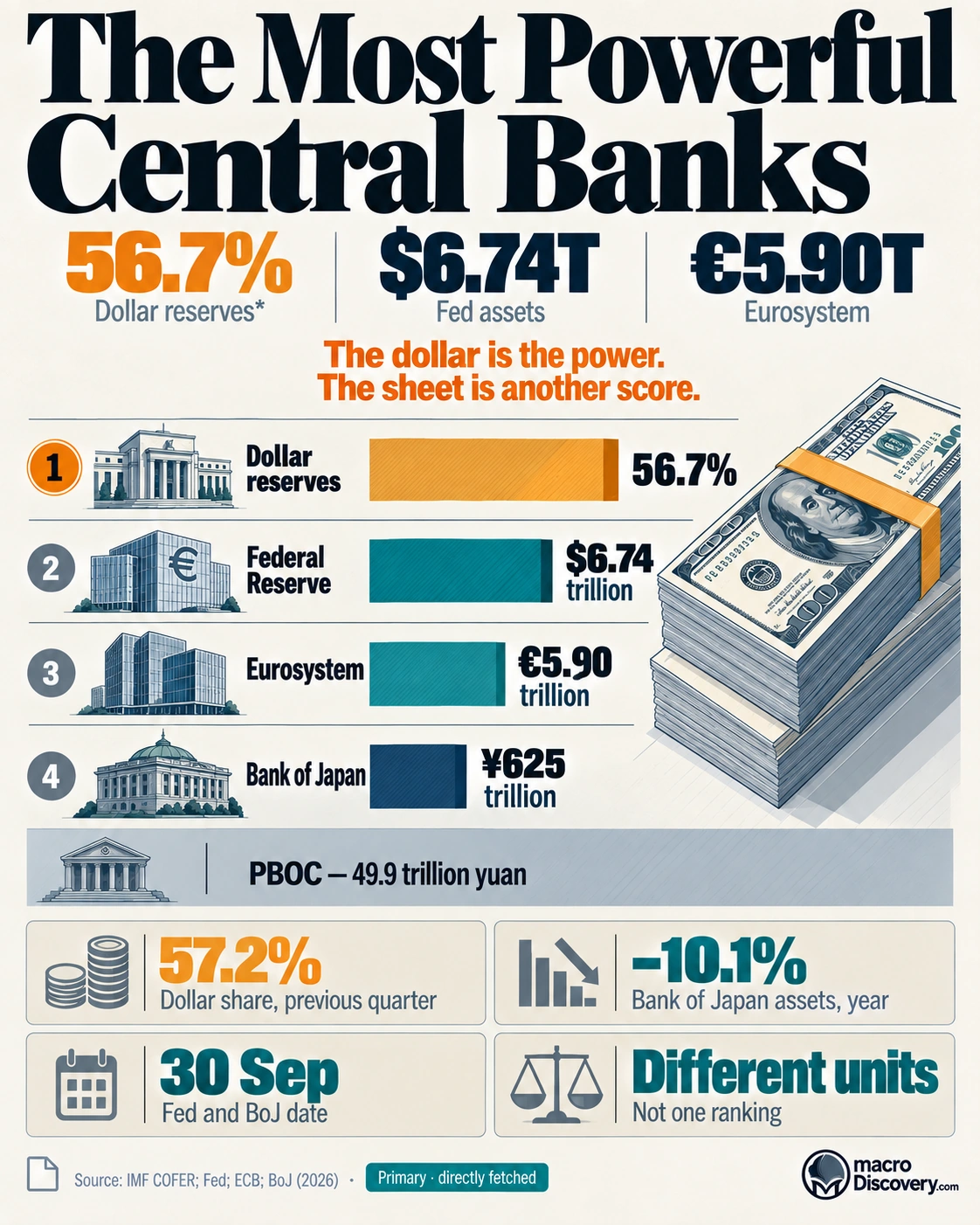
Size and the reserve currency are different lists. China’s central bank has the largest balance sheet. The dollar is still 57% of reserves. The renminbi is under 2%.
Three numbers
- $7.4 trillion — People’s Bank of China assets in August 2026, the largest of the major balance sheets. Source: compiled central-bank data.
- 56.7% — dollar share of official foreign-exchange reserves at the end of June 2026. Source: IMF.
- 1.95% — renminbi share at the end of 2025. The euro was about 20%. Source: IMF.
What the data shows
A common claim is that a ranking already names the world’s most powerful central bank, and that the Federal Reserve sits alone at the top. The fact is that power is three lists, and they do not match. By balance-sheet size in late 2026, the People’s Bank of China was largest, at about $7.4 trillion. The European Central Bank was about $6.8 trillion. The Federal Reserve was about $6.7 trillion. The Bank of Japan was about $4.1 trillion. A size ranking puts Beijing first and Washington third. It does not put the Fed alone at the top.
The reserve list is the other way around. The IMF’s currency survey put the dollar at 56.7% of official foreign-exchange reserves at the end of June 2026, down from 57.2% in the first quarter, with the euro the main gainer. At the end of 2025 the dollar was 56.8%, the euro 20.3%, and the renminbi 1.95%. Japan’s yen sits inside a group of identified currencies that together were about 15%. A central bank can have the largest balance sheet and a currency that is under 2% of what other countries hold. Those are different jobs.
A third list, assets as a share of GDP, names neither. Bank for International Settlements figures for 2026 put Hong Kong at about 130% of GDP, with Switzerland, Singapore, and Japan above 90%. China was about 34%. The United States was about 21%. The compilers of that ranking say the ratios should not be read as monetary influence. A currency board and a reserve issuer do not do the same work. Adding the three lists into one power rank double-counts size and drops the currency the world actually holds.
The dollar is 56.7% of reserves. The renminbi is 1.95%. Size is not that list.
| Count | Figure | What it is |
|---|---|---|
| PBOC assets | $7.4 trillion | Largest major balance sheet, Aug 2026 |
| ECB and Fed | $6.8tn and $6.7tn | Next two |
| Dollar reserves | 56.7% | IMF, end of June 2026 |
| Renminbi reserves | 1.95% | End of 2025. Euro about 20% |
| Assets / GDP, top | about 130% | Hong Kong. Not a power rank |
How it was measured
A balance sheet is assets in dollars at the exchange rate of the day. A stronger yuan raises the Chinese total without a new loan. The IMF reserve share is what central banks report they hold, allocated by currency. A half-point move can be valuation. The 2026 drop was described as driven mainly by more euro holdings.
Assets as a share of GDP include gold, foreign reserves, and claims on government. A small open economy with a currency board scores high. That is a ratio, not a vote on whose interest rate the world borrows at.
What it means
It is settled that the People’s Bank of China had the largest major balance sheet in late 2026, that the dollar was 56.7% of reserves in the second quarter, and that the renminbi was under 2%. It is not settled that one rank is power. Use $7.4 trillion for size. Use 56.7% for the dollar. Use 1.95% for the renminbi. Do not read assets-to-GDP as influence.
Common misreadings
- The Fed is not the largest balance sheet. China’s central bank is.
- Size is not the reserve currency. The dollar is 57%. The renminbi is under 2%.
- Hong Kong’s 130% of GDP is a ratio. It is not a power rank.
Where the numbers come from
How we built this
- Dataset: Major central-bank assets in dollars; IMF COFER reserve shares; BIS assets-to-GDP ratios.
- Scope: The three lists kept apart. No single power rank.
- Figures: $7.4 trillion is size. 56.7% is the dollar. 1.95% is the renminbi. The GDP ratio is treated as not influence.