Where Cash Is Still King
In Japan 80% of transactions are still cash. Here is why some economies refuse to go digital.
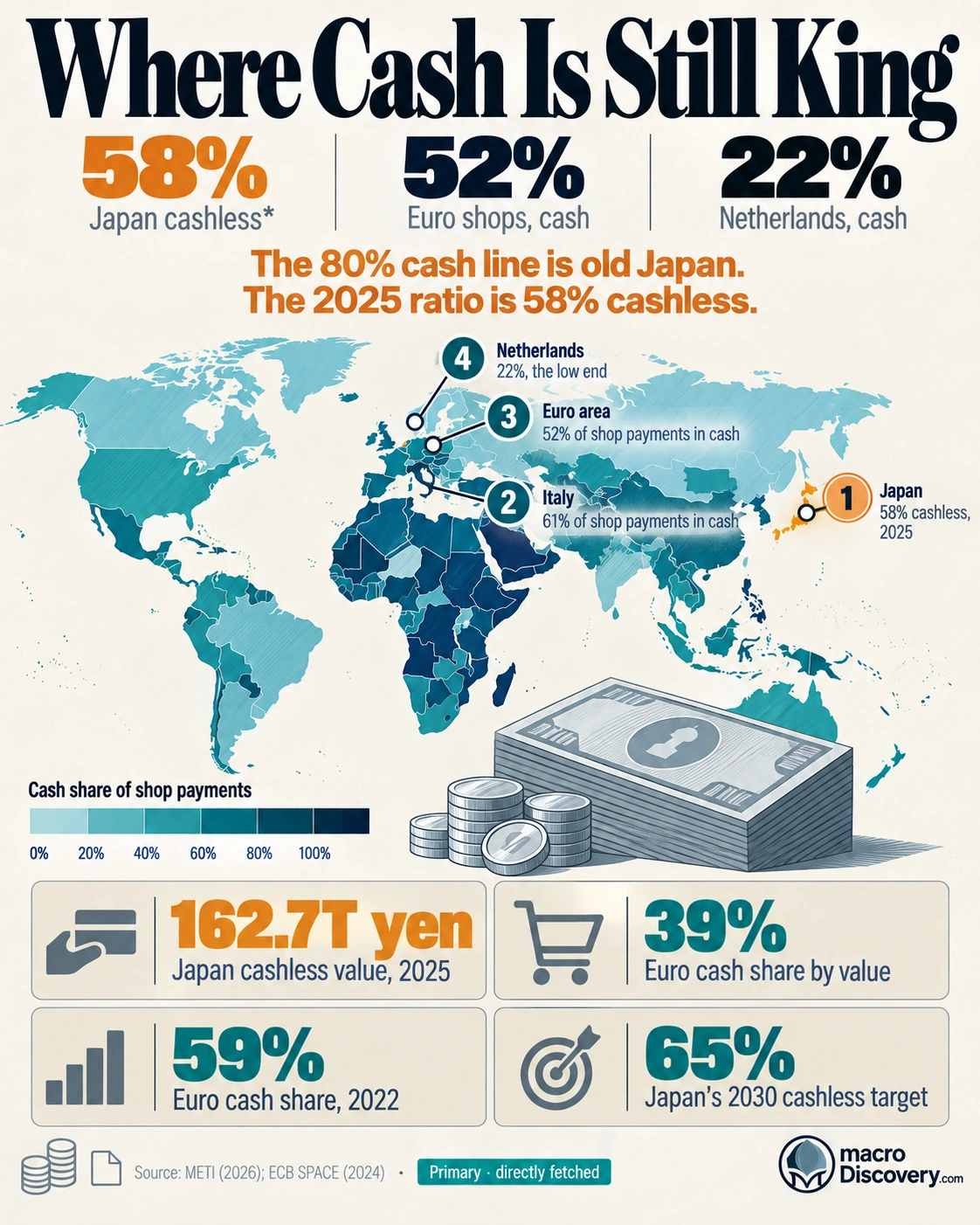
The 80% line is Japan’s cashless target, not the cash share. Cashless payment value was 58% in 2025. Cash is about 42% of that value.
Three numbers
- 58.0% — Japan’s cashless share of consumer payment value in 2025, or 162.7 trillion yen. Source: METI.
- About 42% — the cash share of that same value. The 80% line is the cashless target, not the cash share. Source: METI.
- 21% — cash in circulation as a share of GDP in Japan in 2024, the highest in the BIS set. Sweden was 0.9%. Source: BIS.
What the data shows
A common claim is that 80% of transactions in Japan are still cash, and that some economies refuse to go digital. The fact is that 80% is the cashless target, read backwards. The Ministry of Economy, Trade and Industry says cashless payments were 58.0% of consumer payment value in 2025, or 162.7 trillion yen. On that measure, cash is about 42% of value, not 80% of transactions. The government’s later goal is 80% cashless on its domestic indicator, and 65% by 2030. The viral line swapped the target for the cash share.
The 58% is value, not a count of every purchase. A card payment of 10,000 yen weighs more than a cash payment of 500 yen. Small shops can still be mostly cash by number of tickets and mostly cashless by yen. Of the cashless value, credit cards were 82.7%, code payments 10.2%, electronic money 3.7%, and debit cards 3.4%. The 2024 figure on the earlier series was 42.8%. METI says the domestic indicator runs about 8 to 9 points above the international comparison, because the international denominator includes items such as imputed rent. A jump in the ratio is partly a change in the yardstick.
Japan still looks like a cash country because the stock of notes is large. Bank for International Settlements data for 2024 put cash in circulation at 21% of GDP in Japan, the highest in that country set, and 19% in Hong Kong. Sweden was 0.9%. Cash withdrawals are falling in most places, and cash in circulation has stabilized rather than vanished. A high note stock is a store of value and a backup, not proof that 80% of payments are cash. Germany is the usual European holdout in commentary, and card use there is rising. It is not an 80% cash economy on the Japanese measure.
Cashless and cash shares are of payment value. They are not a count of transactions.
| Count | Figure | What it is |
|---|---|---|
| Cashless, 2025 | 58.0% | 162.7 trillion yen of consumer payment value |
| Cash, same measure | about 42% | Not 80% of transactions |
| Cashless target | 80% | Long-term domestic goal. Interim 65% by 2030 |
| Credit cards in cashless | 82.7% | Code payments 10.2% |
| Cash stock, Japan | 21% of GDP | 2024. Highest in the BIS set |
How it was measured
METI divides cashless payment value by a consumer-payment denominator. Credit cards, debit cards, electronic money, and code payments are in the numerator. The domestic indicator and the international comparison do not use the same denominator. The international one includes imputed rent, about 57 trillion yen, so it reads lower. A 2024 ratio of 42.8% and a 2025 ratio of 58% should not be read as a one-year leap without that note.
The BIS cash-in-circulation figure is notes and coin divided by GDP. It is a stock. The METI ratio is a flow of payments. A country can hold a lot of cash and still settle most yen without it.
What it means
It is settled that cashless payments were 58% of the METI value measure in 2025, and that cash in circulation was 21% of GDP. It is not settled that 80% of transactions are cash, or that Japan is refusing digital payment. Use 58% for cashless value. Use about 42% for the cash remainder. Use 80% only as the target. Do not use it as the cash share.
Common misreadings
- 80% is the cashless goal. The cash share of payment value is about 42%.
- The 58% is value, not a count of transactions. A large card payment outweighs a small cash one.
- A 21% cash stock is notes held, not 21% of payments, and not 80%.
Where the numbers come from
How we built this
- Dataset: METI cashless ratios for 2024 and 2025; BIS CPMI cash-in-circulation shares for 2024.
- Scope: Payment value and note stock. Transaction counts are not in the METI ratio. Germany is noted only as a cash-loyal comparison, not given a fake share.
- Figures: 58% is 2025 cashless value. About 42% is the cash remainder. 80% is the target. 21% is cash stock over GDP.