Countries With No Resources That Got Rich
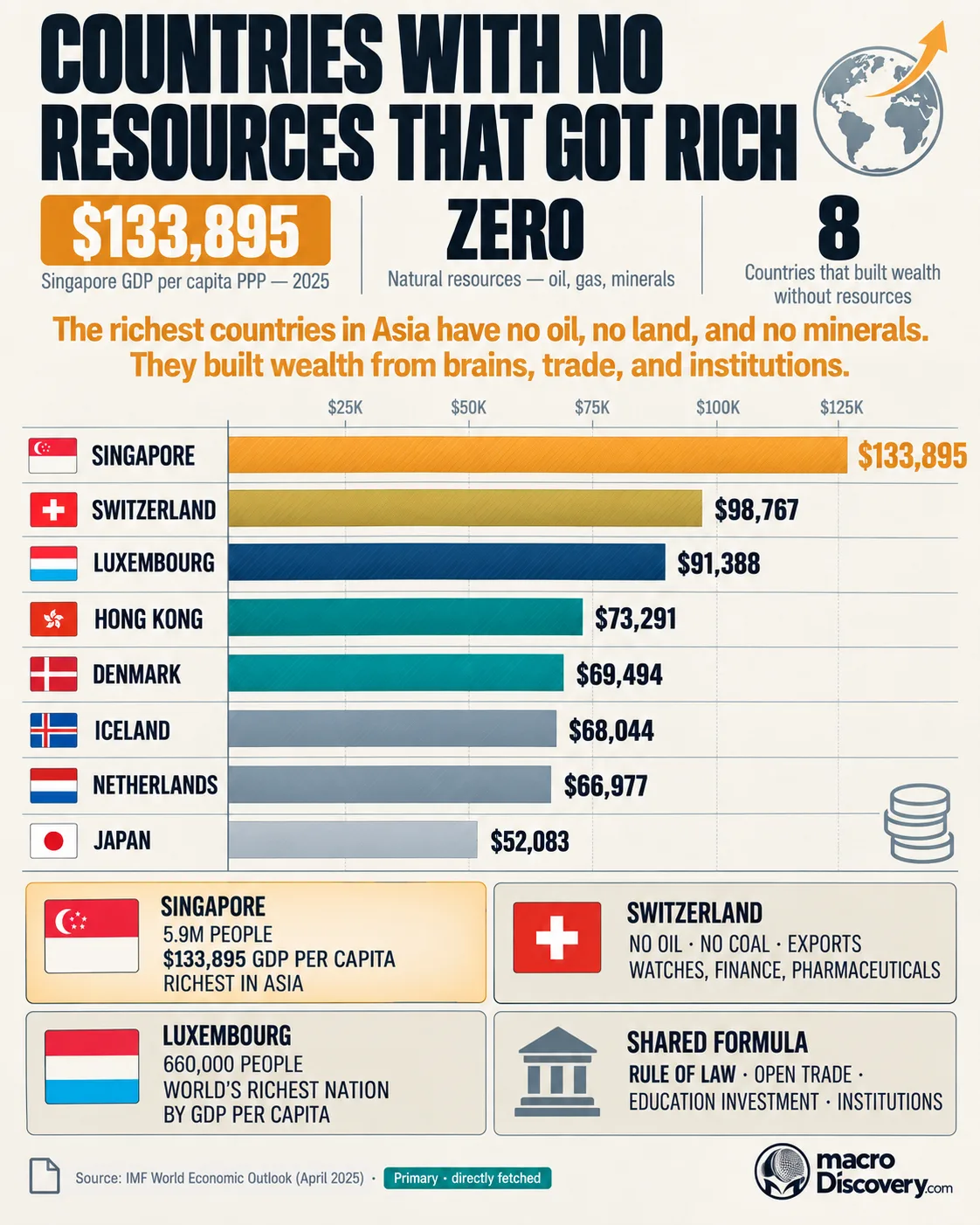
Singapore leads Asia on income per person. It has little oil or land. It does not have no water.
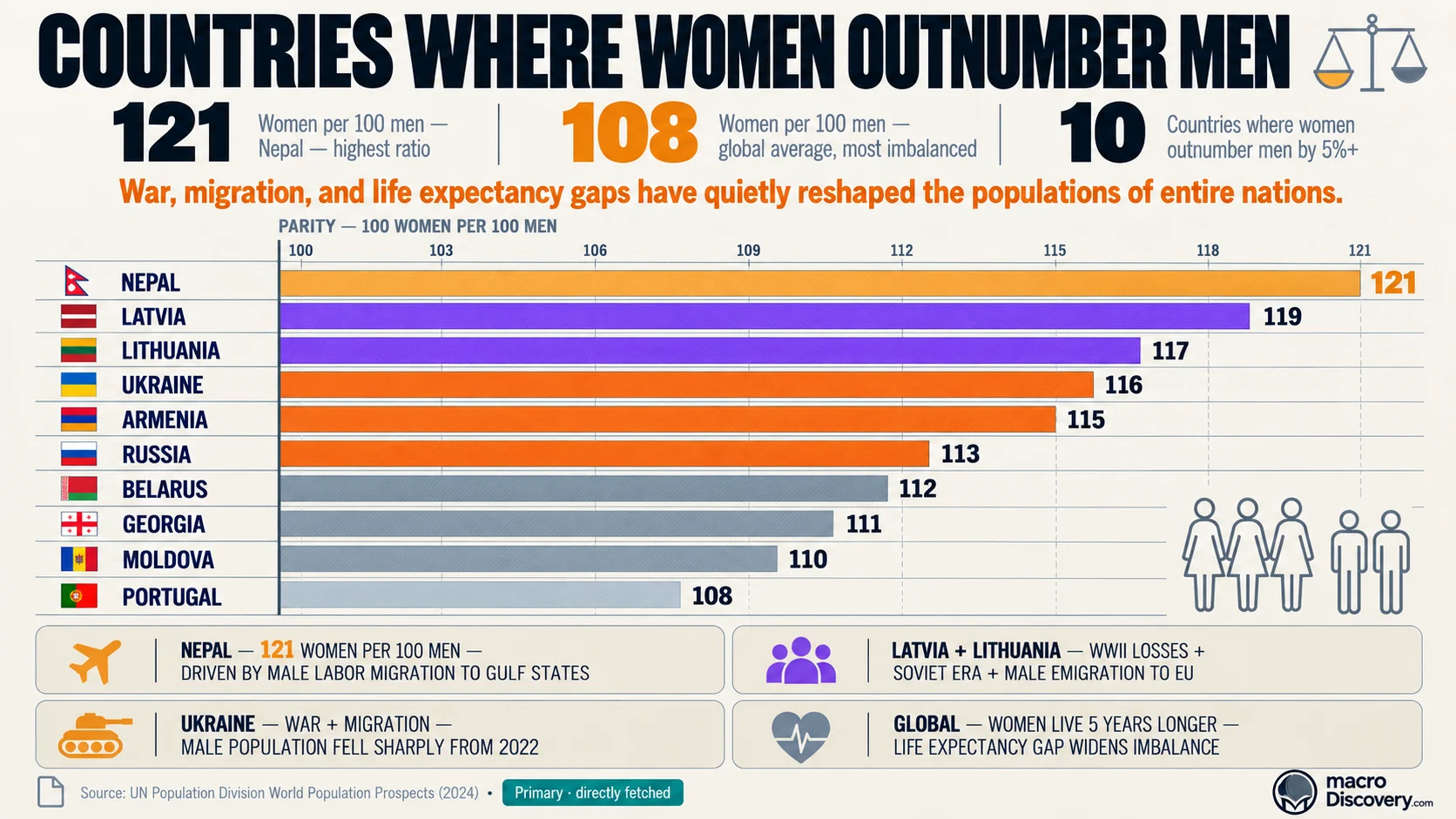
Oil states still sit near the top. The rank is PPP per person, not total GDP.
Three numbers
- 164,318 — Singapore GDP per person in 2025, PPP international dollars. Source: IMF World Economic Outlook, April 2026 estimate.
- 40 — percent of national water demand NEWater capacity can meet. Source: Singapore PUB.
- 2061 — year the Johor raw-water agreement ends. Source: Ministry of Sustainability and the Environment.
What the data shows
A common claim is that Singapore has no oil, no land, and no water, and is the richest country in Asia. The fact is it has no meaningful oil reserves and about 745 square kilometres of land. It does have water. Supply is four taps: local catchments, imported raw water, NEWater, and desalination. NEWater can meet up to 40% of demand. Desalination capacity can meet up to 43%.
On IMF 2025 estimates of GDP per person at purchasing power parity, Singapore is first in Asia at about $164,000. Macao is next at about $134,000. Qatar, an oil and gas state, is about $120,000. Among places with little energy or minerals, Taiwan is about $90,000, South Korea about $65,000, and Japan about $57,000. The rank is income per person. China’s economy is far larger.
| Place | GDP per person, PPP, 2025 | Note |
|---|---|---|
| Singapore | $164,318 | Little oil or land |
| Macao | $134,485 | City economy |
| Qatar | $120,114 | Oil and gas |
| Taiwan | $90,233 | Few energy resources |
| Hong Kong | $80,323 | City economy |
| South Korea | $65,405 | Imports most energy |
| Japan | $56,854 | Imports most energy |
IMF World Economic Outlook, April 2026 estimates for 2025. PPP international dollars. Not a rank of total GDP.
How it was measured
PPP income adjusts for local prices. A dollar buys more in some countries than others. Nominal GDP per person uses market exchange rates and ranks some oil states and small financial centres differently. Neither series is a census of natural resources.
“No resources” is not a World Bank category. Japan’s official profile says it has virtually no natural energy resources. Singapore’s listed resources are a deepwater port and fish. Water is counted separately. The 1962 Johor agreement lets Singapore draw up to 250 million gallons of raw water a day until 2061.
What it means
It is settled that Singapore leads Asia on this PPP series, and that it has little oil and little land. It is not settled that it has no water, or that a lack of resources caused the income. Oil states remain near the top. Use the four taps. Do not use “no water.”
Common misreadings
- This rank is not total GDP. China and Japan are larger economies.
- This does not mean Singapore has no water. It imports raw water and makes NEWater and desalinated water.
- A high income is not proof that resources do not matter. Qatar and Brunei are also near the top.
Where the numbers come from
How we built this
- Dataset: IMF WEO April 2026 PPP estimates for 2025; Singapore PUB and MSE water notes.
- Scope: Asia income per person. Total GDP and wealth excluded. Switzerland noted only as a non-Asian peer.
- Figures: Dollar figures rounded in the deck. Table uses the published estimates. Water shares used as capacity, not as a claim that taps are always full.