Countries Where Women Outnumber Men
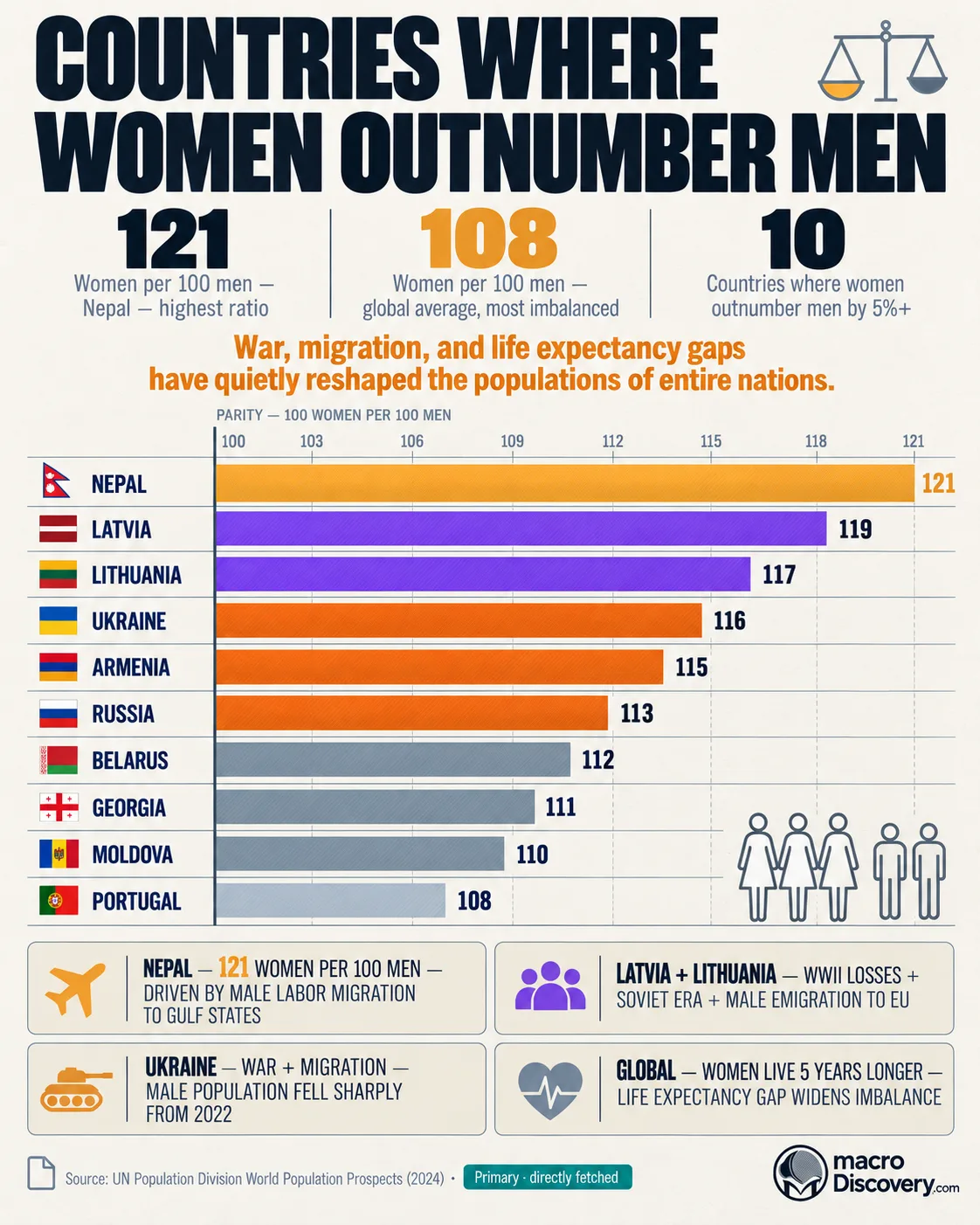
In 10 countries men have almost disappeared. Here is the data.
They have not. The lowest UN ratio in 2025 is 82 men per 100 women. That is about 45% male, not a missing population.
Three numbers
- 82 — men per 100 women in Hong Kong in 2025, the lowest UN ratio. Men are still about 45% of the population. Source: UN WPP 2024.
- 160 of 237 — countries and territories where women outnumber men. Not 10. Source: UN WPP 2024.
- 101 — men per 100 women in the world. About 44 million more men than women. Source: UN WPP 2024.
What the data shows
A common claim is that men have almost disappeared in 10 countries. The fact is that the lowest ratios are a few points off parity, not a collapse. In the UN World Population Prospects 2024, the 2025 low is Hong Kong, at 82 men per 100 women. Guadeloupe is 82. Martinique is 83. Moldova is 85. Macao is 85. Russia is 86, Latvia 87, Ukraine 87, and Belarus 87. At 82 men per 100 women, men are about 45% of the population. At 87, they are about 46%. A majority of women is not an absence of men.
Women outnumber men in 160 of 237 countries and territories. The pattern is common, not a list of 10. Several of the lowest places are territories, not sovereign states. Among countries, the low end is Eastern Europe and the former Soviet Union. Russia has the largest absolute gap, about 10.4 million more women than men. The world still has more men: 101 per 100 women, and about 44 million more men, because China and India have male majorities.
The gap is not there at birth. These places still record about 106 boys per 100 girls. It opens later. In Russia the working-age ratio is about 94 men per 100 women, and the ratio at 65 and over is about 52. Ukraine’s older-age ratio is about 53. Hong Kong is the exception in the other direction: its working-age ratio is about 77, lower than its older-age ratio of 88. That is a migration count, including a large female domestic-worker population, not only a longevity count. The large imbalance runs the other way. Qatar has about 246 men per 100 women.
A ratio of 82 is a 55–45 split. It is not a country without men. Guadeloupe and Martinique, both territories, sit next to Hong Kong.
| Place, 2025 | Men per 100 women | What it is |
|---|---|---|
| Hong Kong SAR | 82 | Lowest. Working-age ratio about 77 |
| Guadeloupe / Martinique | 82 / 83 | Territories, not sovereign states |
| Moldova | 85 | Lowest sovereign state in this series |
| Russia | 86 | About 10.4 million more women |
| Latvia / Ukraine / Belarus | 87 | Older-age ratios near 52 |
| World | 101 | About 44 million more men |
How it was measured
The UN sex ratio is males per 100 females, all ages, on 1 July. A figure under 100 means more women. It is not a count of missing people, and it is not the sex ratio at birth. Birth ratios in these places are still about 105 to 106 boys per 100 girls. The all-age ratio mixes children, workers, and the old.
Hong Kong and Macao are special administrative regions. Guadeloupe and Martinique are French territories. A list that calls all of them countries is mixing units. Russia’s absolute gap is the largest because the country is large, not because its ratio is the lowest.
What it means
It is settled that women are a majority in 160 of 237 places, and that the low end is about 82 to 87 men per 100 women. It is not settled that men have almost disappeared, or that the gap is only 10 countries. Use 82 for the lowest ratio. Use 160 for how common a female majority is. Use 101 for the world. Do not use “almost disappeared.”
Common misreadings
- A female majority is not a missing male population. The low end is still about 45% male.
- This is not 10 countries. Women outnumber men in 160 places, and several of the lowest are territories.
- The world does not have fewer men. China and India keep the global ratio above 100. Qatar is the extreme the other way.
Where the numbers come from
How we built this
- Dataset: UN World Population Prospects 2024, 2025 estimates, as tabulated for all-age and age-group sex ratios.
- Scope: All ages, both sexes. Territories kept separate from sovereign states. Birth ratios and age splits used only to show where the gap opens.
- Figures: Ratios rounded in the chart. Table uses the published 2025 estimates. Male share is ratio divided by ratio plus 100.