The Global Gig Economy
Informal work is about 2.1 billion people. App-based gig work is a much smaller set.
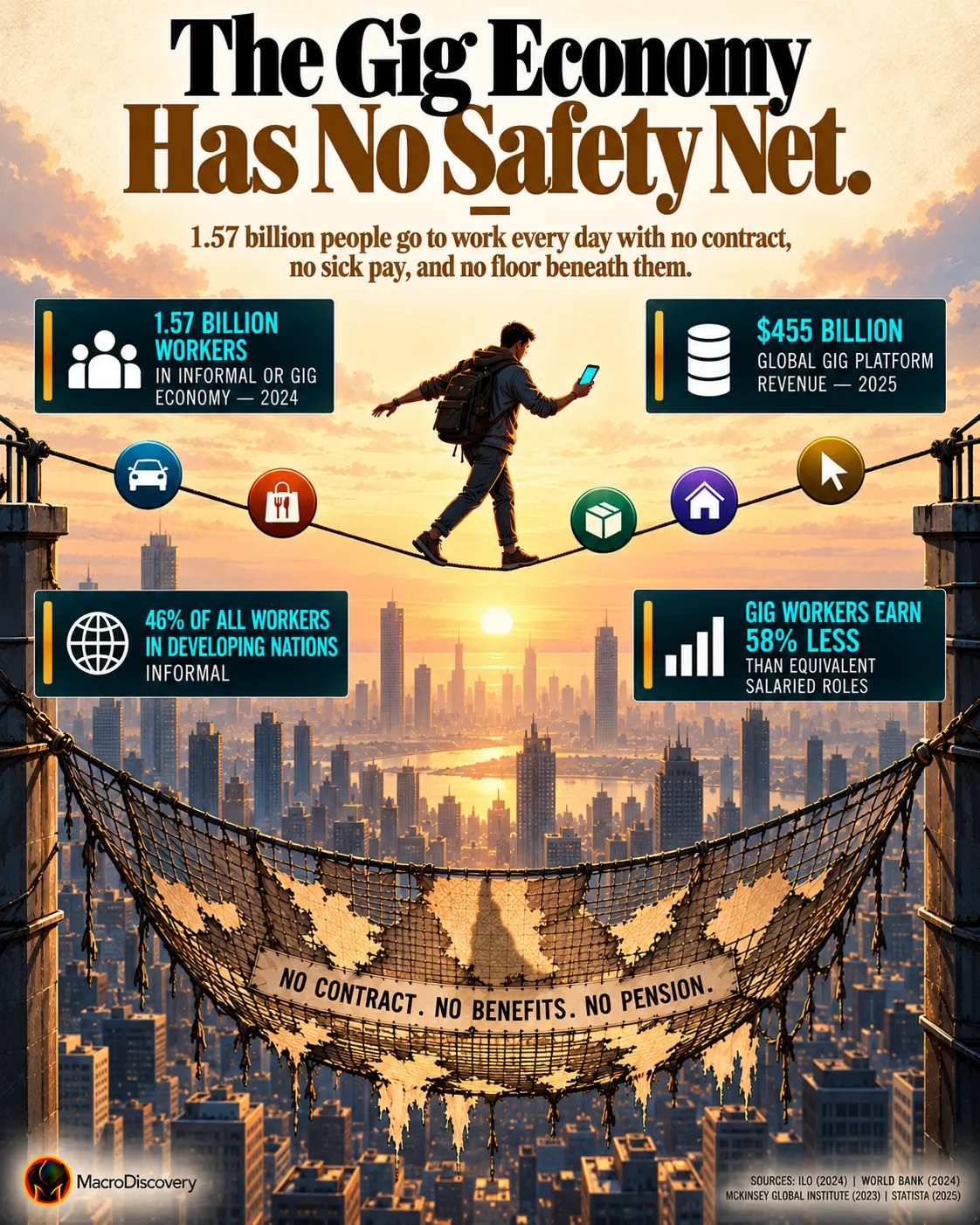
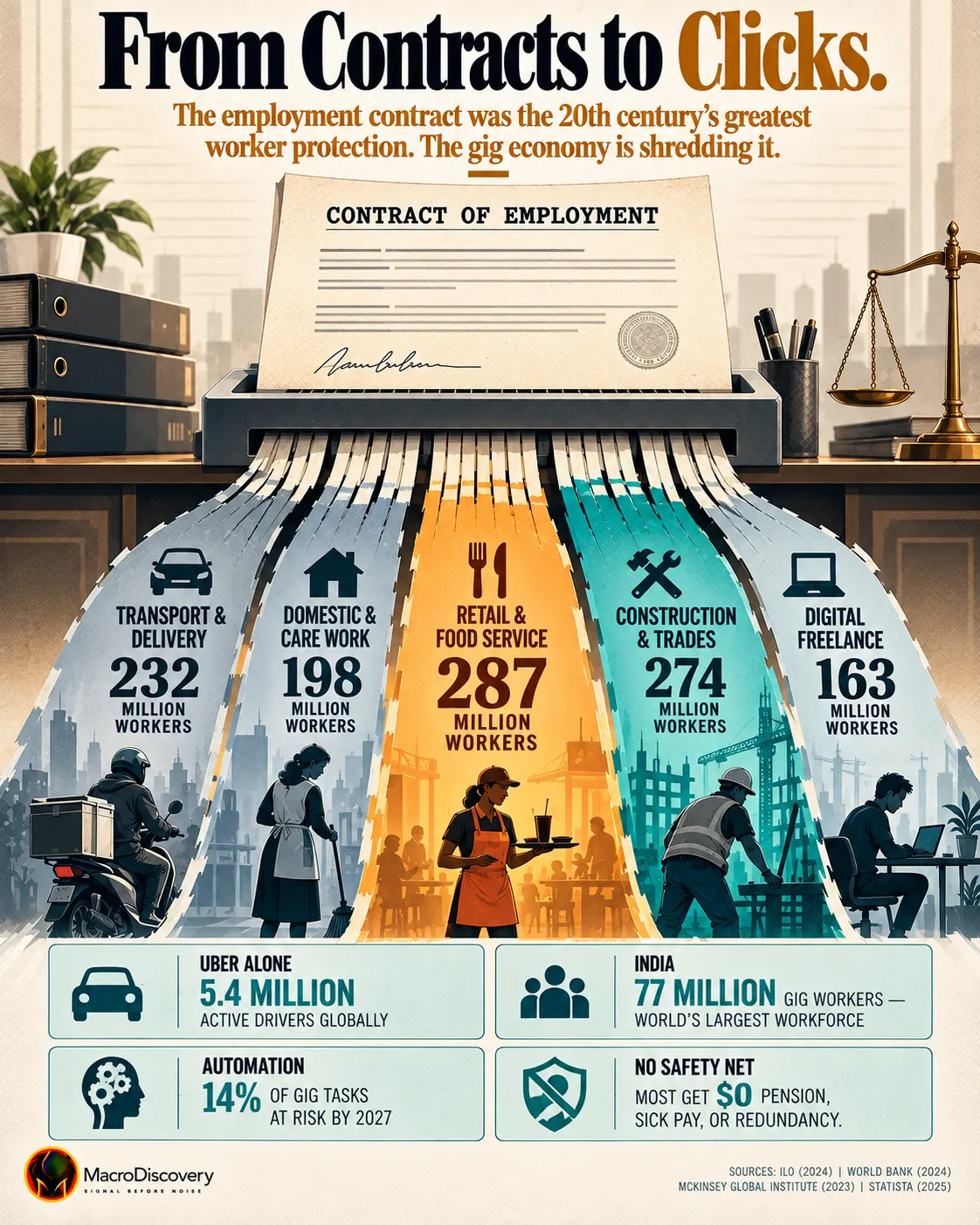
The 1.57 billion figure is an older informal or self-employment count. It is not a headcount of Uber and Upwork.
Three numbers
- 2.1 billion — workers projected in informal employment in 2026. Source: ILO Employment and Social Trends 2026.
- 58 — percent of world employment that is informal. Source: ILO / ILOSTAT.
- 154–435 million — estimated online gig workers. Source: World Bank, Working Without Borders.
What the data shows
A common claim is that 1.57 billion people work in the gig economy with no contract, benefits, or safety net. The fact is that figure is usually taken from older ILO self-employment or informal-work totals. Informal employment — a job without formal legal or social-security cover — is now about 2.1 billion people in 2026, according to the ILO’s Employment and Social Trends report. That is about 58 percent of world employment.
App-based gig work is a slice of that world, not the whole map. The World Bank’s 2023 study of online gig work put the range at about 154 million to 435 million people. The ILO said in 2026 that platform-worker counts still lack a single agreed method. Most informal workers are farmers, traders, builders, and unpaid family helpers, not ride-hail drivers.
| Region | Informal share of jobs |
|---|---|
| South Asia | about 87% |
| Sub-Saharan Africa | about 86% |
| Africa (all) | about 83% |
| Asia and the Pacific | about 66% |
| Latin America and the Caribbean | about 52% |
| Europe and Central Asia | about 17% |
| Northern, Southern and Western Europe | about 9% |
ILO modelled estimates published 2024–2025. Rates are shares of employment, not of population.
How it was measured
Informal employment, in ILO terms, is work for pay or profit that is not covered — in law or in practice — by labour law, tax, or social security. The global totals are modelled estimates on ILOSTAT, updated through 2024 and 2025 and projected to 2026. They include wage jobs and self-employment. They exclude unpaid housework and illegal work.
Online gig work in the World Bank study means tasks sold through a digital platform. The low end counts registered workers found on platform sites. The high end adds survey-based secondary and marginal workers. Location-based apps such as taxis and delivery sit in a related, poorly counted group. The two datasets should not be added together.
What it means
It is settled that most of the world’s jobs are still informal, and that the headcount is rising even when the share edges down. It remains uncertain how many of those people work mainly through an app. A new ILO convention on platform work, adopted in June 2026, covers the smaller, digital group. The larger informal map is still farm plots and street stalls. Use the label that matches the source.
Common misreadings
- This figure is not 1.57 billion gig-app workers. That number is an older informal or self-employment total.
- This does not include only Uber, Deliveroo, or Upwork. Most informal jobs never touch a platform.
- A change of a few tens of millions in one year may be population growth, not a gig boom.
Where the numbers come from
How we built this
- Dataset: ILO modelled informal-employment estimates and the 2026 trends report; World Bank 2023 online-gig range.
- Scope: Informal employment and published platform/gig estimates. Illegal work excluded. Platform and informal totals not added.
- Figures: 2.1 billion and 58 percent used as published. Regional rates rounded to the nearest point from ILO tables.