The Global Meat Economy
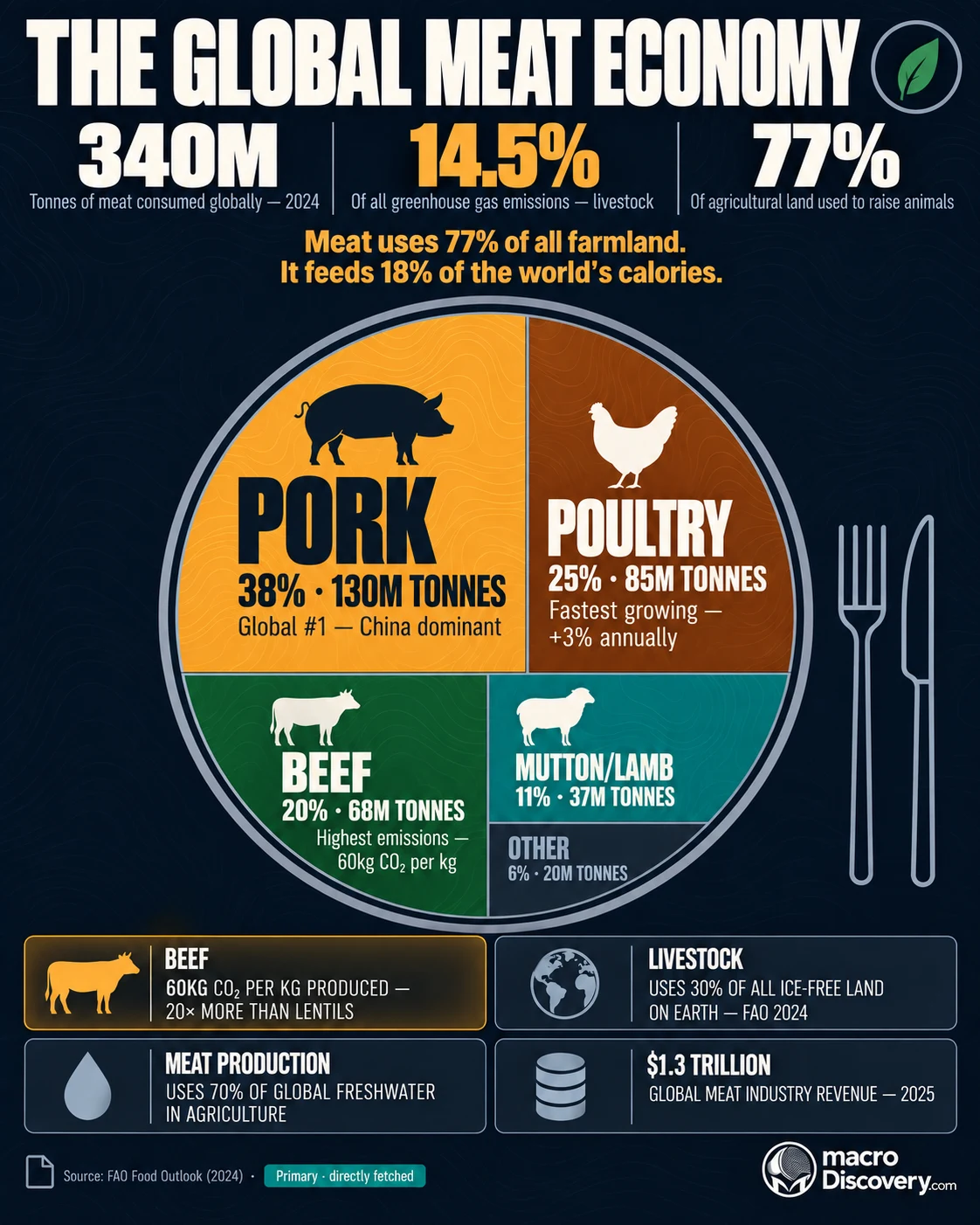
The world eats 340 million tons of meat a year. The planet cannot keep up.
That line is an old production total, not plate intake. FAO’s 2025 carcass count is 387 million tonnes, and it is still rising.
Three numbers
- 387 million tonnes — world meat production in 2025, carcass weight. Not 340 million, and not what people eat. Source: FAO.
- 45 kg — world food-balance supply per person in 2023. The United States was about 122 kg. India was about 8 kg. Source: FAOSTAT.
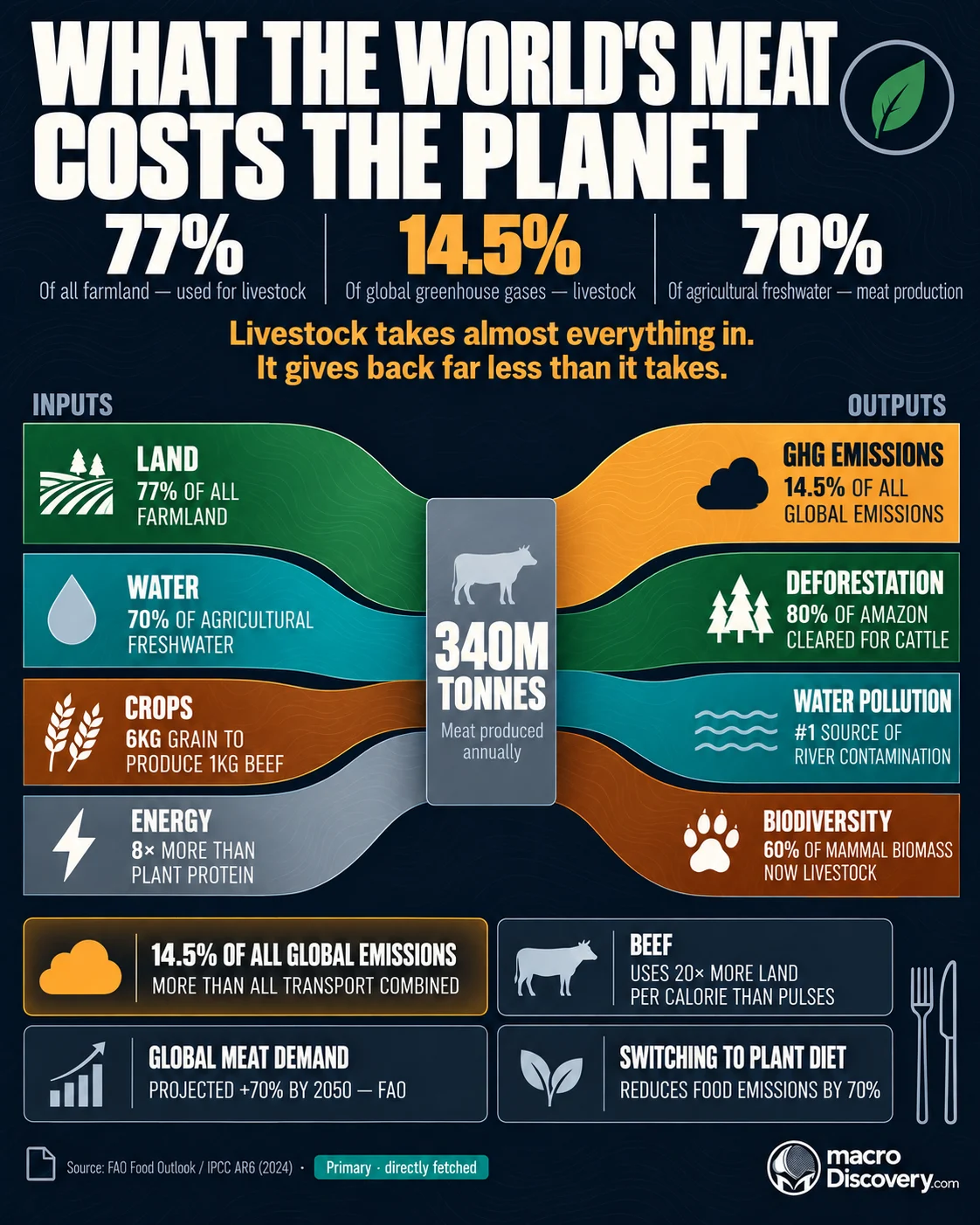
- 12% — livestock agrifood systems’ share of human-caused greenhouse gases in 2015. Source: FAO GLEAM.
What the data shows
A common claim is that the world eats 340 million tons of meat a year, and that the planet cannot keep up. The fact is that 340 million is an older production total, around 2018 to 2020, not a count of food eaten. FAO estimated global meat output at 336 million tonnes in 2018. A 2026 FAO study put 2022 production at 361 million tonnes, up from about 71 million in 1961. The June 2026 Food Outlook puts 2025 output at 387 million tonnes carcass weight, and forecasts 391 million in 2026.
The mix has shifted. Of the 2025 total, poultry is 156 million tonnes, pig meat 129 million, bovine meat 78 million, and ovine meat 19 million. Poultry was the main source of the 2025 rise. The OECD-FAO outlook published in 2025 still projected more carcass output by 2034, with poultry most of the gain. That is the opposite of a ceiling already hit.
Supply is not the same as a meal. FAO food balances for 2023 put world supply at about 45 kg per person. The United States was about 122 kg, China about 71 kg, India about 8 kg, and Nigeria about 7 kg. These figures do not subtract waste at home. Fish is not in the meat total.
Carcass weight includes bone. It is not boneless retail meat, and it is not the weight on a plate.
| Count | Figure | What it is |
|---|---|---|
| FAO production, 2025 | 387 million tonnes | Carcass weight estimate |
| FAO forecast, 2026 | 391 million tonnes | Not a fall |
| FAOSTAT production, 2023 | 367 million tonnes | Poultry 142, pig 125, bovine 68 |
| Food-balance supply, 2023 | 45 kg per person | World average. Not household waste removed |
| GLEAM, 2015 | 6.2 billion tonnes CO2e | About 12% of human-caused emissions |
How it was measured
FAO production is carcass weight equivalent. It includes bone and excludes meat unfit for people. A short ton is about 0.91 metric tonnes. Even if the viral line meant short tons, 340 million of them is about 308 million tonnes. That is further below the current FAO count, not above it.
Food-balance supply starts from production, adds imports, and subtracts exports, feed, seed, and losses, then divides by population. It is food available, not food eaten. GLEAM counts cattle, buffalo, sheep, goats, pigs, and chickens, including feed and some supply-chain steps. The reference year is 2015. Cattle were more than 60% of that livestock total. Meat was about two-thirds of emissions from edible livestock products.
What it means
It is settled that output is about 387 million tonnes and still rising, that poultry is the growth meat, and that supply per person is very uneven. It is not settled that the planet has hit a production stop. FAO’s own warning is emissions: without productivity gains, meeting higher demand could lift livestock emissions from 6.2 billion tonnes of CO2 equivalent in 2015 toward about 9.1 billion by 2050. Use 387 million tonnes for 2025 production. Use 45 kg for average supply. Do not use 340 million tons as what the world eats.
Common misreadings
- This figure is not current, and it is not plate intake. 340 million is an old carcass total.
- A rising total is not proof of no environmental cost. The 12% share is a 2015 emissions count, not a production cap.
- A world average hides the gap. About 122 kg of supply in the United States is not 8 kg in India.
Where the numbers come from
How we built this
- Dataset: FAO Food Outlook June 2026; FAO Meat Market Review April 2026; FAOSTAT 2023 via Destatis; FAO GLEAM 2015.
- Scope: Terrestrial meat only. Fish excluded. Production is carcass weight. Supply is food balance, not household intake.
- Figures: 2025 is an FAO estimate. 2026 is a forecast. The 340 million line is treated as a circa-2020 production total, not a current eaten total.