The Economics of Luxury
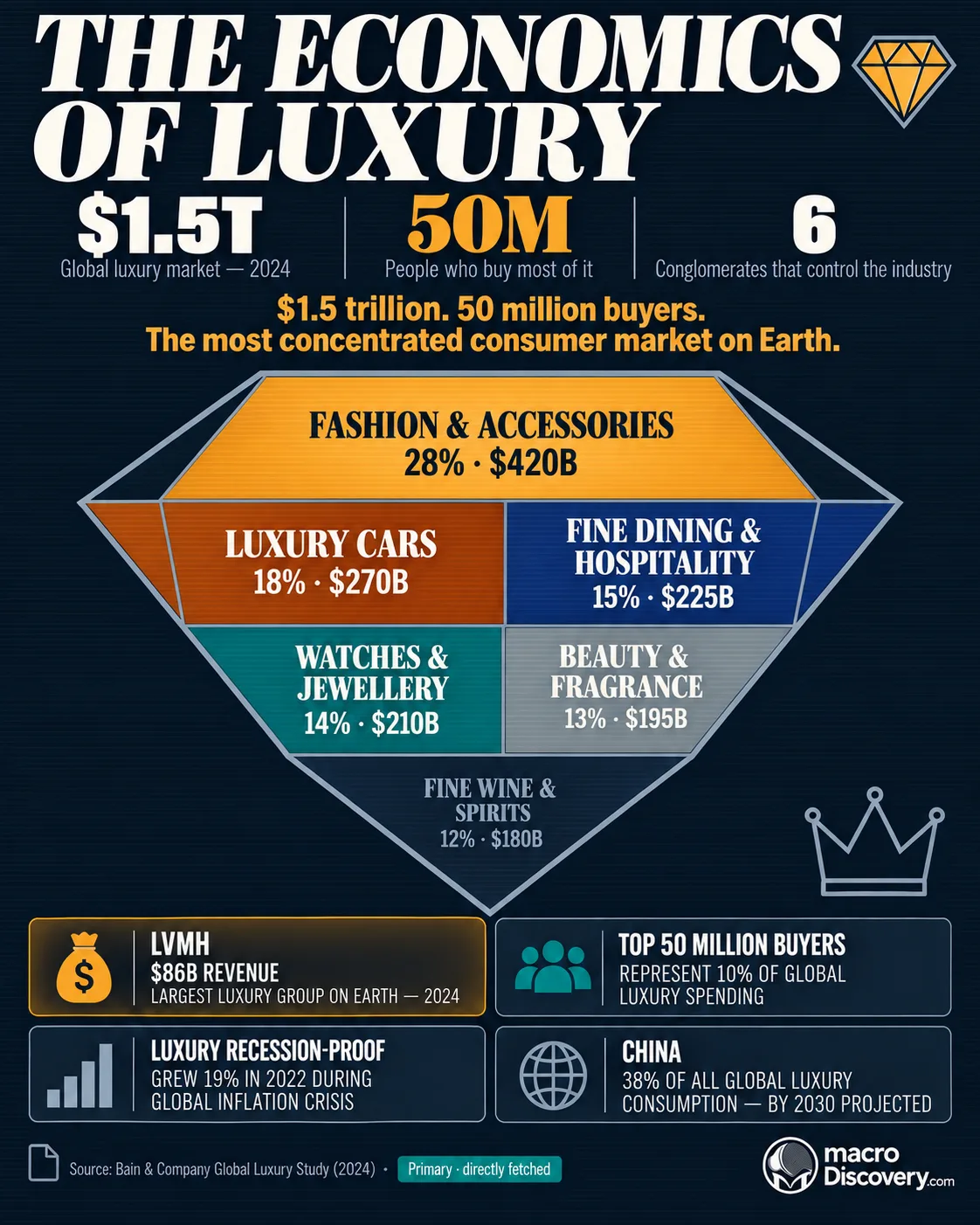
The global luxury market hit $1.5 trillion. Most of it is sold to 50 million people.
The total is about €1.44 trillion in 2025, and it is slightly down. The 50 million figure is customers lost, not the buyer base.
Three numbers
- €1.44 trillion — overall luxury spending in 2025, goods and experiences. Slightly down from €1.48 trillion in 2024. Source: Bain and Altagamma.
- €358 billion — personal luxury goods in 2025. Handbags and watches are not the whole market. Source: Bain and Altagamma.
- 330 million — active luxury customers in 2025, down from 400 million in 2022. The 50 million is a loss, not the base. Source: Bain.
What the data shows
A common claim is that the global luxury market hit $1.5 trillion, and that most of it is sold to 50 million people. The fact is that the $1.5 trillion line is a round dollar reading of a euro total, and the 50 million is customers lost, not the buyer pool. Bain and Altagamma put overall luxury spending at €1.48 trillion in 2024 and €1.44 trillion in 2025, a decline of about 1% to 3% at current exchange rates. The 2025 level was still 12% to 14% above 2019. It was not a fresh peak.
The total is nine segments, not a handbag count. Luxury cars, personal luxury goods, and luxury hospitality together are about 80% of it. Personal luxury goods, the core of the industry, were €364 billion in 2024 and €358 billion in 2025, flat at constant exchange rates. That is about a quarter of the €1.44 trillion, not the whole of it.
The buyer base shrank, and it is still far above 50 million. Bain counted about 400 million active customers in 2022, about 350 million at the end of 2024, and about 330 million in 2025, after another 20 million left. The 50 million figure is the loss from 2022 to 2024. Spending did concentrate. Customers buying more than €20,000 of luxury goods a year held their spending in 2025 and accounted for a little more than 46% of luxury goods sales, up from 30% in 2019. That is a large share of the goods slice. It is not most of a $1.5 trillion market sold to 50 million people.
Active customers are people who bought. Addressable consumers who did not buy are excluded. Bain says only 40% to 45% of the addressable base bought personal luxury goods in 2025.
| Count | Figure | What it is |
|---|---|---|
| Overall luxury, 2025 | €1.44 trillion | Goods and experiences. Slightly down |
| Overall luxury, 2024 | €1.48 trillion | Prior year. Not a 2025 peak |
| Personal luxury goods, 2025 | €358 billion | About a quarter of the total |
| Active customers, 2025 | about 330 million | Down from 400 million in 2022 |
| Top customers’ goods share | a bit over 46% | Buyers of more than €20,000 a year |
How it was measured
Bain and Fondazione Altagamma estimate retail sales value across nine luxury segments. Cars, personal goods, and hospitality dominate the total. Personal goods are apparel, leather, shoes, jewelry, watches, and beauty sold as luxury. A euro total is not a dollar total. At recent rates, €1.44 trillion is above $1.5 trillion. The viral line rounds the other way.
The customer count is active buyers of personal luxury, not millionaires and not the whole addressable market. Bain says 40% to 45% of addressable consumers bought in 2025, down from about 60% in 2022. The top-customer share is goods spending by people buying more than €20,000 a year. It is not a count of 50 million buyers, and it is not a share of the car and hotel total.
What it means
It is settled that the broad market is about €1.44 trillion, that personal goods are about €358 billion, and that the active base fell from 400 million to about 330 million. It is not settled that most of a $1.5 trillion market is sold to 50 million people. Use €1.44 trillion for the broad 2025 market. Use €358 billion for personal goods. Use 330 million for buyers. Use 50 million only as the 2022–2024 loss.
Common misreadings
- This total is not handbags. Cars and hotels are inside the €1.44 trillion.
- Fifty million is a loss, not the buyer base. The 2025 base is about 330 million.
- A 46% share of goods spending is not most of the broad market, and it is not a headcount of 50 million.
Where the numbers come from
How we built this
- Dataset: Bain–Altagamma Luxury Goods Worldwide Market Study, 23rd and 24th editions, plus the spring 2026 update.
- Scope: Global retail sales value. Personal goods separated from cars and experiences. Customer counts are active buyers, not millionaires.
- Figures: Euro figures kept as published. The $1.5 trillion line is treated as a round reading of the broad total. The 50 million line is treated as the 2022–2024 customer loss.