The Global Addiction Economy
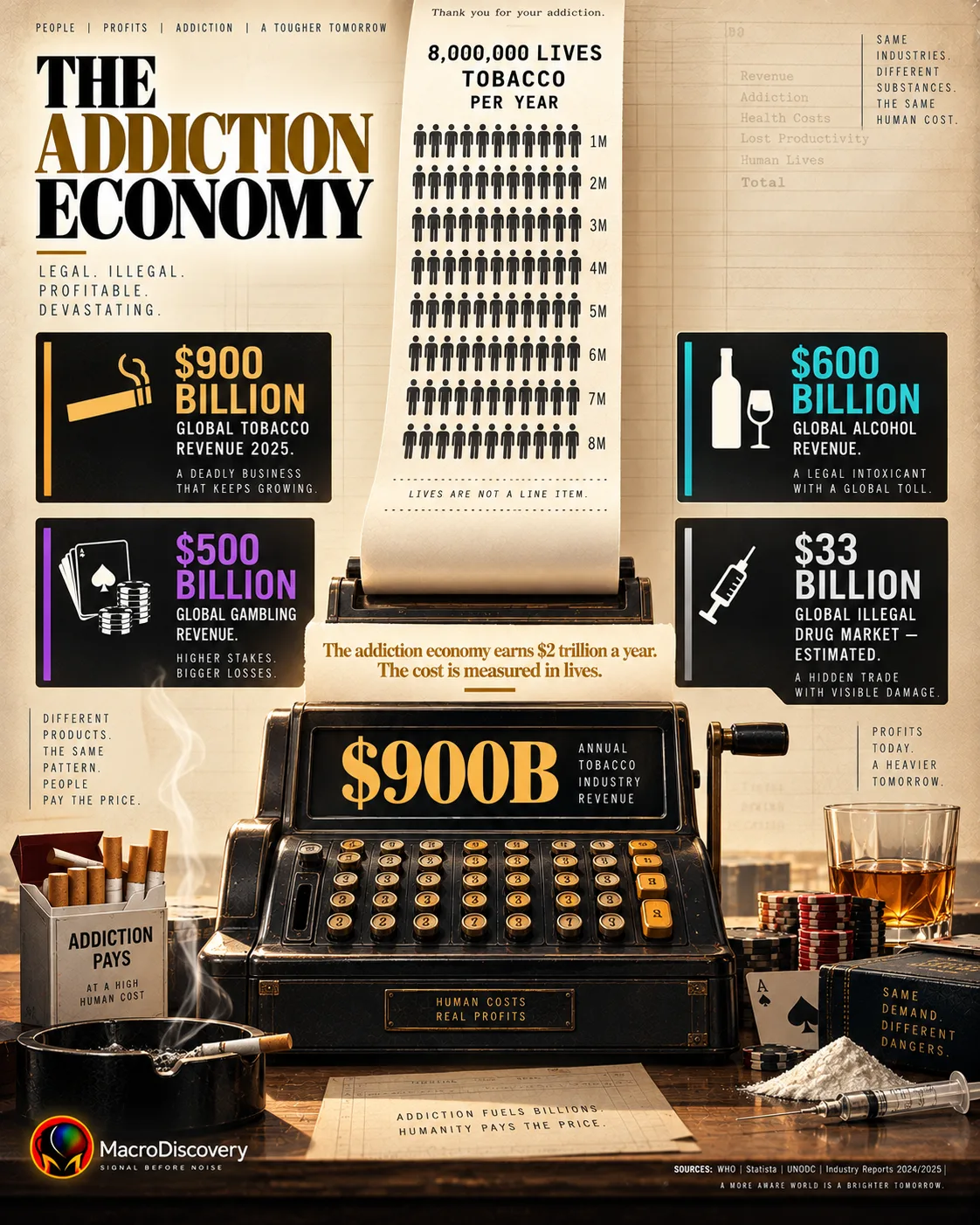
Tobacco kills more than 7 million people a year. The sales book sits near $900 billion. Those are not one number.
The UN still prints “8 million” on campaign days. WHO’s current fact sheet says more than 7 million, including 1.6 million people who never lit the cigarette. The money is a commercial estimate. The deaths are a health estimate. Do not staple them into a price per life.
A packet on a shop counter is a small object. Scale it up and two ledgers appear. One is a morgue. One is a cash register.
WHO’s tobacco-and-nicotine fact sheet, updated June 2026, says tobacco kills more than 7 million people a year. That total includes over 1.6 million non-smokers who breathed someone else’s smoke. About 1.2 billion people still use tobacco. Four in five of them live in low- and middle-income countries.
World No Tobacco Day posts still say “more than 8 million.” That is the older campaign line. We keep both in view. We do not pretend the fact sheet and the poster are the same vintage.
$900 billion is a cluster of private estimates. Not a WHO invoice.
There is no single official “world tobacco GDP.” Commercial researchers disagree on what to count — factory gate, retail, China National Tobacco, vapes, duty-free.
MarketLine put the global tobacco-and-products market at about $844 billion in 2024. Grand View Research put $926 billion in 2025. Statista’s 2026 outlook for tobacco products sits near $1 trillion, with cigarettes alone around $893 billion in that model. The subtitle’s $900 billion is the middle of that band. Treat it as an order of magnitude, labeled “commercial,” not as a treaty statistic.
The FCTC secretariat has used a different, larger figure for losses: social and economic damage around $1.7 trillion in 2022 — about 1.7% of world GDP. That is harm, not shop-till revenue. Another book again.
- —Tobacco deaths / year>7M
- —of which second-hand1.6M
- —Alcohol-attributable deaths2.6M
- —Psychoactive-drug deaths0.6M
Alcohol and drug deaths are WHO 2019. Tobacco is the current fact-sheet total. These causes can overlap in a single life. Do not add them into one “addiction death” headline without that caveat.
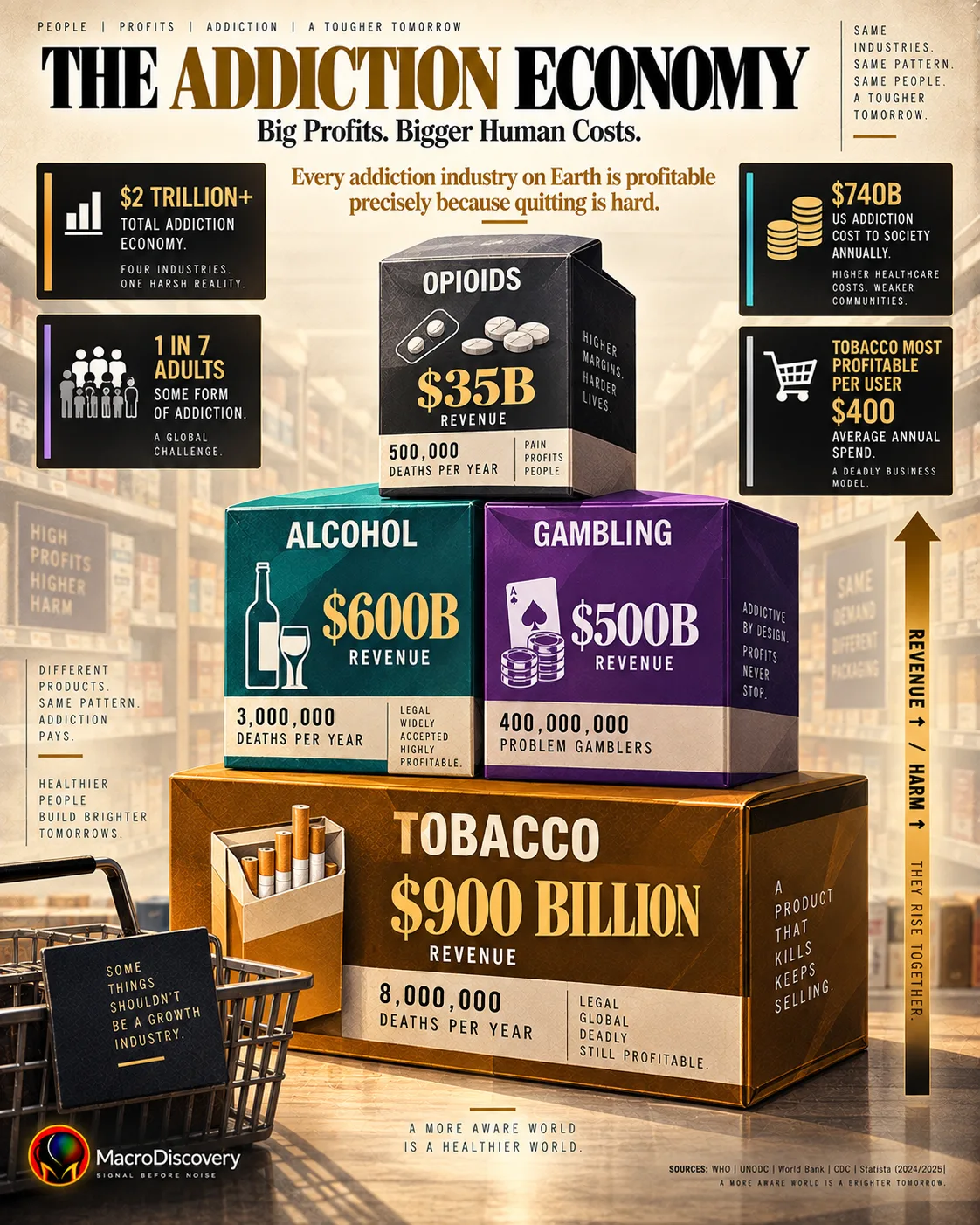
Alcohol and gambling are not a footnote. They are other firms.
WHO’s 2024 alcohol status work (2019 data) attributes 2.6 million deaths a year to alcohol — 4.7% of all deaths that year — and 0.6 million to psychoactive drugs. About 400 million people live with alcohol-use disorders.
Gambling is a sales story more than a death certificate. WHO’s 2024 gambling note cites industry analysts who put global gambling revenue on a path toward $700 billion by 2028, and estimates that about 1.2% of adults have a gambling disorder. People gambling at harmful levels generate around 60% of the losses. That is not tobacco. Do not dump it into the $900 billion cigarette till.
Includes 1.6M second-hand
Campaign posters still say 8 million. We print the fact sheet first.
Commercial, not WHO
$844B (2024) to $926B (2025) to ~$1T product outlooks. Scope differs.
WHO status report
Plus 0.6 million psychoactive-drug deaths. Separate year, separate causes.
FCTC economic harm
Not retail sales. About 1.7% of world GDP that year.
The addiction economy is not one industry. It is several cash registers standing next to one very large graveyard.Macro Discovery reading of WHO and the commercial tobacco book
A dollar of sales is not a dollar of guilt you can divide by seven million
Dividing $900 billion by 7 million deaths spits out a grotesque “price.” That arithmetic is a trick. Sales include tax, retail margin, and a billion-plus users who did not die this year. Deaths include people who never bought a pack. The honest pair is side by side: a preventable death toll that still looks like a mid-size country’s population, and a legal market that remains huge after twenty years of the FCTC.
Prevalence is falling. WHO says use dropped by about a third since the treaty. The death count is still industrial. New nicotine products are the industry’s plan to keep the cash register open after the cigarette peak. Count them later, on their own page, when the death models catch up.
Editorial reading of the WHO tobacco fact sheet (June 2026), the 2024 alcohol status report, the 2024 gambling note, and commercial market sizes. Those bodies did not write this box.If you remember two things
More than 7 million tobacco deaths a year
Including 1.6 million from second-hand smoke. 1.2 billion users. The “8 million” line is campaign language still in circulation.
~$900 billion is a band, not a treaty number
$844B to $926B in recent researcher tallies. FCTC harm estimate ($1.7T) is losses, not turnover.
Short answers
A death sheet and a till
- Tobacco deaths: WHO fact sheet “Tobacco and nicotine,” 26 June 2026 — more than 7 million a year, including over 1.6 million from second-hand smoke; 1.2 billion users.
- 8 million: still used in UN / World No Tobacco Day 2026 campaign copy. Flagged as campaign language.
- Sales band: MarketLine ~$844B (2024); Grand View Research $926B (2025). Headline “~$900B” is that cluster.
- Harm: FCTC materials citing ~$1.7 trillion social and economic losses in 2022.
- Alcohol / drugs: WHO, 2.6 million and 0.6 million (2019).
- Gambling: WHO fact sheet citing ~$700B industry revenue path by 2028; 1.2% adult gambling disorder.