The map of what kills humanity is not fixed. It shifts as populations age, as lifestyles change, as medicines improve, and as pathogens evolve. Two decades of WHO data reveal a world in epidemiological transition: winning against the diseases that killed children in the 20th century, and losing against the diseases that kill adults in the 21st. The picture is neither one of pure progress nor pure regression — it is a transfer of burden.
WHO — “The top 10 causes of death” Fact Sheet · PRIMARY · who.int · directly fetched · August 7, 2024 · WHO Global Health Estimates 2000-2021
9.1M
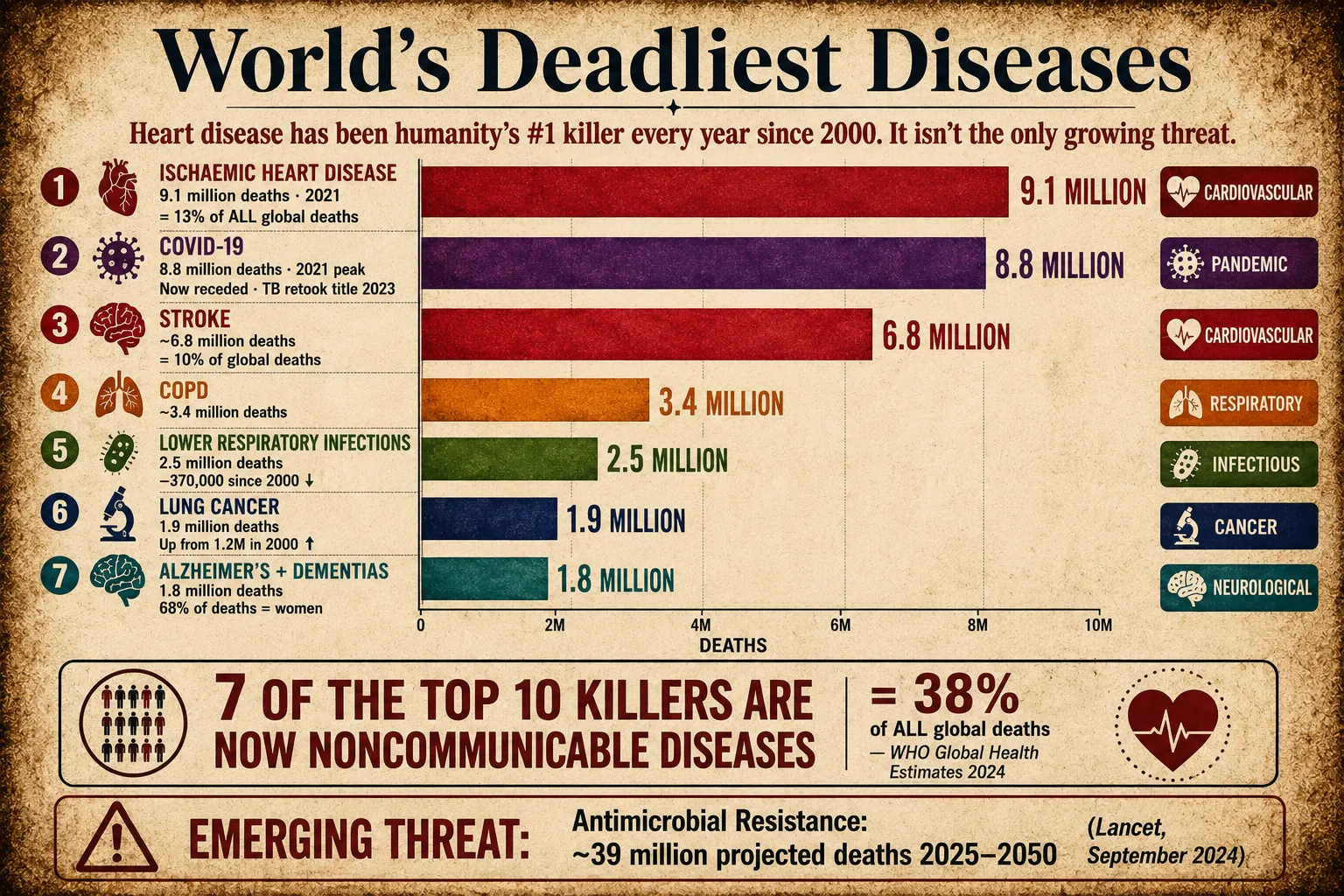
“The world’s biggest killer is ischaemic heart disease, responsible for 13% of the world’s total deaths. Since 2000, the largest increase in deaths has been for this disease, rising by 2.7 million to 9.1 million deaths in 2021.” — WHO primary verbatim. Together, heart disease and stroke account for roughly 23% of all global deaths.
Heart disease kills more people than any other condition — and has done so continuously since the WHO began comprehensive tracking. The 9.1 million deaths in 2021 represent a 42% increase from the roughly 6.4 million deaths attributed to ischaemic heart disease in 2000. The disease is not equally distributed: in high-income countries, IHD deaths have actually fallen 15% since 2000, driven by statins, blood pressure management, improved cardiac care, and declining smoking rates. But in lower-middle-income countries, IHD deaths rose by 1.4 million in the same period — the largest absolute increase of any disease category — as these countries undergo economic development that brings both longer lives and Western-style risk factors. The result is a global total that keeps rising even as wealthy countries make progress. “At a global level, 7 of the 10 leading causes of deaths in 2021 were noncommunicable diseases, accounting for 38% of all deaths, or 68% of the top 10 causes.” — WHO primary verbatim. The epidemiological transition is real: humanity has shifted from dying of infections to dying of lifestyle-driven chronic disease.
Source: WHO — “The top 10 causes of death” Fact Sheet (PRIMARY · directly fetched · who.int/news-room/fact-sheets/detail/the-top-10-causes-of-death · August 7, 2024 · © 2026 World Health Organization · WHO Global Health Estimates 2024, trends 2000-2021 · KEY VERBATIM: “The world’s biggest killer is ischaemic heart disease, responsible for 13% of the world’s total deaths. Since 2000, the largest increase in deaths has been for this disease, rising by 2.7 million to 9.1 million deaths in 2021” · “In 2021, the top 10 causes of death accounted for 39 million deaths, or 57% of the total 68 million deaths worldwide” · “At a global level, 7 of the 10 leading causes of deaths in 2021 were noncommunicable diseases, accounting for 38% of all deaths, or 68% of the top 10 causes” · “As a newly emerged cause of deaths, COVID-19 was directly responsible for 8.8 million deaths in 2021” · “Trachea, bronchus and lung cancers deaths have risen from 1.2 million in 2000 to 1.9 million in 2021” · “Alzheimer’s disease and other forms of dementia ranked as the seventh leading cause of death, killing 1.8 million lives. Women are disproportionately affected. Globally, 68% of deaths from Alzheimer’s and other forms of dementia are women” · “Diabetes was also among the top 10 causes of death, following a significant percentage increase of 95% since 2000” · “kidney diseases have risen from the world’s nineteenth leading cause of death to the ninth, with number of deaths increasing by 95% between 2000 and 2021” · “Deaths from HIV and AIDS have fallen by 61%, moving from the world’s seventh leading cause of death in 2000 to the twenty-first in 2021” · “deaths due to diarrhoeal diseases have dropped by 45%, from sixth leading cause of death in 2000 to thirteenth in 2021” · “Lower respiratory infections…in 2021 it claimed 2.5 million lives, 370,000 fewer than in 2000” · high-income countries: dementias “nearly four-fold since 2000…on track to overtake stroke as one of the top three” · “Deaths from HIV and AIDS…biggest decrease among the top 10 deaths in [low-income countries], with 63% fewer deaths in 2021 than in 2000”)
“The fact that TB still kills and sickens so many people is an outrage, when we have the tools to prevent it, detect it and treat it.”
— Dr. Tedros Adhanom Ghebreyesus, WHO Director-General · WHO Global Tuberculosis Report 2024 (PRIMARY · who.int · October 29, 2024)
The Wealth Divide — In Low-Income Countries, 8 of 10 Killers Are Still Infectious
The global rankings conceal a profound divide. The world average — in which NCDs dominate — reflects a transition that wealthier countries have largely completed. In low-income countries, the picture is entirely different: “8 of the top 10 causes of death in 2021 in low-income countries were communicable diseases.” Lower respiratory infections — not heart disease — was the leading killer. Malaria, tuberculosis, and HIV and AIDS all remained in the low-income top 10. This is the “double burden” problem: middle-income countries face both the unfinished business of infectious disease and the oncoming wave of NCDs simultaneously. Death in the 21st century remains deeply determined by where you were born.
Why it matters: the same resources that could fund clean water, vaccines, and antibiotic access in low-income settings — eliminating diseases that have already been all but eradicated in wealthy countries — are needed in dramatically different proportions than global disease burden would suggest. Most global health funding follows the geography of donor nations, not the geography of need.
WHO — “The top 10 causes of death” Fact Sheet (PRIMARY · directly fetched) + WHO TB Report 2024 (PRIMARY · October 29, 2024) + WHO TB Report 2025 (PRIMARY · 2024 data)
8 of 10
“People living in a low-income country are far more likely to die of a communicable disease than a noncommunicable disease. Despite the global decline, 8 of the top 10 causes of death in 2021 in low-income countries were communicable diseases.” — WHO primary verbatim. And TB, the oldest and most curable of those diseases, killed 1.23 million people in 2024.
The contrast between low-income and high-income country mortality profiles is stark. In high-income countries, ischaemic heart disease, stroke, and Alzheimer’s dominate. In low-income countries, lower respiratory infections, neonatal conditions, diarrhoeal diseases, malaria, tuberculosis, and HIV and AIDS remain among the top killers. Tuberculosis in 2023 was diagnosed in 8.2 million people — “the highest number recorded since WHO began global TB monitoring in 1995” (WHO TB Report 2024, October 29, 2024). In 2024, 1.23 million people died from TB (WHO TB Report 2025 — freshest available data). The net reduction in TB deaths since 2015 has been 29% — real progress. But TB and HIV co-infection compound both diseases; TB is also “the leading killer of people with HIV” (WHO TB 2024). And critically, TB is now “a major cause of deaths related to antimicrobial resistance” — making AMR and tuberculosis increasingly intertwined threats.
Source: WHO — “The top 10 causes of death” Fact Sheet (PRIMARY · directly fetched · verbatim: “People living in a low-income country are far more likely to die of a communicable disease than a noncommunicable disease. Despite the global decline, 8 of the top 10 causes of death in 2021 in low-income countries were communicable diseases” · “Malaria, tuberculosis and HIV and AIDS all remain in the top 10”) · WHO — “Tuberculosis resurges as top infectious disease killer” (PRIMARY · who.int/news/item/29-10-2024-tuberculosis-resurges-as-top-infectious-disease-killer · October 29, 2024 · “In 2023, TB returned to being the world’s leading infectious disease killer, surpassing COVID-19” · “approximately 8.2 million people were newly diagnosed with TB in 2023 – the highest number recorded since WHO began global TB monitoring in 1995” · 1.25 million TB deaths in 2023 · Dr. Tedros: “The fact that TB still kills and sickens so many people is an outrage, when we have the tools to prevent it, detect it and treat it.”) · WHO — Global Tuberculosis Report 2025 (PRIMARY · who.int · 2024 data: “Globally in 2024, an estimated 10.7 million people fell ill with TB and 1.23 million died from the disease. The net reduction in TB incidence from 2015 to 2024 was 12%, and 29% for number of TB deaths over the same period”)
The Shadow Threat — Antimicrobial Resistance Could Kill 39 Million by 2050
Antimicrobial resistance does not yet appear in the WHO top 10 causes of death — but it is reshaping every list that does. It threatens to reverse the gains against lower respiratory infections, which have declined steadily since 2000. It amplifies TB, which is already “a major cause of deaths related to antimicrobial resistance” (WHO TB 2024). And the Lancet’s landmark study published September 28, 2024 — analysing 22 pathogens and 84 pathogen-drug combinations across 204 countries — projects a 69.6% rise in direct AMR deaths from 2022 to 2050, accumulating approximately 39 million preventable deaths over that period. These are not exotic new diseases. They are ordinary infections — pneumonia, urinary tract infections, wound infections, bloodstream infections — made deadly because the bacteria causing them no longer respond to available antibiotics.
Why it matters: antibiotic resistance is not a future problem. The 1.27 million direct AMR deaths recorded in 2019 already place antimicrobial resistance among the top 15 causes of death globally. By 2050, the Lancet projects it rises among the top five. Overuse of antibiotics in medicine and agriculture is accelerating the problem faster than new drugs are being developed to address it.
Lancet — “Global burden of bacterial antimicrobial resistance 1990-2021: a systematic analysis with forecasts to 2050” (PRIMARY · PMID 39299261 · September 28, 2024)
39M
Approximately 39 million cumulative deaths attributable directly to antimicrobial resistance projected between 2025 and 2050 — a 69.6% rise from 2022. In 2019, AMR already caused approximately 1.27 million direct deaths. By 2050, direct AMR deaths projected to reach nearly 2 million per year.
The Lancet study analysed 22 pathogens and 84 pathogen-drug combinations across 204 countries and territories. The projected 69.6% rise in AMR deaths from 2022 to 2050 is driven primarily by ageing populations (65.9% of all AMR deaths in 2050 will be among those aged 70 and older) and the continued spread of resistant strains without commensurate development of new antibiotics. South Asia and Latin America and the Caribbean are projected to have the highest all-age AMR mortality rates by 2050. The associated death toll — including deaths where AMR contributed but was not the direct cause — reaches 169 million over the same period. The WHO TB Report 2024 confirms that TB is already “a major cause of deaths related to antimicrobial resistance,” and drug-resistant TB (MDR-TB) incidence surged 743.2% in sub-Saharan Africa between 1990 and 2021. The threat is not hypothetical: it is already measurable in the mortality data.
Source: Lancet — “Global burden of bacterial antimicrobial resistance 1990-2021: a systematic analysis with forecasts to 2050” (PRIMARY · published September 28, 2024 · PMID 39299261 · doi: 10.1016/S0140-6736(24)01885-3 · “cumulative deaths averted” analysis by Institute for Health Metrics and Evaluation · “Increases in deaths attributable to AMR will be largest among those 70 years and older (65.9% [61.2-69.8] of all-age deaths attributable to AMR in 2050)” · “In stark contrast to the strong increase in number of deaths due to AMR of 69.6% (51.5-89.2) from 2022 to 2050” · “Super-regions with the highest all-age AMR mortality rate in 2050 are forecasted to be south Asia and Latin America and the Caribbean” · ~1.27M direct AMR deaths 2019 from earlier Lancet 2022 study PMID 35065702) · WHO TB Report 2024 (PRIMARY · who.int · October 29, 2024 · “In 2023, TB…was also…a major cause of deaths related to antimicrobial resistance”)