Mapped: The Geography of
Global Poverty
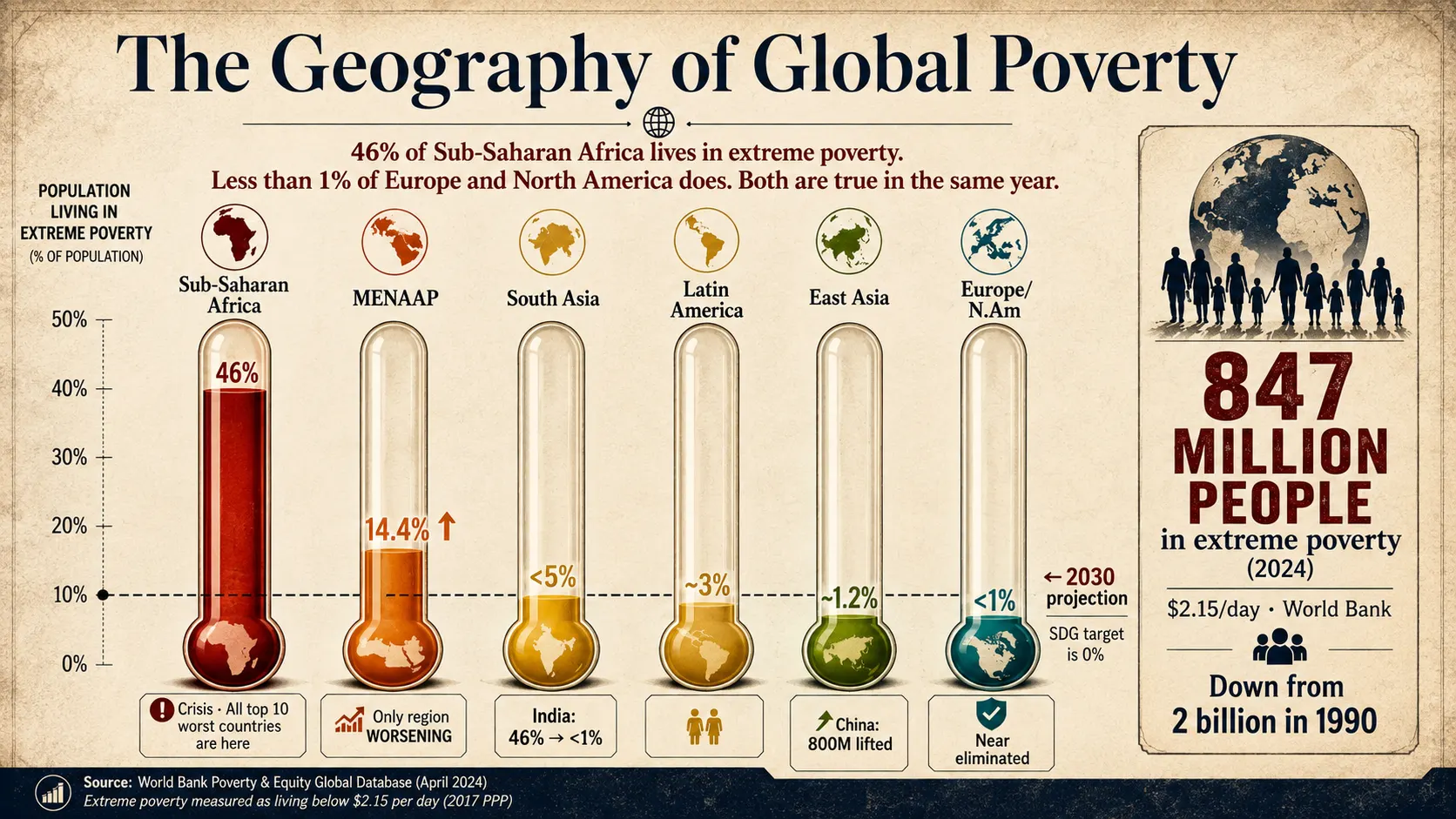
847 million people live in extreme poverty as of 2024 — surviving on less than $2.15 a day. That number fell from nearly 2 billion in 1990. But progress has stalled. The global rate is only three percentage points below where it was in 2015. Just two world regions account for almost all of it. The Democratic Republic of the Congo holds 85% of its people in extreme poverty — and 75% of the world’s cobalt.
Extreme poverty rate (% living below $2.15/day, 2017 PPP) by world region, 2024. The World Bank confirms: “all but two regions have extreme poverty rates below 5 percent.” Bars scaled to Sub-Saharan Africa’s 46% rate. Tap any row for details. Sources: World Bank PIP — March 2026 Update (PRIMARY · blogs.worldbank.org · directly fetched · March 26, 2026) · World Bank PIP — September 2025 Update (PRIMARY) · UN SDG Progress Report 2026 (PRIMARY).
The global poverty rate has fallen dramatically since 1990. But the pace has slowed sharply since COVID, and the remaining 10% is concentrated in the world’s hardest-to-reach places. Sources: World Bank PIP (PRIMARY · March 26, 2026 · directly fetched) · UN SDG Progress Report 2026 (PRIMARY · unstats.un.org) · World Bank Poverty and Prosperity Report 2024.
Poverty is not evenly distributed. That is the most important fact about it. The reduction from 36% to 10% since 1990 represents one of humanity’s most significant achievements. But the geography of the remaining 10% is stark. It is concentrated in places defined by conflict, climate vulnerability, and extractive economies that generate wealth without distributing it. The DRC is the most extreme example.
“The global extreme poverty rate stands at 10 per cent in 2026, only three percentage points below 2015 averages.”
— UN SDG Progress Report 2026 (PRIMARY · unstats.un.org/sdgs/report/2026/Goal-01/ · 2026)The Resource Curse — The DRC Has 85% Poverty and 75% of the World’s Cobalt
The Democratic Republic of the Congo is the starkest illustration of a development paradox. It has the world’s highest extreme poverty rate — 85.3% of its population living on less than $2.15 a day — and the largest absolute number of people in extreme poverty of any country: 76.2 million. At the same time, the DRC produces approximately 75% of the world’s cobalt. Cobalt is essential for the lithium-ion batteries that power smartphones, electric vehicles, and AI data centres. The DRC holds the resources that are driving the clean energy transition — yet its people are the world’s poorest. Weak governance, armed conflict spanning decades, and multinational extraction without domestic value creation explain the gap. The DRC is not poor because it lacks resources. It is poor because those resources have been extracted without building the institutions, infrastructure, or legal frameworks that translate natural wealth into human wellbeing.
What Actually Works — and Why China’s 800 Million Cannot Simply Be Repeated
The largest poverty reduction in human history came from economic growth. China’s manufacturing sector absorbed hundreds of millions of rural workers into formal employment. Export-led growth generated tax revenue that funded rural health and education. Urbanisation created productivity gains. The Chinese government also ran targeted poverty programmes in the final phase, including transferring hundreds of millions of people above the poverty line through direct intervention. The lesson is not that any country can replicate China’s specific model. It is that sustained economic growth — the kind that generates employment for low-skill workers — remains the primary mechanism for reducing extreme poverty. The regions failing on poverty are largely those where economic growth is slow, informal, or captured by elites. The UNDP’s multidimensional poverty measure — which counts 1.1 billion people as poor when incorporating health, education, and living standards alongside income — extends the picture. Many of those 1.1 billion live in countries where income growth has occurred but health systems, schools, and clean water still fail.