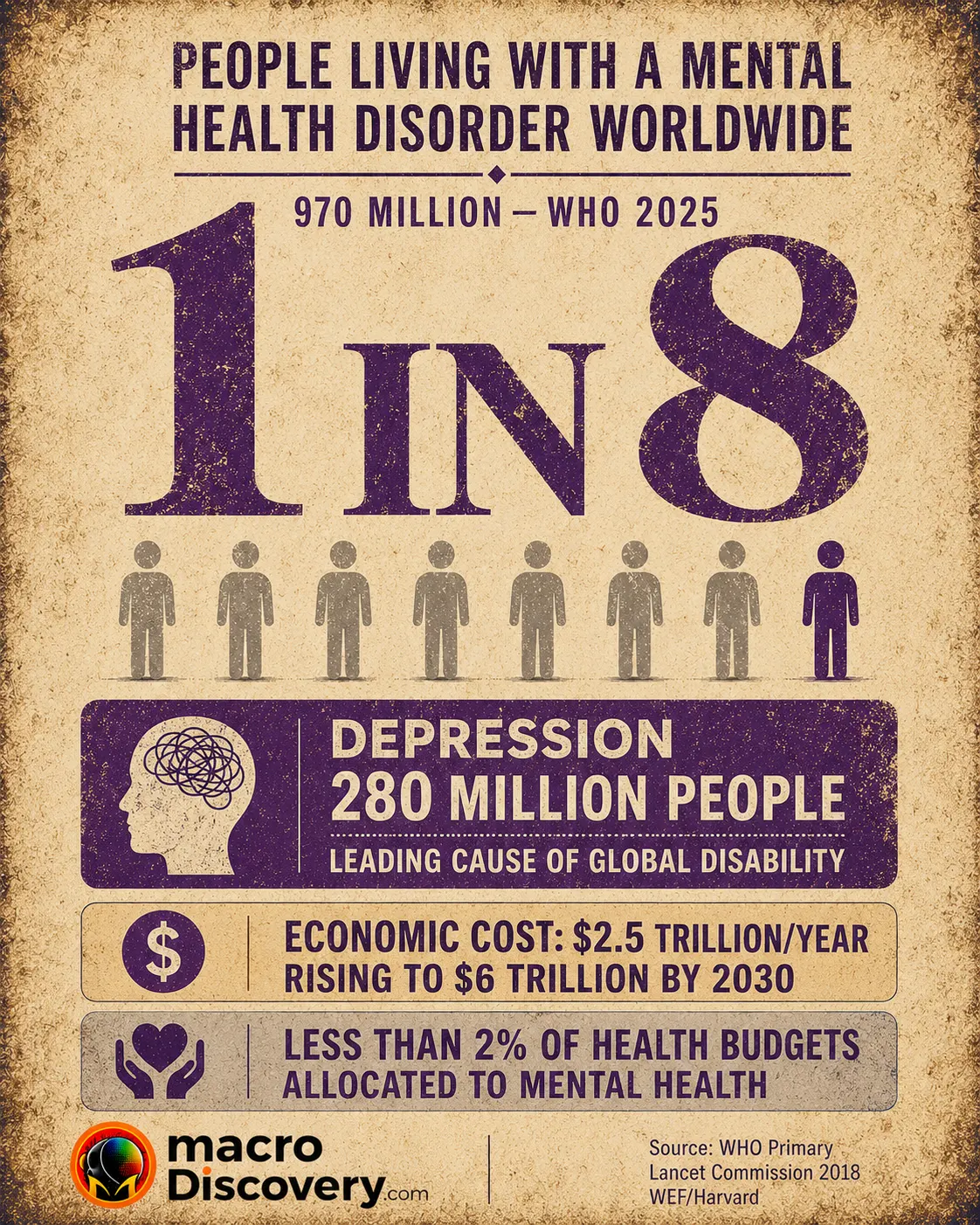
The Global Mental Health Crisis —
Data, Geography, and Economic Cost
Depression is now the world’s leading cause of disability, affecting 280 million people. Mental health conditions cost the global economy an estimated $2.5 trillion per year — projected to reach $6 trillion by 2030. The countries with the highest rates are not the poorest. They are middle- and high-income countries with high urban density, intense work cultures, and declining community structures. South Korea, Japan, and the United States rank among the highest. Governments have begun responding — but less than 2% of health budgets globally are allocated to mental health.
| Country / Region | Key indicator | Specific burden | Government response | Status |
|---|---|---|---|---|
| 🇺🇸 United States | ~50% adults lonely (2023); high depression rates | $6.7B excess Medicare spending from loneliness alone. Depression among top 3 causes of disability. | Surgeon General Vivek Murthy declared loneliness an epidemic (May 2023). National Strategy to Advance Social Connection launched. | Advisory issued |
| 🇰🇷 South Korea | Highest OECD suicide rate. Severe youth isolation crisis. | ~290,000 reclusive youth (hikikomori-equivalent). High academic and workplace pressure culture. | 2023: Government isolation support programs, including monthly payments (~$500/month) for severely isolated young people to re-engage with society. | Intervention 2023 |
| 🇯🇵 Japan | 1.46 million hikikomori (2022 Cabinet Office). Karoshi (death from overwork) documented. | Combination of social withdrawal, workplace pressure, and demographic loneliness among elderly population. | February 2021: Japan appointed world’s second Minister of Loneliness (Tetsushi Sakamoto) — following the UK in 2018. | Minister 2021 |
| 🇬🇧 United Kingdom | Significant loneliness and mental health burden. | Mental health accounts for ~7% of all ill health. Economic cost growing rapidly. | January 2018: World’s FIRST Minister for Loneliness appointed (Tracey Crouch) following the Jo Cox Commission on Loneliness. | First in world 2018 |
| 🇺🇸 Low-income countries | ~23% of population; but lowest treatment access. | Mental health spending: $0.04 per person per year (vs $65.89 in high-income). 75%+ receive no treatment. | Lancet Commission 2018 called this the largest treatment gap in all of medicine. WHO Comprehensive Action Plan targets 20% improvement. | Severe gap |
| 🌍 Global | 970M total (1 in 8). COVID-19 added +25% in 2020. | $2.5T (2010) → $6T/yr (2030 projection). Depression+anxiety alone: $1T/yr in economic losses. | WHO Commission on Social Connection (2023, Murthy co-chair). Less than 2% of health budgets currently allocated to mental health. | ▲ Rising |
Sources: US: Surgeon General’s Advisory 2023 (hhs.gov, primary). South Korea: Global Wellness Summit (2023) + Korean Ministry of Health and Welfare. Japan: Cabinet Office Survey 2022 + Minister appointment Feb 2021. UK: Minister for Loneliness appointment Jan 2018 (DCMS). Spending gap: WHO Mental Health Atlas 2024. Global economic burden: WEF/Harvard 2011, cited in Lancet Commission 2018. $1T/yr: WHO Strategic Direction for Mental Health (who.int).
Why Depression Is Now the Leading Cause of Disability — Not Disease, Not Injury
The WHO classifies depression as the single leading contributor to disability worldwide measured in years lived with disability (YLDs) — a metric that captures how much of human life is spent impaired rather than healthy. 280 million people currently live with depression (WHO Fact Sheet, GBD 2021), including 23 million children and adolescents. Anxiety disorders affect a further 301 million. Together they account for approximately 60% of all mental health disorder cases globally. The COVID-19 pandemic accelerated this trajectory sharply: depression and anxiety rates rose by 25–28% in 2020 alone, adding 53 million new depression cases and 76 million new anxiety cases in a single year. By 2030, WHO projects depression will be the leading cause of global disease burden — surpassing cardiovascular disease and cancer in total disability-adjusted life years.
Why it matters: depression’s ranking above physical diseases as the leading cause of disability reflects a fundamental shift in what is making humanity unable to function.
The Wealthy Country Paradox — Why South Korea, Japan, and the US Rank Among the Worst
The intuitive assumption — that mental health disorders track with poverty — does not hold in the data. High-income, high-density, high-achievement societies consistently report among the highest rates of depression, anxiety, and suicide. South Korea has the highest suicide rate of any OECD member and an estimated 290,000 reclusive young people. Japan has documented 1.46 million people in severe social withdrawal (Cabinet Office, 2022) and gave the phenomenon a name — hikikomori — before most countries acknowledged it existed. Portugal has the world’s highest anxiety rate at 13.3% of the population (WHO/IHME), followed by Brazil (12.4%) and Iran (12.3%). The drivers are common: urban isolation, workplace intensity, declining community and religious structures, and the displacement of in-person connection by screen interaction.
Why it matters: treating mental health as a problem of poverty misses the populations actually most affected — and the policies needed to address it.
What Vivek Murthy’s 2023 Advisory Actually Said — and Why It Matters Beyond the US
In May 2023, US Surgeon General Vivek Murthy issued an 82-page advisory titled “Our Epidemic of Loneliness and Isolation,” calling social disconnection a public health crisis. The advisory documented that approximately half of US adults reported experiencing loneliness — a figure that predated the COVID-19 pandemic. It established that loneliness carries a risk of premature death equivalent to smoking up to 15 cigarettes a day, and raises the risk of premature death by 26–29%. Murthy stated: “We have an opportunity, and an obligation, to make the same investments in addressing social connection that we have made in addressing tobacco use, obesity, and the addiction crisis.” By November 2023, the WHO appointed Murthy co-chair of its Commission on Social Connection — the first global initiative of its kind.
United Kingdom (2018): World’s first Minister for Loneliness appointed following the Jo Cox Commission on Loneliness. The position recognises loneliness as a public health issue requiring dedicated policy coordination across housing, transport, and community services.
Japan (2021): Appointed Tetsushi Sakamoto as Minister of Loneliness — the world’s second such position — in response to a documented crisis of hikikomori (social reclusion) affecting an estimated 1.46 million people, and rising suicide rates among women accelerated by pandemic conditions.
South Korea (2023): Introduced isolation support programs including monthly payments of approximately $500 per month for severely isolated young people, aimed at re-engagement with social life. The government estimates approximately 290,000 reclusive young people require targeted support.
All three interventions share a structural recognition: that loneliness is not a personal failing but a systemic public health condition requiring government action — the same logic applied to tobacco, obesity, and addiction.
Sources: UK DCMS (2018) · Japanese Cabinet Office (2021, 2022) · Global Wellness Summit citing Korean Ministry of Health (2023).
Why it matters: when a Surgeon General, the WHO, and governments in three countries simultaneously declare loneliness a public health emergency, the evidence threshold has been reached.
The Treatment Gap — Why 75% of People Who Need Help Receive None
The Lancet Commission on Global Mental Health and Sustainable Development (Patel V et al., 2018) identified the mental health treatment gap as the largest in all of medicine: more than 75% of people in low- and middle-income countries who require treatment receive none. The economic cost of this inaction is measured in the gap between health spending and burden: high-income countries spend an average of $65.89 per person on mental health annually; low-income countries spend $0.04 — a difference of 1,647 times. Less than 2% of global health budgets are allocated to mental health, despite mental health conditions accounting for 16% of all disability-adjusted life years globally (Harvard/eClinicalMedicine, 2022). The result is a $2.5 trillion annual burden projected to nearly triple by 2030 without systemic investment.
Why it matters: the global mental health treatment gap is not a knowledge gap — effective treatments exist — it is a funding and priority gap that has been documented and unaddressed for decades.
- 970 million people — 1 in 8 globally — live with a mental health disorder; depression affects 280 million and is the leading cause of disability (WHO, GBD 2021).
- The COVID-19 pandemic increased depression and anxiety rates by 25–28% in 2020, adding 53 million new depression cases and 76 million new anxiety cases in a single year (Lancet, 2021).
- The economic cost was $2.5 trillion in 2010 and is projected to reach $6 trillion annually by 2030 (WEF/Harvard School of Public Health, cited in Lancet Commission 2018).
- The highest anxiety rate in the world is in Portugal at 13.3%, followed by Brazil and Iran — not the countries most people would predict (WHO/IHME).
- Loneliness carries a mortality risk equivalent to smoking 15 cigarettes a day, raising the risk of premature death by 26–29% (US Surgeon General’s Advisory 2023, primary).
- The UK (2018), Japan (2021), and South Korea (2023) have each created formal government structures specifically to address loneliness and social isolation.
- Less than 2% of global health budgets are allocated to mental health, while high-income countries spend 1,647 times more per person than low-income countries (WHO Mental Health Atlas 2024).
The global mental health crisis is not an emerging problem. The data has been clear for decades: 970 million people affected, depression overtaking cancer and heart disease as the leading cause of years lost to disability, $2.5 trillion in annual economic loss, and a treatment gap in which three-quarters of those who need help receive none. What is emerging is the recognition — now official in the US, the UK, Japan, South Korea, and the WHO — that loneliness is a disease vector, not a mood. The cost of continuing to underfund mental health is not just human. It is measurable in trillions, and it is compounding.
- WHO — Fact Sheet: Mental Disorders (primary · who.int · updated 2025 · “In 2019, 280 million people were living with depression” · GBD 2021 IHME cited · 970M total = 1 in 8 · 301M anxiety · suicide 700,000/yr)
- WHO — Global Strategic Direction for Mental Health (primary · “depression and anxiety alone associated with up to US$1 trillion per year in economic losses” · “depression ranked as second largest contributor to global disability 5.6% of all YLDs in 2019” · <2% of health budgets)
- Patel V et al. — Lancet Commission on Global Mental Health and Sustainable Development (primary · Lancet 2018 · 392:1553–1598 · doi:10.1016/S0140-6736(18)31612-X · largest treatment gap in medicine · 75%+ in LMICs receive no treatment · cites WEF/Harvard $2.5T→$6T economic burden)
- World Economic Forum — Mental Health Strategic Intelligence (primary · “cost of mental health conditions projected to rise to $6 trillion globally by 2030 from $2.5 trillion in 2010” · WEF/Harvard School of Public Health source · high-income countries bear more than half the cumulative cost)
- US Surgeon General Vivek Murthy — “Our Epidemic of Loneliness and Isolation” (primary · hhs.gov · 2023 · 82-page advisory · ~50% of US adults lonely · loneliness = 15 cigarettes/day mortality risk · +26–29% premature death risk · $6.7B excess Medicare spending · 6-pillar National Strategy)
- Global Wellness Summit — Governments Ramp Up the War on Loneliness (2023 · Murthy advisory confirmed May 2023 · South Korea $500/month program for isolated youth confirmed · UK Minister for Loneliness 2018 · Japan Minister 2021)
- Al Jazeera — Mental Health Statistics Worldwide (May 21, 2026 · WHO/IHME basis · Portugal 13.3% anxiety #1 globally · Brazil 12.4% · Iran 12.3% · WHO Mental Health Atlas 2024 spending data: $0.04 low-income vs $65.89 high-income per capita)