The Malnutrition Paradox
2 billion people are overweight. 800 million are underfed. Both are rising.
Adult overweight is 2.5 billion, not 2 billion. Hunger in 2024 was 673 million, and it fell. The two trends are not the same.
Three numbers
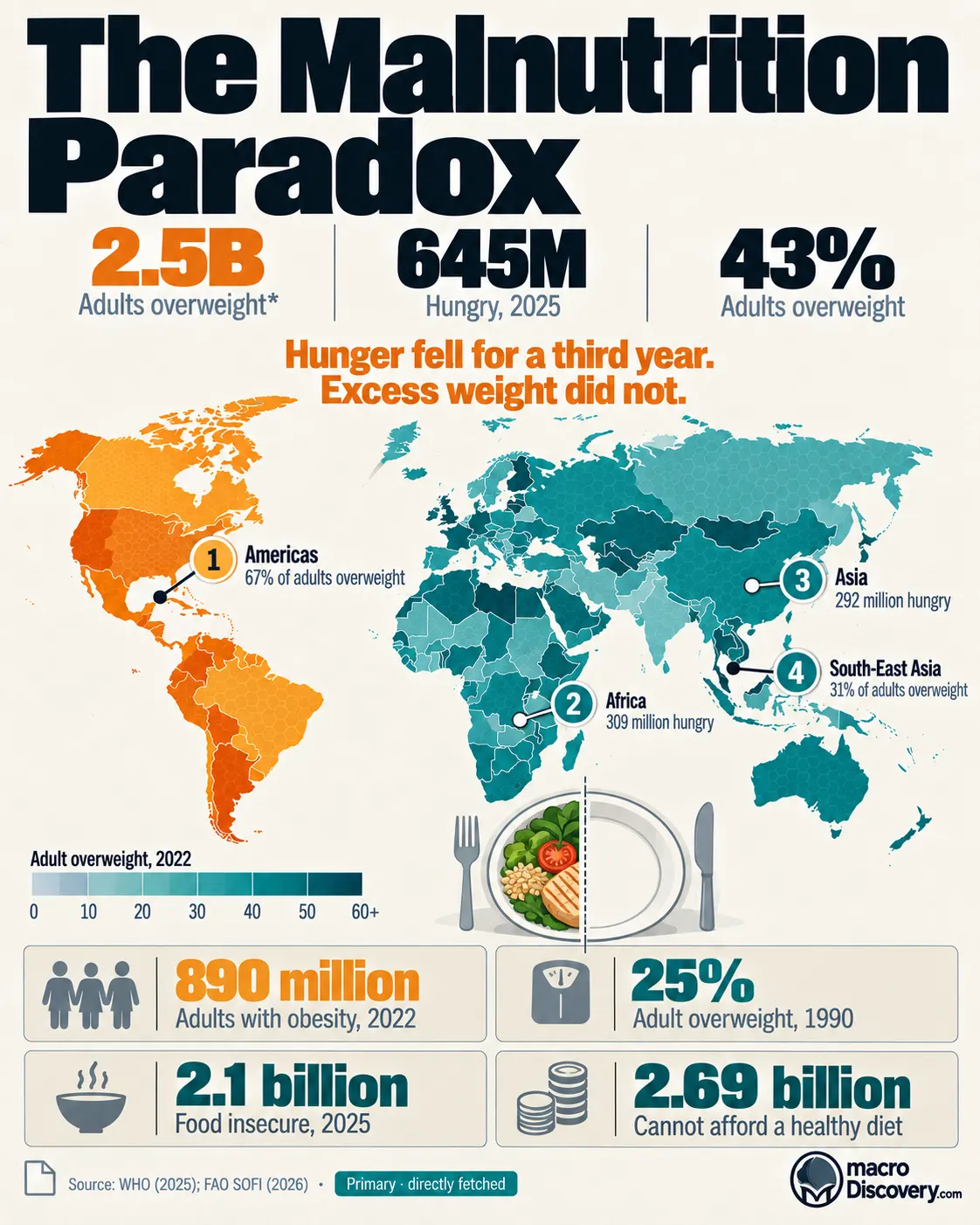
- 2.5 billion — overweight adults in 2022. Of these, 890 million were living with obesity. Source: WHO.
- 673 million — people facing hunger in 2024, 8.2% of the world. Down from 2023. Source: SOFI 2025.
- 15.8% — adult obesity in 2022, up from 12.1% in 2012. Source: SOFI 2025.
What the data shows
A common claim is that 2 billion people are overweight, 800 million are underfed, and both are rising. The fact is that the overweight count is higher, the hunger count is lower, and only one of the two is rising worldwide. WHO counted 2.5 billion overweight adults in 2022, 43% of adults, up from 25% in 1990. Of those adults, 890 million were living with obesity. Another 390 million children and adolescents aged 5 to 19 were overweight, including 160 million with obesity. The 2 billion line leaves out about 500 million adults.
Hunger is not 800 million, and it is not rising globally. SOFI 2025, from FAO, IFAD, UNICEF, WFP, and WHO, puts hunger at 673 million people in 2024, within a range of 638 to 720 million. That is 8.2% of the world, down from 8.5% in 2023 and 8.7% in 2022, about 22 million fewer people than in 2022. The 800 million line matches an older, higher year. The count is still above the pre-pandemic level. It is rising in Africa, where 307 million people, more than one in five, faced hunger in 2024, and in western Asia, about 39 million. It fell in Asia as a whole and in Latin America.
The two measures are not opposites. Adult obesity rose from 12.1% in 2012 to 15.8% in 2022. Child overweight was almost flat, 5.5% in 2024 against 5.3% in 2012. Moderate or severe food insecurity, a wider count than hunger, covered 2.3 billion people in 2024, about 336 million more than in 2019. A person can be food insecure and overweight. Not being able to afford a healthy diet covered 2.6 billion people in 2024. That number has fallen since 2019 globally, and worsened in Africa.
Overweight is a different stock: 2.5 billion adults in 2022. It is not drawn on this hunger scale.
| Count | Figure | What it is |
|---|---|---|
| Overweight adults, 2022 | 2.5 billion | WHO. 890 million of them with obesity |
| Hunger, 2024 | 673 million | SOFI point estimate. Range 638–720 million |
| Hunger change, 2022–2024 | about −22 million | Global fall. Still rising in Africa |
| Adult obesity, 2022 | 15.8% | Up from 12.1% in 2012 |
| Food insecurity, 2024 | 2.3 billion | Moderate or severe. Not the hunger count |
How it was measured
Hunger in SOFI is the prevalence of undernourishment: a model of whether usual calories fall short of needs. It is a point inside a range, not a headcount from a census. Overweight in WHO is a body-mass cutoff. For adults, overweight starts at a body-mass index of 25, and obesity at 30. The two cutoffs are not the same condition, and a country can have both.
Food insecurity is a survey of access, not a calorie model. Moderate or severe food insecurity is wider than hunger. Child overweight is a separate series and has been nearly flat since 2012. Do not add the adult and child overweight figures into one “2 billion” and call it the whole stock.
What it means
It is settled that 2.5 billion adults were overweight in 2022, and that 673 million people faced hunger in 2024. It is not settled that both stocks are the viral sizes, or that both are rising. Use 2.5 billion for overweight adults. Use 673 million for hunger in 2024. Use 15.8% for the obesity rise. Do not use 800 million as the current hunger count.
Common misreadings
- The hunger count is 673 million, not 800 million. The global number fell in 2024.
- Overweight adults are 2.5 billion. Obesity is the 890 million subset, not the whole stock.
- Food insecurity, 2.3 billion, is not hunger. A person can be in both the overweight and the food-insecure counts.
Where the numbers come from
How we built this
- Dataset: WHO overweight fact sheet, 2022 adult and child figures; SOFI 2025 hunger, obesity, and food-insecurity estimates.
- Scope: Hunger is undernourishment. Overweight is a body-mass cutoff. Food insecurity is kept as a separate count and not added to hunger.
- Figures: 2.5 billion is overweight adults. 673 million is the 2024 hunger point estimate. 15.8% is adult obesity in 2022. The 800 million line is treated as stale.