Visualized: The Economics
of Fast Fashion
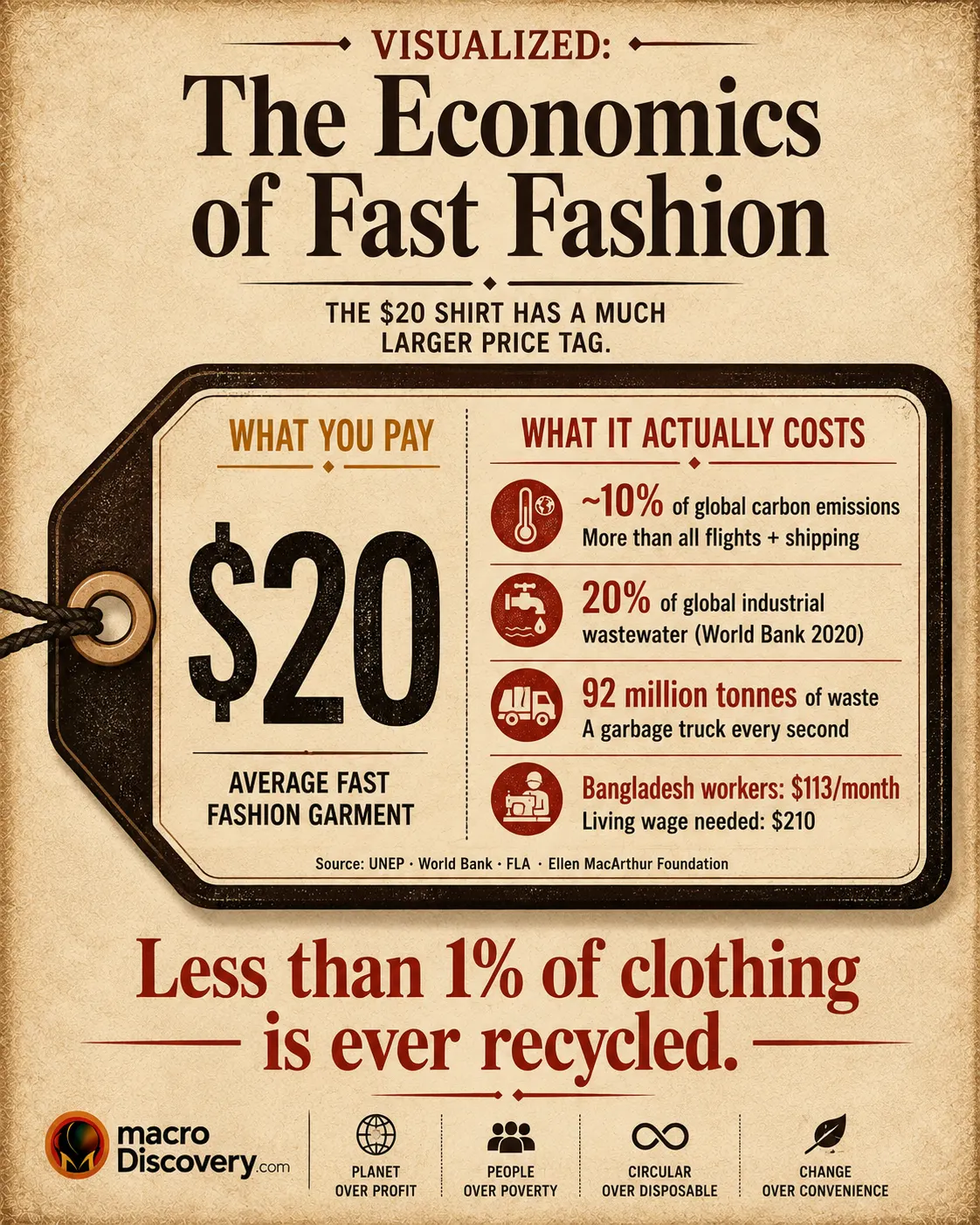
A $20 shirt. Worn seven times. Discarded in a landfill. The fashion industry generates roughly 10% of global carbon emissions — more than all international flights and shipping combined. 92 million tonnes of clothing waste every year. Garment workers earning $113 a month while a living wage costs $210. Here is the full price tag.
Key environmental metrics of the global fashion industry. The price tag on your clothes covers none of these costs. Source: UNEP (primary · unep.org · directly fetched) · Global Fashion Agenda (UNEP partner) · World Bank 2020 (wastewater) · Ellen MacArthur Foundation 2017 (recycling, material value) · UNEP Zero Waste Day 2025 press release (waste projection).
The full lifecycle of a fast fashion garment — from a Shein algorithm to a Chilean desert landfill. Source: UNEP (primary) · Business of Apps · Bangladesh Minimum Wage Board (Dec 2023) · Fair Labor Association (primary).
Fast fashion’s business model is simple: make it cheap, make it fast, sell a lot of it, and let someone else deal with the consequences. The consequences are the carbon, the water, the waste, and the suppressed wages that do not appear on the price tag. This article is a price tag for what the price tag leaves out.
“People are buying 60 per cent more clothes and wearing them for half as long.”
— United Nations Environment Programme (UNEP), unep.orgThe Living Wage Gap — $113 vs $210 a Month
In December 2023, Bangladesh’s Minimum Wage Board set the garment sector minimum at 12,500 taka — $113 per month. This was a 56% increase from the previous rate, which had not changed since 2018 and had fallen below the World Bank poverty line. Workers and unions demanded $210. The Bangladesh Institute of Labour Studies calculated $302 as the living wage needed for a dignified life. The $113 rate was the compromise a global industry chose. That gap — between what workers earn and what a living costs — is built into the price of every garment.
The Shein Model — Ultra-Fast Fashion’s Next Level
Shein represents the logical extreme of fast fashion economics. Where Zara might release 24 collections a year, Shein releases up to 10,000 new styles per day. A design can go from idea to finished product in 3 to 7 days. The company generated an estimated $38 billion in revenue in 2024 — growing 23% year-on-year — and holds roughly 50% of the US fast fashion market. Its carbon emissions hit 26.2 million metric tonnes in 2024. The ultra-fast fashion model did not invent the problems of fast fashion. It accelerated them in every direction simultaneously.