Home AI Technology Gaming Future Automobile Geography Top 10 Trending How To Discover
---Advertisement---

Mapped: The Global Water Crisis

Macro Discovery
On: August 3, 2026 3:50 PM
Follow Us:
---Advertisement---
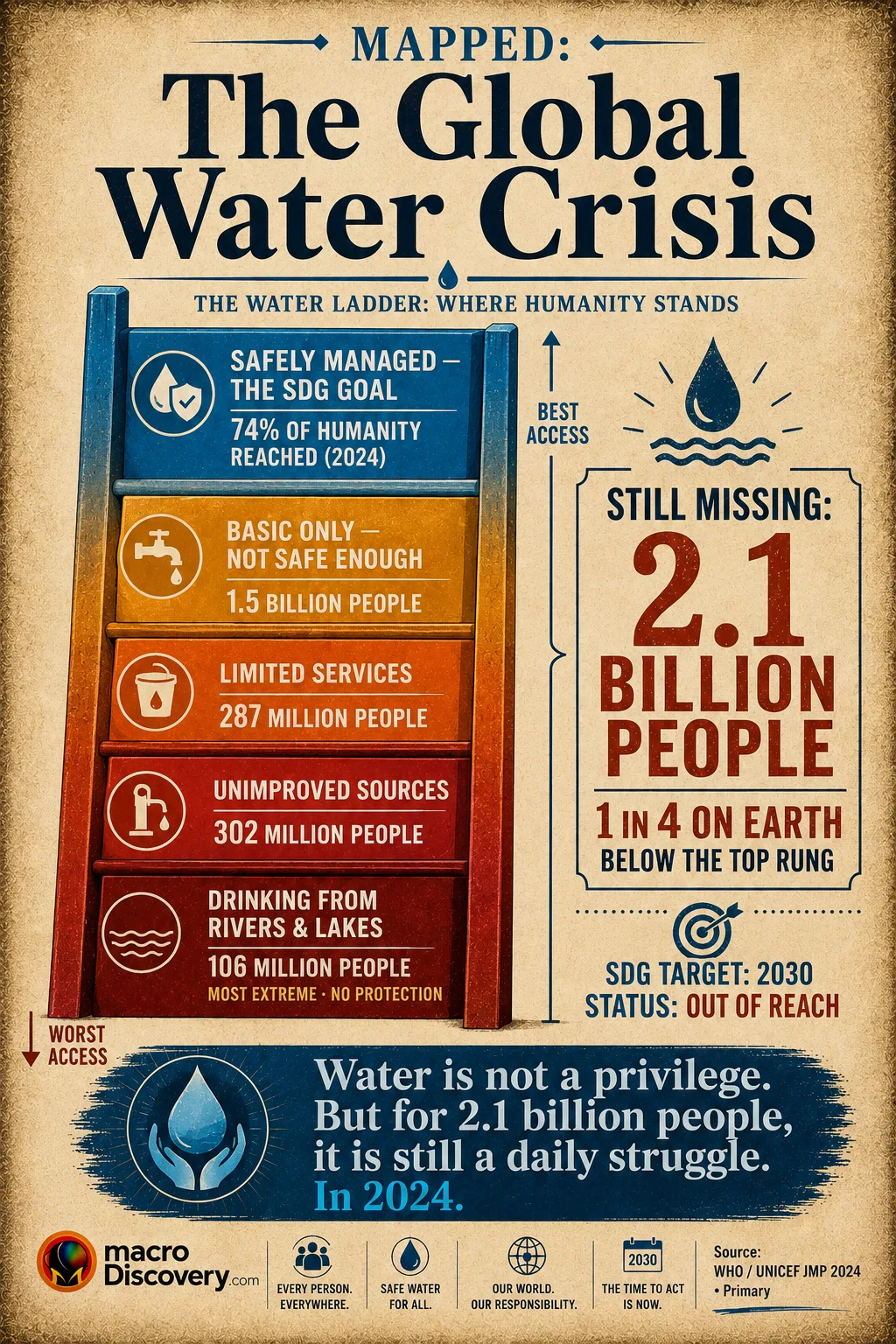
Premium editorial infographic displaying a vertical access ladder showing levels of global water access in 2024 — from the bottom rung (106 million people drinking directly from rivers and lakes) through unimproved sources (302 million), limited services (287 million), and basic access (1.5 billion), up to the top rung of safely managed water reached by 74% of humanity. A callout shows that 2.1 billion people — 1 in 4 globally — remain below the safely managed level. The SDG 2030 target is noted as "out of reach." Based on WHO/UNICEF Joint Monitoring Programme primary data (who.int, August 26, 2025). Part of MacroDiscovery's "Mapped: The Global Water Crisis."
The Global Water Crisis
Global Water Crisis , How many people lack access to clean water globally? , How many people lack access to sanitation worldwide? , Will the world meet the 2030 clean water goals? , How many children die from unsafe water? , Which regions face the worst water stress by 2050? , people without clean water WHO data , how many people lack clean water globally , global water sanitation crisis SDG 2030 targets out of reach data , water scarcity economic impact GDP risk 2050 WRI statistics , how many people in the world don’t have access to clean water , how many people lack access to sanitation worldwide , will the world achieve the 2030 clean water and sanitation goals , how many children die from unsafe water every day WHO statistics , which countries will face the worst water stress by 2050 MENA ,
Mapped: The Global Water Crisis — MacroDiscovery
MacroDiscovery
Global Health & Environment · 5 min read · WHO/UNICEF JMP 2025 · Primary · Aug 26
WHO/UNICEF JMP “Progress on Household Drinking Water and Sanitation 2000–2024” · Released August 26, 2025 · 160 Countries · 35-Year Programme
Water, Sanitation & Global Inequality

Mapped: The Global
Water Crisis

In 2024, 2.1 billion people — one in four people on earth — still lacked safely managed drinking water. 106 million drank directly from rivers and lakes. 3.4 billion had no safe sanitation. The targets set for 2030 are now described as “increasingly out of reach.” Here is the full picture, from the freshest primary data available.

By MacroDiscovery
Source: WHO/UNICEF JMP 2025 (primary · who.int · directly fetched · August 26, 2025)
Latest data: 2024 · Released 5 days ago
2.1B
people lack safely managed drinking water · 1 in 4 globally · WHO/UNICEF 2025
3.4B
people lack safely managed sanitation · 354M practice open defecation
~900
children under 5 die daily from diarrhea caused by unsafe water · WHO
2030
SDG universal water target · now “increasingly out of reach” · WHO/UNICEF
Visualization 01 — The Global Water & Sanitation Access Gap
Who Is Being Left Behind — and by How Much

People living without adequate water, sanitation and hygiene (WASH) services globally, 2024. Bars scaled to 3.4 billion (largest gap — sanitation). Source: WHO/UNICEF Joint Monitoring Programme for Water Supply, Sanitation and Hygiene — “Progress on Household Drinking Water and Sanitation 2000–2024” (primary · directly fetched · who.int · released August 26, 2025 · data from 160 countries).
Crisis — billions affected
Severe — drinking from surface water
Significant gap
Progress made — but insufficient
🚱 No safely managed sanitationLargest gap
3.4 billion people — the biggest WASH gap on earth · 354 million still practice open defecation · sanitation lags even further behind drinking water progress
3.4Bno safe sanitation
💧 No safely managed water1 in 4 globally
2.1 billion people lack access to drinking water that is on-premises, free from contamination, and available when needed · including those with basic or no service
2.1Bno safely managed water
🧼 No basic hygiene at homeSignificant
1.7 billion people lack basic hygiene services at home — including 611 million without access to any hygiene facility whatsoever · soap and water to wash hands
1.7Bno basic hygiene
🚽 Practicing open defecationSevere
354 million people have no toilet or latrine of any kind · open defecation is a leading driver of water contamination and child diarrheal deaths
354Mopen defecation
🏞️ Drinking from rivers/lakesMost extreme
106 million people collect drinking water directly from rivers, ponds, or lakes in 2024 · exposed to cholera, typhoid, dysentery, and other waterborne disease daily
106Msurface water
✅ Gained access since 2015Progress made
961 million people gained safely managed water between 2015 and 2024 · rural safely managed coverage rose from 50% to 60% · but urban coverage stagnated and 2030 SDG targets are slipping
961Mgained access
Definition — “Safely managed” drinking water: Water from a source located on premises, free from contamination, and available when needed. This is the SDG target for universal access. “Basic” access (clean source but not on premises or not always available) is a lower standard met by 1.5 billion more people — progress, but not the goal. Source: WHO/UNICEF JMP 2025 (primary · directly fetched · who.int).
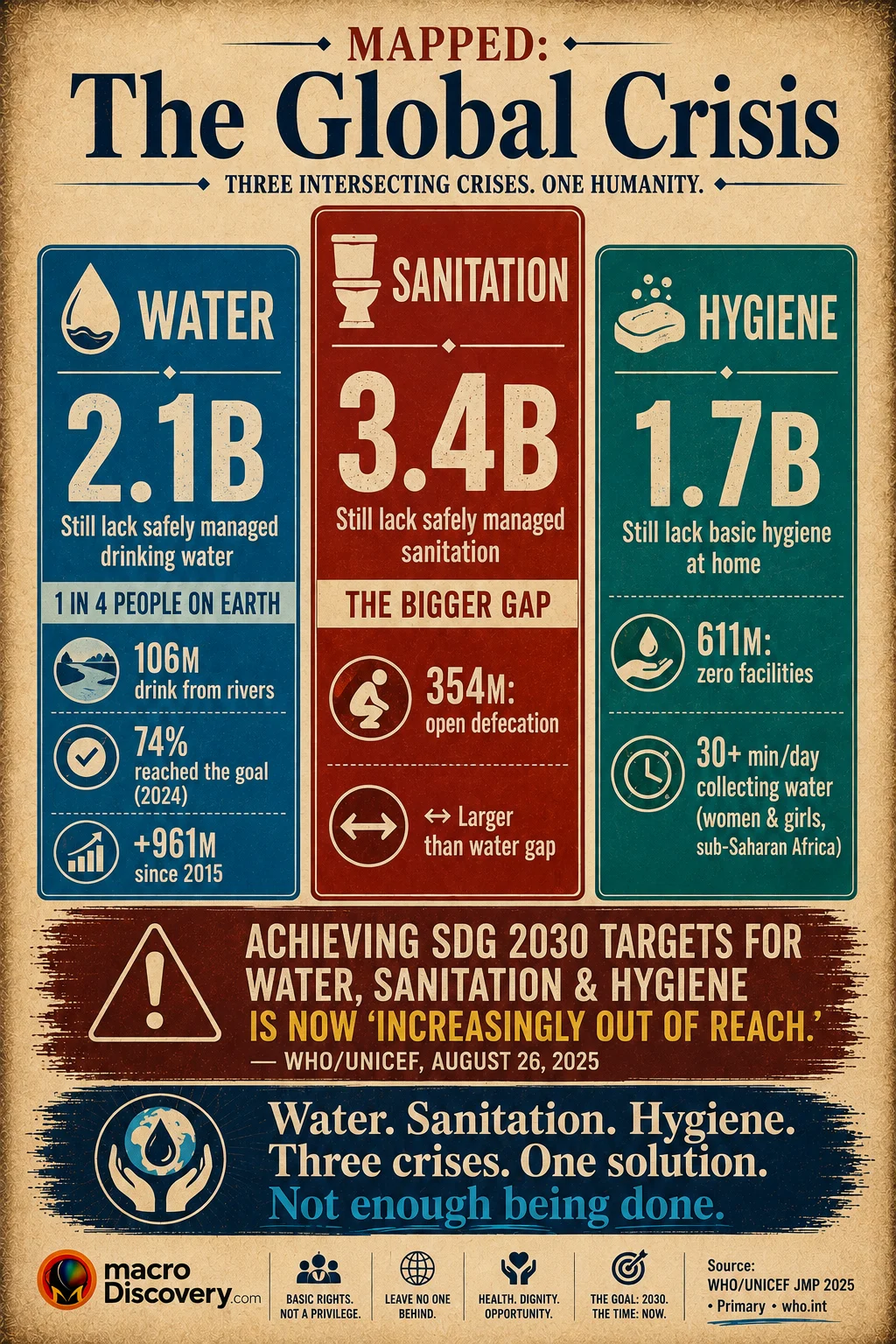
Premium editorial infographic showing three vertical columns representing the three intersecting global crises: the water column (ocean blue) shows 2.1 billion people still lack safely managed water; the sanitation column (deep red, tallest — signifying the largest gap) shows 3.4 billion people without safely managed sanitation including 354 million practicing open defecation; the hygiene column (dark teal) shows 1.7 billion without basic hygiene including 611 million with zero facilities. A statement below the columns quotes the WHO/UNICEF JMP 2025 report: achieving 2030 SDG water and sanitation targets is now "increasingly out of reach." Based on WHO/UNICEF primary data (who.int, August 26, 2025). The Global Water Crisis.
The Global Water Crisis
Visualization 02 — From the SDGs to 2050
The Timeline of a Crisis Running Out of Time

Progress has been made. But not fast enough. The 2030 deadline for universal water access is now out of reach — and the crisis is set to worsen dramatically by 2050. Source: WHO/UNICEF JMP 2025 (primary) · WRI Aqueduct · UN-Water.

2000
Baseline
The Millennium Development Goals Launch — ~40% Have Safe Water
The global WASH tracking programme (JMP) began measuring progress in 1990. By 2000, only around 40% of the global population had safely managed drinking water. Rural communities in sub-Saharan Africa and South Asia had the worst access. The scale of the problem became quantifiable for the first time.
JMP tracking begins~40% have safely managed water
2015
SDGs
SDG 6 Adopted — Universal Safe Water and Sanitation by 2030
The world committed to universal access to safe water and sanitation by 2030. At the time, 68% of people had safely managed water — still leaving 3+ billion behind. The goal was ambitious but not impossible, provided the pace of progress accelerated substantially. It did not.
SDG 6: universal water by 203068% coverage · 2015
2020–2022
Setback
COVID-19 Disrupts Progress — Urban Coverage Stagnates
The pandemic disrupted water and sanitation infrastructure funding and delivery globally. Rural areas saw some improvement. But urban coverage — where rapid population growth is highest — stagnated. Fragile states fell further behind. Countries in conflict lost ground already gained. The gap widened precisely where it needed to close fastest.
Urban coverage: stagnatedFragile contexts: 38pp behind
Aug 2025
Now
WHO/UNICEF JMP 2025: 74% Coverage · 2.1B Still Waiting · 2030 Out of Reach
The 2025 JMP report — the most comprehensive global water dataset ever produced — confirmed 74% coverage by 2024. 961 million people gained access since 2015. But 2.1 billion were still left behind. The report stated plainly: achieving the 2030 SDG targets “will require acceleration, while universal coverage of safely managed services appears increasingly out of reach.”
74% coverage 2024961M gained access 2015-20242030 target: out of reach
2050
Risk
$70 Trillion of Global GDP at Risk · MENA: 100% in Extreme Stress
World Resources Institute projects 31% of global GDP — $70 trillion — will be exposed to high water stress by 2050. The entire Middle East and North Africa region will be in extreme water stress. Global water demand will rise 20–25%. Drought costs already exceed $307 billion annually. Three in four people could face drought impacts by 2050.
$70T GDP at risk (WRI)MENA: 100% extreme stress$307B drought cost today

Water is the most basic requirement of human life. More basic than food, shelter, or safety. And yet in 2024, one in four people on earth still lacked access to drinking water that was safe, on their premises, and available when they needed it. The WHO and UNICEF released the most comprehensive global measurement of this gap just five days ago. What it shows is stark.

WHO/UNICEF JMP 2025 · Primary · Directly Fetched · August 26, 2025
2.1B
2.1 billion people globally still lack safely managed drinking water in 2024 — one in four people on earth. 106 million drink directly from rivers, ponds, and lakes.
961 million people gained access to safely managed water between 2015 and 2024 — real progress. Global coverage rose from 68% to 74%. But the 2030 SDG targets now appear “increasingly out of reach.” Least developed countries are more than twice as likely to lack basic water services.
Source: WHO/UNICEF JMP — “Progress on Household Drinking Water and Sanitation 2000–2024” (primary · directly fetched · who.int · August 26, 2025 · data from 160 countries)

“Water, sanitation and hygiene are not privileges. They are basic human rights.”

— Dr Ruediger Krech, Director a.i., Environment, Climate Change and Health, World Health Organization · August 26, 2025

The Sanitation Crisis Is Even Bigger Than the Water Crisis

3.4 billion people lack safely managed sanitation — more than lack safe water. 354 million still practice open defecation. This is not just a dignity issue. It is a water quality issue. Human waste that enters rivers and groundwater becomes the drinking water of the next community downstream. Sanitation and water are the same problem seen from different ends. Without solving sanitation, solving water access is impossible.

Why it matters: the world talks more about drinking water than sanitation — but the sanitation gap is wider, dirtier, and more deadly.
WHO/UNICEF JMP 2025 · Children’s Health
~900
Approximately 900 children under 5 die every day from diarrheal diseases caused by unsafe water, sanitation, and hygiene — WHO estimate.
Waterborne diseases — cholera, typhoid, dysentery, hepatitis A, polio — spread through contaminated water. They are almost entirely preventable. Children living in fragile contexts, conflict zones, and least developed countries bear the heaviest burden. Safely managed water coverage in fragile contexts is 38 percentage points lower than in stable countries.
Source: WHO estimate cited Health Policy Watch (January 2026) · WHO/UNICEF JMP 2025 (fragile contexts figure, primary · who.int · directly fetched)

Women Collect the Water the World Fails to Deliver

In most countries with available data, women and girls are primarily responsible for collecting household water. In sub-Saharan Africa and Central and Southern Asia, many women spend more than 30 minutes per day on this task alone — every day, for their entire lives. This is not a water statistic. It is a gender equality statistic. Every hour spent collecting water is an hour not spent in school, in paid work, or in rest. The water crisis and gender inequality are the same crisis.
Why it matters: solving the water crisis is one of the highest-return investments in gender equality that exists — the two problems share the same solution.
World Resources Institute · WRI Aqueduct · 2050 Projections
$70T
31% of global GDP — $70 trillion — will be exposed to high water stress by 2050, up from just $15 trillion (24%) in 2010.
India, Mexico, Egypt, and Turkey together account for more than half of the exposed GDP. The entire Middle East and North Africa region will face extreme water stress by 2050. Global water demand is set to rise 20–25%. Drought costs already exceed $307 billion annually (UNU-INWEH 2024). The water crisis is not approaching. In large parts of the world, it has already arrived.
Source: World Resources Institute — WRI Aqueduct (primary · wri.org) · UN-Water citing UNU-INWEH 2024 (drought costs $307B · by 2050: 3 in 4 face drought)
Key Numbers at a Glance
Water · Access Gap
2.1B
People still without safely managed water in 2024 — 1 in 4 globally. 106 million drink from rivers and lakes directly.
WHO/UNICEF JMP 2025 (primary · directly fetched)
Sanitation · Largest Gap
3.4B
People without safely managed sanitation. 354 million have no toilet of any kind. The sanitation gap is bigger than the water gap.
WHO/UNICEF JMP 2025 (primary · directly fetched)
Economy · 2050 Risk
$70T
Global GDP exposed to high water stress by 2050 — up from $15T in 2010. India, Mexico, Egypt, Turkey account for half.
World Resources Institute (primary · wri.org)
SDG · 2030 Target
2030
Universal access to safe water and sanitation — the SDG target. WHO and UNICEF now say it is “increasingly out of reach.”
WHO/UNICEF JMP 2025 (primary · who.int · Aug 26, 2025)
Frequently Asked Questions
How many people lack access to clean water globally?
2.1 billion people — 1 in 4 globally — still lack safely managed drinking water as of 2024. This means water that is on their premises, free from contamination, and available when needed. A further 106 million drink directly from rivers, ponds and lakes. Source: WHO/UNICEF JMP (primary · who.int · directly fetched · August 26, 2025).
How many people lack access to sanitation worldwide?
3.4 billion people — more than lack safe water — still have no access to safely managed sanitation as of 2024. 354 million have no toilet of any kind and practice open defecation. 611 million have no hygiene facilities whatsoever. Source: WHO/UNICEF JMP (primary · who.int · August 26, 2025).
Will the world meet the 2030 clean water goals?
Almost certainly not. The WHO and UNICEF stated in August 2025 that universal coverage of safely managed water and sanitation services is “increasingly out of reach” by the 2030 SDG deadline. While 961 million people gained access between 2015 and 2024, the pace is far too slow. Source: WHO/UNICEF JMP (primary · who.int · August 26, 2025).
How many children die from unsafe water?
Approximately 900 children under 5 die every day from diarrheal diseases caused by unsafe water, sanitation and hygiene — according to WHO estimates. Waterborne diseases including cholera, typhoid, dysentery, hepatitis A and polio are almost entirely preventable with clean water and basic sanitation. Source: WHO estimate · Health Policy Watch (January 2026) citing WHO.
Which regions face the worst water stress by 2050?
The Middle East and North Africa — 100% of the MENA population will face extremely high water stress by 2050, per WRI Aqueduct projections. India, Mexico, Egypt and Turkey together account for more than half of the $70 trillion in global GDP exposed to high water stress by 2050. Drought costs already exceed $307 billion annually. Source: WRI Aqueduct (primary) · UN-Water citing UNU-INWEH 2024.
Sources
  • WHO/UNICEF — “1 in 4 people globally still lack access to safe drinking water — WHO, UNICEF” (PRIMARY · directly fetched · who.int/news/item/26-08-2025 · August 26, 2025 · all 10 key JMP facts confirmed verbatim · 2.1B lack safely managed water · 106M surface water · 3.4B no safe sanitation · 354M open defecation · 1.7B no basic hygiene · 611M zero hygiene access · LDCs 2x more likely · fragile contexts 38pp lower · rural 50%→60% · urban stagnated · 2030 SDG “increasingly out of reach” · Dr Ruediger Krech quote confirmed)
  • UNICEF Data Hub — “Access to drinking water” (primary · data.unicef.org · August 25, 2025 · 961 million gained safely managed water 2015–2024 · global coverage 68%→74% · 1.5B basic only · 287M limited · 302M unimproved · 106M surface water · 89 countries universal basic access)
  • UN-Water — “Water Scarcity” facts page (primary · unwater.org · citing UNU-INWEH 2024: drought costs $307B annually · by 2050: 3 in 4 face drought · citing Mekonnen & Hoekstra 2016: ~4B face severe scarcity ≥1 month/year · 720M in high/critical stress countries (2021) · 72% withdrawals: agriculture · 1.42B including 450M children in high water vulnerability (UNICEF 2021) cited)
  • World Resources Institute — “25 Countries Face Extremely High Water Stress” (primary · wri.org/insights · WRI Aqueduct data · $70T GDP at risk by 2050 (31% of world GDP, from $15T/24% in 2010) · India, Mexico, Egypt, Turkey: >50% of exposed GDP · MENA: 100% extreme stress by 2050 · GDP losses 7-12% India/China/Central Asia · 6% Africa · water demand +20-25% by 2050)
  • Health Policy Watch — “World Enters New Era of Water Crisis” (January 2026 · citing WHO: ~900 children under 5 die daily from diarrheal diseases caused by unsafe water · 3.5M annual deaths from waterborne disease and inadequate water)
Macro Discovery

Sukh Dhaliwal

Sukh Dhaliwal is the founder of Macro Discovery, an independent digital publication covering AI, technology, science, future trends, and global innovation through visual storytelling and data-driven analysis.

Join WhatsApp

Join Now

Join Facebook

Follow us

Leave a Comment