Home AI Technology Gaming Future Automobile Geography Top 10 Trending How To Discover
---Advertisement---

Compared: The Future of Work From Home

Macro Discovery
On: August 13, 2026 6:57 AM
Follow Us:
---Advertisement---
Future of Work From Home , Is working from home actually productive? , What percentage of Americans work from home in 2026? , Will companies force everyone back to the office? , Is hybrid work here to stay? , Do remote workers get promoted less often? , work from home future statistics , is working from home actually productive according to research 2026 , what percentage of Americans work from home in 2025 and 2026 BLS data , will companies force everyone back to the office in 2026 return mandate , is hybrid work here to stay or will companies go back to full office , do remote workers get promoted less often than in-office employees , work from home productivity statistics 2025 2026 hybrid remote Stanford BLS research primary data , return to office statistics 2025 2026 how many companies mandating RTO employee compliance Gallup data , hybrid work benefits research evidence Stanford Nature study 2024 results resignation productivity promotion ,
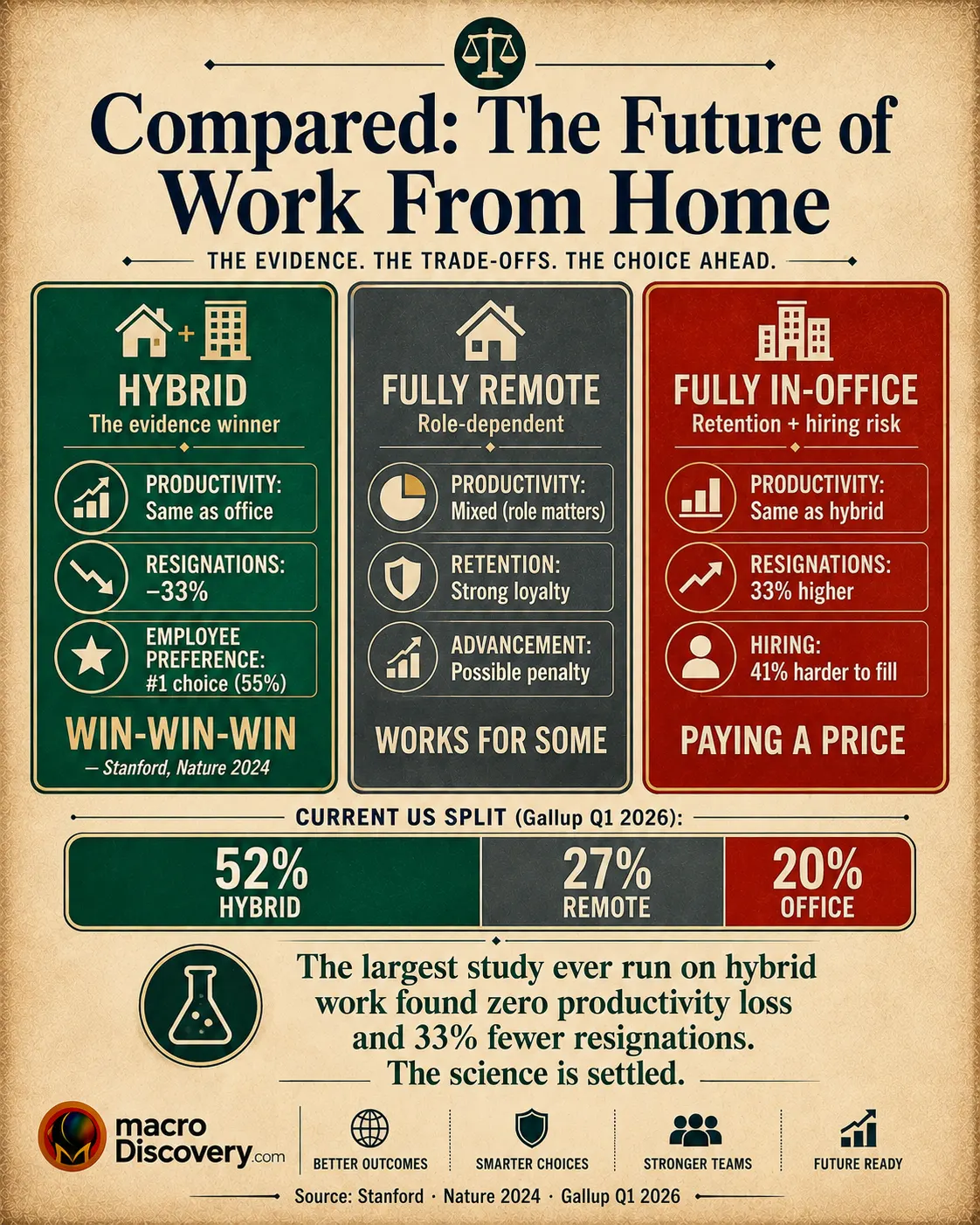
Premium editorial infographic showing
a triptych of three vertical panels
comparing work arrangements. The left
panel (emerald green) represents hybrid
work, showing Stanford/Nature evidence
of zero productivity loss, 33% fewer
resignations, and 55% employee
preference — labelled "Win-Win-Win."
The centre panel (grey) represents
fully remote, noting mixed productivity
evidence and possible advancement
penalty. The right panel (red)
represents fully in-office, showing
33% higher resignation risk and 41%
harder to fill roles — labelled
"Paying a Price." Below all three
panels, a unified horizontal bar shows
the current US split among remote-
capable workers (Gallup Q1 2026):
52% hybrid, 27% remote, 20% in-office.
Based on Stanford/Nature primary data
(news.stanford.edu, June 2024), BLS
March 2026, and Gallup Q1 2026. Part
of MacroDiscovery's "Compared: The
Future of Work From Home."
Future of Work From Home
Compared: The Future of Work From Home — MacroDiscovery
MacroDiscovery
The Future of Work · 5 min read · Stanford Nature 2024 · BLS March 2026 · Gallup Q1 2026
Stanford University — “Hybrid working from home improves retention without damaging performance” (PRIMARY · news.stanford.edu · directly fetched · Nature Jun 2024 · Bloom, Han, Liang) · BLS Current Population Survey (March 2026) · Gallup Workforce Survey (Q1 2026) · Pew Research · McKinsey 2025 · Robert Half Q1 2026
The Future of Work · 2026 Data

Compared: The Future of
Work From Home

The debate is largely over. Hybrid work won. The largest randomised controlled trial ever run on the question found zero impact on productivity, zero impact on promotions, and 33% fewer resignations. The Bureau of Labor Statistics counts 35 million Americans working remotely right now. And only 44% of workers say they’d comply with a full return-to-office mandate. Here is what the evidence actually says.

By MacroDiscovery
Science: Stanford/Nature (primary · directly fetched) · BLS · Gallup · Pew
Latest data: BLS March 2026 · Gallup Q1 2026 · Robert Half Q1 2026
52%
of remote-capable workers are hybrid · barely changed in 3 years despite RTO mandates · Gallup Q1 2026
−33%
fewer resignations in hybrid vs full on-site · Stanford/Nature RCT · 1,600+ workers · primary · June 2024
44%
of workers would comply with a full RTO policy · the rest would quit or start looking · Stanford SWAA Dec 2024
22.6%
of all US employees telework at least part-time · March 2026 · BLS Current Population Survey · 3.3× pre-pandemic rate
Visualization 01 — The Three Arrangements Compared
Hybrid vs Fully Remote vs Fully In-Office — What the Evidence Shows

A comparison of the three main work arrangements across productivity evidence, retention, employee preference, and hiring impact. Sources: Stanford/Nature (primary · directly fetched) · BLS · Gallup Q1 2026 · Pew Research · McKinsey 2025 · Robert Half Q1 2026 · KORE1 (April 2026) · Cisco 2025.

Dimension 🏠🏢 Hybrid 🏠 Fully Remote 🏢 Fully On-Site
Productivity
(RCT evidence)
Same as in-office
Stanford/Nature RCT (primary): “zero effect on workers’ productivity or career advancement” vs fully in-office peers
Mixed evidence
Strong for solo tasks (CTrip +13% call centre); weaker for collaboration-heavy roles (Gibbs et al. negative)
The baseline
No controlled difference from hybrid; used as control arm in Stanford/Nature study
Employee
Retention
33% fewer quits
Stanford/Nature: resignations fell 33% vs fully in-office · Cisco 2025: 69% of employers report retention improved after introducing hybrid
Strong
Pew: 61% of fully remote workers say they would leave if remote work was eliminated · high loyalty to arrangement
Attrition risk
McKinsey 2025: 17% of recent job quitters left due to office policy change — one of the top 3 voluntary exit triggers
Employee
Preference
#1 choice
Robert Half Q1 2026: 55% of job seekers rank hybrid as top choice · Gallup: 52% of remote-capable workers currently hybrid
Strong demand
Gallup Q1 2026: 27% of remote-capable workers fully remote · Pew: 71% say improves work-life balance · 56% say improves productivity
Low demand
Robert Half Q1 2026: only 16% of job seekers want fully in-office as top choice · 25% would even consider a 5-day office role
Hiring
Difficulty
Fastest to fill
Hybrid roles fill fastest and have lowest offer-decline rates (~8% at final stage) · strongest hiring lever for knowledge roles
Strong pull
~12% of new job postings in Q4 2025 were fully remote · still a premium signal for candidates · strong in tech (47% of tech workers fully remote)
Hardest to fill
KORE1 2026: fully on-site roles take 41% longer to fill than equivalent hybrid roles · offers declined 23% vs 8% on hybrid at final stage
Career
Advancement
No penalty
Stanford/Nature: “zero effect on career advancement” — promotion rates statistically identical to fully in-office peers in the RCT
Possible penalty
Some evidence of “proximity bias” — fully remote workers may be overlooked for promotions at companies without deliberate equity policies
Traditional path
Historically the default path for advancement; still preferred by some managers; mentorship and visibility easier on-site
Overall verdict ✓ Best overall outcomes ↔ Role-dependent ↓ Retention + hiring risk
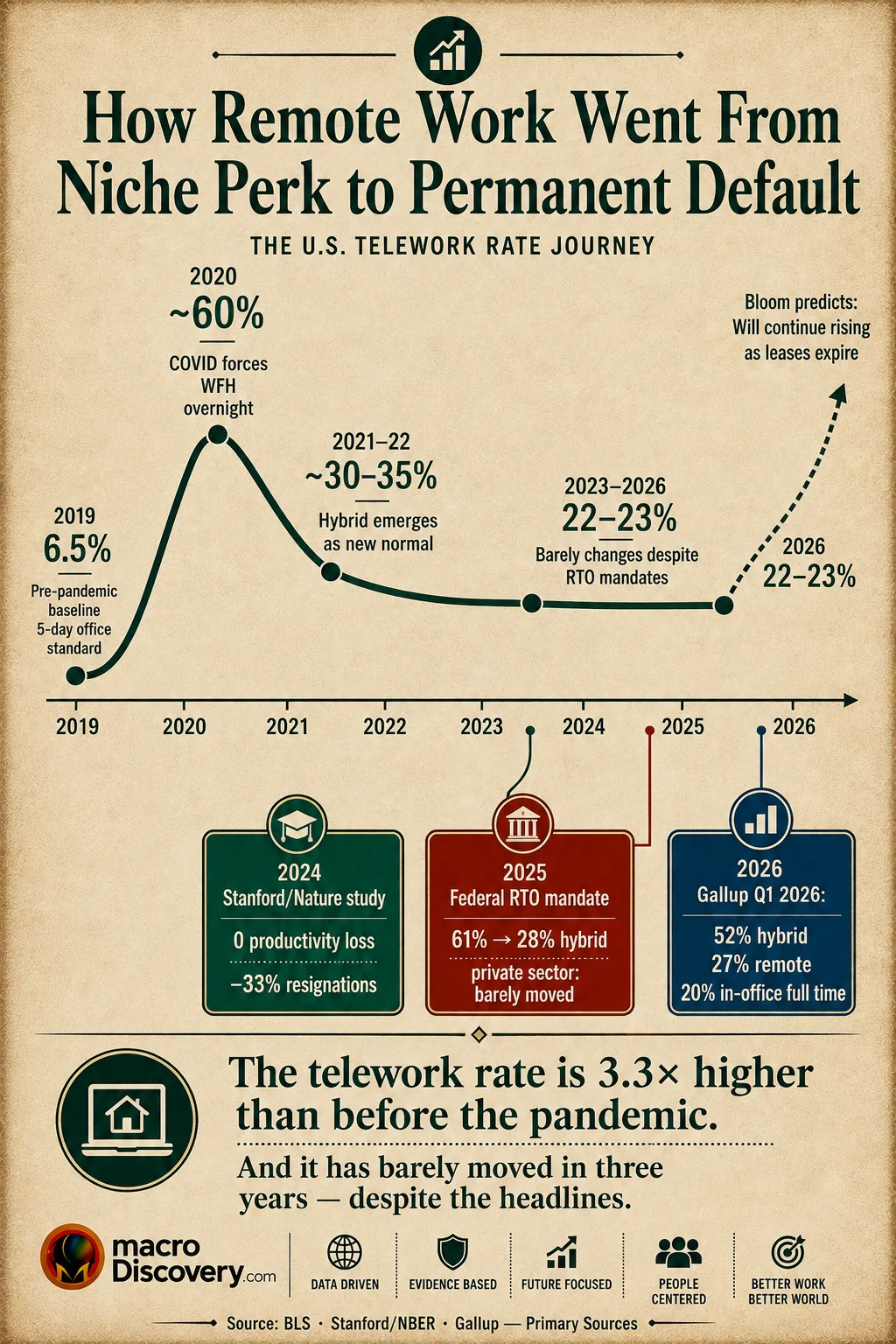
Premium editorial infographic showing a timeline of US telework rates from 2019 to 2026. Starting at 6.5% (pre-pandemic BLS baseline), rising dramatically to approximately 60% during COVID in 2020, then stabilising at a plateau of roughly 22-23% from 2022 to 2026. Three callout boxes mark key events: the June 2024 Stanford/Nature study (zero productivity loss, 33% fewer resignations), the 2025 federal RTO mandate (hybrid federal workers fell from 61% to 28% while private sector barely moved), and Gallup Q1 2026 data (52% hybrid, 27% fully remote, 20% fully in-office). A dotted upward arrow extends beyond 2026 with Stanford economist Nick Bloom's prediction that WFH will continue rising as office leases expire. A note below states the current rate is 3.3 times higher than pre-pandemic and has barely moved in three years despite widespread RTO headlines.
Future of Work From Home
Visualization 02 — The Work From Home Timeline · 2019 to 2026
From 6.5% to 22.6% — How a Pandemic Permanently Rewired Where We Work

The share of US workers teleworking before the pandemic was around 6.5%. It will never return there. Sources: BLS (primary) · Stanford/NBER (primary) · Gallup (primary).

2019
Before
~6.5% of Private-Sector Workers Primarily at Home. WFH Is a Niche Perk. Most Executives Dismiss It.
The Bureau of Labor Statistics counted just 6.5% of private-sector workers primarily working from home in 2019. Mostly freelancers and senior knowledge workers. Most large companies had policies explicitly discouraging it. Jamie Dimon had called remote work “doesn’t work for those who want to hustle” and Elon Musk had not yet made headlines on the topic. The five-day office week was assumed permanent.
6.5% remote · BLS5-day office standard
2020–21
Forced shift
COVID Forces the Largest Involuntary Remote Work Experiment in History. Millions Discover It Works.
The pandemic forced roughly 60% of knowledge workers into full-time remote work overnight. Most expected it to be temporary. It was not. Companies that had spent years claiming remote work was impossible discovered their employees were productive at home. Zoom revenues multiplied. Ergonomic chair sales spiked. And workers experienced, for the first time, what life without a daily commute felt like. Many would not give it back without a fight.
Involuntary WFH experimentProductivity held upCommute savings realised
2022–23
RTO push
The RTO Mandates Begin. Executives Push Back. Badge-Swipe Data Reveals Nobody Is Actually Complying.
Major companies announced return-to-office mandates beginning in 2022. Goldman Sachs, JPMorgan, Apple, Google — all issued some form of in-office requirement. At the same time, office utilisation data from building sensors and badge-swipe systems showed employees were not actually returning at the rates demanded. The gap between what companies announced and what employees did became one of the most discussed management problems in corporate history. BLS data showed remote work rates actually rising through this period.
RTO mandates beginBadge-swipe gap: mandates ≠ complianceBLS rate: rising despite mandates
June 2024
Science settled
Stanford’s Nature Study Lands. The Largest RCT on Hybrid Work Finds Zero Productivity Loss and 33% Fewer Resignations.
Stanford economist Nicholas Bloom published the results of a six-month randomised controlled trial of more than 1,600 workers at Trip.com in the journal Nature. The verdict: hybrid work had zero effect on productivity or career advancement, and cut resignations by 33%. Bloom called it “a win-win-win for employee productivity, performance, and retention.” The company rolled hybrid work out to all employees. The study became the most widely-cited piece of evidence in the WFH debate — and it did not support the return-to-office narrative.
Nature RCT: 0 productivity lossResignations: −33%“Win-win-win” — Bloom
2025–26
Hybrid default
Hybrid Becomes the Permanent Default. BLS: 22.6% Teleworking March 2026. Gallup: 52% Hybrid. Rate Barely Moved in Three Years.
The Bureau of Labor Statistics counted 35.1 million Americans working remotely as of April 2026 — roughly 3.3 times the pre-pandemic rate. Among remote-capable workers, Gallup found the split has held almost constant for 18 months despite a wave of high-profile RTO announcements. The federal government’s 2025 mandate provides the clearest evidence of the limits of forcing return: hybrid federal workers fell from 61% to 28% — but private-sector rates barely shifted. Stanford’s research found 80% of Fortune 500 companies now operate on a hybrid schedule.
22.6% telework · BLS March 202652% hybrid · Gallup Q1 202680% Fortune 500: hybridFederal: 61%→28% (mandated)

For four years, the dominant narrative about remote work has been about its end. Every major RTO announcement made headlines. Every CEO who called workers back to the office was quoted extensively. What received less attention was the data: the share of Americans working from home has barely changed in three years. The executives were loud. The Bureau of Labor Statistics was quiet. The data sided with the Bureau.

Stanford University · PRIMARY · news.stanford.edu · directly fetched · Nature · June 2024 · Bloom, Han, Liang
−33%
“Resignations fell by 33% among workers who shifted from working full-time in the office to a hybrid schedule.” The largest RCT on hybrid work found zero productivity loss and zero career advancement penalty.
The Stanford/Nature study randomised 1,600+ workers at Trip.com by birthday (odd vs even) — those with odd birthdays could work from home two days a week. Over six months, hybrid workers quit 33% less often. Performance reviews were statistically identical. Promotion rates were identical. Bloom called it “a win-win-win for employee productivity, performance, and retention.” Managers predicted the experiment would reduce productivity. By the end, they had changed their minds. Trip.com rolled hybrid work out to the whole company.
Source: Stanford University — “Study finds hybrid work benefits companies and employees” (PRIMARY · directly fetched · news.stanford.edu · June 12, 2024) · Published: Nature (“Hybrid working from home improves retention without damaging performance” · Bloom, Han, Liang · June 2024) · “The research is also the largest to date of hybrid work involving university-trained professionals”

“From an economic policymaking standpoint, hybrid work is one of the few instances where there aren’t major trade-offs with clear winners and clear losers. There are almost only winners.”

— Nicholas Bloom, William D. Eberle Professor of Economics, Stanford University · news.stanford.edu (primary · directly fetched)

The RTO Paradox — Why CEOs Can’t Win an Argument Against Their Own Data

KPMG surveyed 1,300 CEOs in 2024 and found 83% expected a full return to office by 2027. Gallup surveyed those same executives’ actual plans and found only 12% had any RTO mandate scheduled for the coming year. These two numbers describe the same group of people. One reflects what CEOs say when asked about the ideal future. The other reflects what they actually plan to do when they consider attrition, hiring difficulty, and employee satisfaction. The gap between aspiration and action is the real data point. The federal government provides the most honest evidence. When a mandate is actually enforced — as the US government did in 2025 — hybrid rates fall dramatically. In the private sector, where enforcement is softer, they barely move.

Why it matters: companies that force full return to office are not winning a culture war — they are losing a hiring competition. Fully on-site roles take 41% longer to fill and have three times the offer-decline rate of hybrid equivalents.
Stanford SWAA Survey · December 2024 · Bloom, Barrero, Davis
44%
Only 44% of workers surveyed said they would comply with a return-to-office policy requiring fully onsite work. The other 56% said they would quit or start looking for a new job.
The Stanford Survey of Working Arrangements and Attitudes (SWAA) — an ongoing survey tracking worker preferences — found in its December 2024 results that more than half of knowledge workers would either quit or begin job-searching rather than comply with a full return-to-office requirement. McKinsey’s 2025 survey of 9,560 US adults found that 17% of recent job quitters had left specifically because their employer changed office policies — making it one of the top three triggers for voluntary exits. Research from Harvard and Stanford estimates that employees value the option to work hybrid as equivalent to an 8% pay raise.
Source: Stanford SWAA — Survey of Working Arrangements and Attitudes (December 2024 · Bloom, Barrero, Davis · reported in Stanford Report March 2025 · news.stanford.edu PRIMARY · “only 44 percent of respondents said they would comply with a RTO policy requiring fully onsite work. The rest said they would quit or start looking for a new job.”) · McKinsey 2025 (9,560 US adults · 17% left due to office policy change)

Who Actually Works From Home — and Who Doesn’t

Remote and hybrid work is not evenly distributed. Technology workers are its biggest beneficiaries — Gallup found 47% of tech workers are fully remote, and 45% hybrid, leaving just 9% fully on-site. Workers aged 35 to 44 have the highest WFH rates, around 27%. Workers aged 16 to 24 have the lowest, around 6% — a finding consistent with Gen Z’s preference for social connection that the office provides. Women telework at slightly higher rates than men. The federal government’s 2025 mandate caused the sharpest shift seen in any sector, with hybrid federal workers falling from 61% to 28% in months. Globally, English-speaking countries lead on WFH: the US, UK, Australia, and Canada average significantly above the global average of 1.27 days per week at home.

Why it matters: the WFH divide is also a skills divide — the workers most likely to work from home are those with college degrees in knowledge-intensive roles. For the majority of workers in manufacturing, retail, and healthcare, this debate is irrelevant. They cannot work remotely at all.
Stanford/NBER Working Paper · February 2025 · Bloom et al.
~27%
Work-from-home days now account for roughly a quarter of all paid full-time workdays in the United States — far above pre-pandemic levels and holding steady despite three years of RTO mandates.
Stanford economist Nick Bloom’s NBER working paper (February 2025) — cross-referencing multiple US surveys to correct for methodological variation — estimated that approximately 27% of paid full-time workdays in the US are now worked from home. This is consistent with BLS monthly data showing 22.6% of all employees teleworking at least part-time, and Gallup’s finding that hybrid workers spend 46% of their working hours in the office (implying roughly 54% outside of it). Nick Bloom predicts this share will continue to grow as office leases expire, companies downsize real estate, and younger executives — more comfortable with WFH — move into leadership.
Source: Stanford/NBER — Working Paper (February 2025 · Bloom, Barrero, Davis · “work-from-home days account for a quarter of all paid workdays in the U.S.” · reported in Stanford Report March 2025 · news.stanford.edu PRIMARY) · BLS Current Population Survey (March 2026 · 22.6% telework) · Gallup Q1 2026 (46% of hybrid workers’ hours in office)
Key Numbers at a Glance
Arrangement · Gallup Q1 2026
52%
Of remote-capable US workers are in hybrid arrangements. 27% fully remote. 20% fully on-site. The split has barely moved in 18 months.
Gallup Workforce Survey Q1 2026
Retention · Stanford/Nature
−33%
Fewer resignations among hybrid workers vs fully in-office, in the largest RCT ever run on the subject. Zero impact on productivity or promotions.
Stanford (primary · news.stanford.edu)
RTO Compliance · Stanford
44%
Would comply with a full return-to-office mandate. The other 56% would quit or start looking for a new job. Survey of 2024 US knowledge workers.
Stanford SWAA (primary · Dec 2024)
Equivalent Value · Research
8%
Pay raise equivalent that employees assign to the option to work hybrid. Losing it triggers attrition at the same rate as a meaningful pay cut.
Harvard Business School / Stanford research
Frequently Asked Questions
Is working from home actually productive?
Yes, for hybrid arrangements — the evidence is strong and comes from a randomised controlled trial. Stanford economist Nicholas Bloom’s study of more than 1,600 workers at Trip.com, published in the journal Nature in June 2024, found that hybrid work (two days home, three days office) had zero effect on productivity or career advancement compared to fully in-office peers. Resignations fell 33%. A separate BLS study of 61 industries found a positive link between telework and total factor productivity. Fully remote results are more mixed and depend heavily on role type. Source: Stanford (primary · news.stanford.edu · directly fetched) · BLS Beyond the Numbers (October 2024).
What percentage of Americans work from home in 2026?
22.6% of all US employees telework at least part-time as of March 2026, according to the Bureau of Labor Statistics Current Population Survey. That translates to about 35.1 million people as of April 2026. The pre-pandemic rate was around 6.5% — so the current rate is roughly 3.3 times higher, and it has held broadly stable for three years despite a wave of return-to-office mandates. Among workers in roles where remote work is possible, Gallup found 52% are hybrid, 27% fully remote, and 20% fully on-site in Q1 2026. Source: BLS · Gallup Q1 2026.
Will companies force everyone back to the office?
Most won’t — and those that try face measurable consequences. Gallup found that only 12% of executives with hybrid or remote workers plan any RTO mandate in the coming year. Stanford’s SWAA survey found that only 44% of knowledge workers would comply with a full return-to-office policy — the rest said they would quit or start looking for new jobs. Fully on-site job roles take 41% longer to fill than equivalent hybrid roles and have nearly three times the offer-decline rate. The federal government’s 2025 mandate provides evidence of what enforcement looks like: hybrid federal worker rates fell from 61% to 28%. Most private employers saw this and quietly stayed put.
Is hybrid work here to stay?
Yes — and Stanford predicts it will grow. Nick Bloom, the world’s leading researcher on work-from-home, estimated in a 2025 NBER working paper that roughly 27% of paid full-time workdays in the US are now worked from home. He predicts this will increase over the coming years for three reasons: office leases are expiring and companies are downsizing real estate; younger executives are more comfortable with hybrid work; and the evidence base — including the Nature study — firmly supports hybrid as a net positive. 80% of Fortune 500 companies are already on hybrid schedules, typically three days in the office and two days at home. Source: Stanford/NBER (February 2025) · Stanford Report (April 2025 · news.stanford.edu).
Do remote workers get promoted less often?
In hybrid arrangements, no — the evidence is clear. The Stanford/Nature RCT found that hybrid workers were promoted at statistically identical rates to their fully in-office peers. For fully remote workers, the picture is murkier — some research suggests proximity bias can disadvantage workers who are rarely seen in person, particularly at companies without deliberate equity policies. The distinction matters: hybrid (two to three days in the office) appears to eliminate any visibility penalty, while fully remote may carry some risk depending on company culture. Source: Stanford — “Hybrid working from home improves retention without damaging performance” (Nature · June 2024 · primary · news.stanford.edu).
Sources
  • Stanford University — “Study finds hybrid work benefits companies and employees” (PRIMARY · directly fetched · news.stanford.edu/stories/2024/06/hybrid-work-is-a-win-win-win-for-companies-workers · June 12, 2024 · by Krysten Crawford · “Resignations fell by 33% among workers who shifted from working full-time in the office to a hybrid schedule” · “zero effect on workers’ productivity or career advancement” · “Hybrid work is a win-win-win for employee productivity, performance, and retention” — Bloom · “From an economic policymaking standpoint, hybrid work is one of the few instances where there aren’t major trade-offs with clear winners and clear losers. There are almost only winners.” — Bloom · Published in Nature: “Hybrid working from home improves retention without damaging performance” · Bloom, Han, Liang · June 2024 · 1,600+ workers at Trip.com · largest RCT of hybrid among university-trained professionals)
  • Stanford University — “Return to office? Not everybody is doing it” (PRIMARY · news.stanford.edu · March 2025 · “only 44 percent of respondents said they would comply with a RTO policy requiring fully onsite work. The rest said they would quit or start looking for a new job.” · Stanford SWAA December 2024 · Bloom, Barrero, Davis · “only 12 percent who currently have hybrid or fully remote workers reported plans for some kind of RTO mandate” · “80 percent of Fortune 500 companies have their staff on a hybrid schedule, typically working three days in the office and two days at home”)
  • Stanford University — “Remote work endures more in English-speaking countries, global survey finds” (PRIMARY · news.stanford.edu · April 22, 2025 · 16,000+ college graduates · 40 countries · Nov 2024-Feb 2025 · global average 1.27 days/week WFH)
  • Stanford/NBER — Working Paper (February 2025 · Bloom, Barrero, Davis · “work-from-home days account for a quarter of all paid workdays in the U.S.” · ~27% of paid full-time workdays · cross-referenced multiple US surveys to correct for methodological variation)
  • Bureau of Labor Statistics — Current Population Survey (PRIMARY · bls.gov · 22.6% of all US employees telework at least part-time · March 2026 · 35.1 million Americans remote for pay · April 2026 · pre-pandemic ~6.5% · current = 3.3× higher · “barely budged for three straight years”) · BLS Beyond the Numbers (October 2024 · Pabilonia & Redmond · 61 private-sector industries · positive relationship between telework and total factor productivity) · Women: 25% WFH vs men 20% · Ages 35-44: ~27% · Ages 16-24: ~6%
  • Gallup — Workplace Surveys (PRIMARY · Q1 2026 · remote-capable workers: 52% hybrid · 27% fully remote · 20% fully on-site · “barely changed from 18 months earlier despite RTO mandates” · tech workers: 47% fully remote · 45% hybrid · 9% on-site · hybrid workers: 46% of hours in office · stable since 2023 · federal workers: hybrid fell 61% → 28% after 2025 mandate · only 12% of executives plan RTO mandate · Gen Z: loneliest generation, prefers some on-site)
  • Pew Research Center (PRIMARY · remote worker surveys 2024-2025 · 56% say remote improves productivity · 71% say improves work-life balance · 46% unlikely to stay if WFH eliminated · 61% of fully remote workers would leave if eliminated)
  • McKinsey & Company (PRIMARY · 2025 survey of 9,560 US adults · 17% of recent job quitters left due to office policy change · one of top 3 voluntary exit triggers)
  • Robert Half (PRIMARY · Q1 2026 · 88% of employers offer some hybrid options · 55% of job seekers prefer hybrid as top choice · 16% want fully in-office · 25% would even consider 5-day office role)
  • KORE1 (April 2026 · kore1.com · citing Gallup employer pulse Q1 2026 · fully on-site roles: 41% longer to fill than hybrid equivalent · offers declined 23% at final stage vs 8% on hybrid · “53% of remote-capable workers hybrid, 27% fully remote”)
  • Cisco (2025 · 69% of employers reported improved retention after introducing hybrid · companies requiring only one in-office day/week saw 41% average retention improvement)
Macro Discovery

Sukh Dhaliwal

Sukh Dhaliwal is the founder of Macro Discovery, an independent digital publication covering AI, technology, science, future trends, and global innovation through visual storytelling and data-driven analysis.

Join WhatsApp

Join Now

Join Facebook

Follow us

Leave a Comment