The Future of the Internet
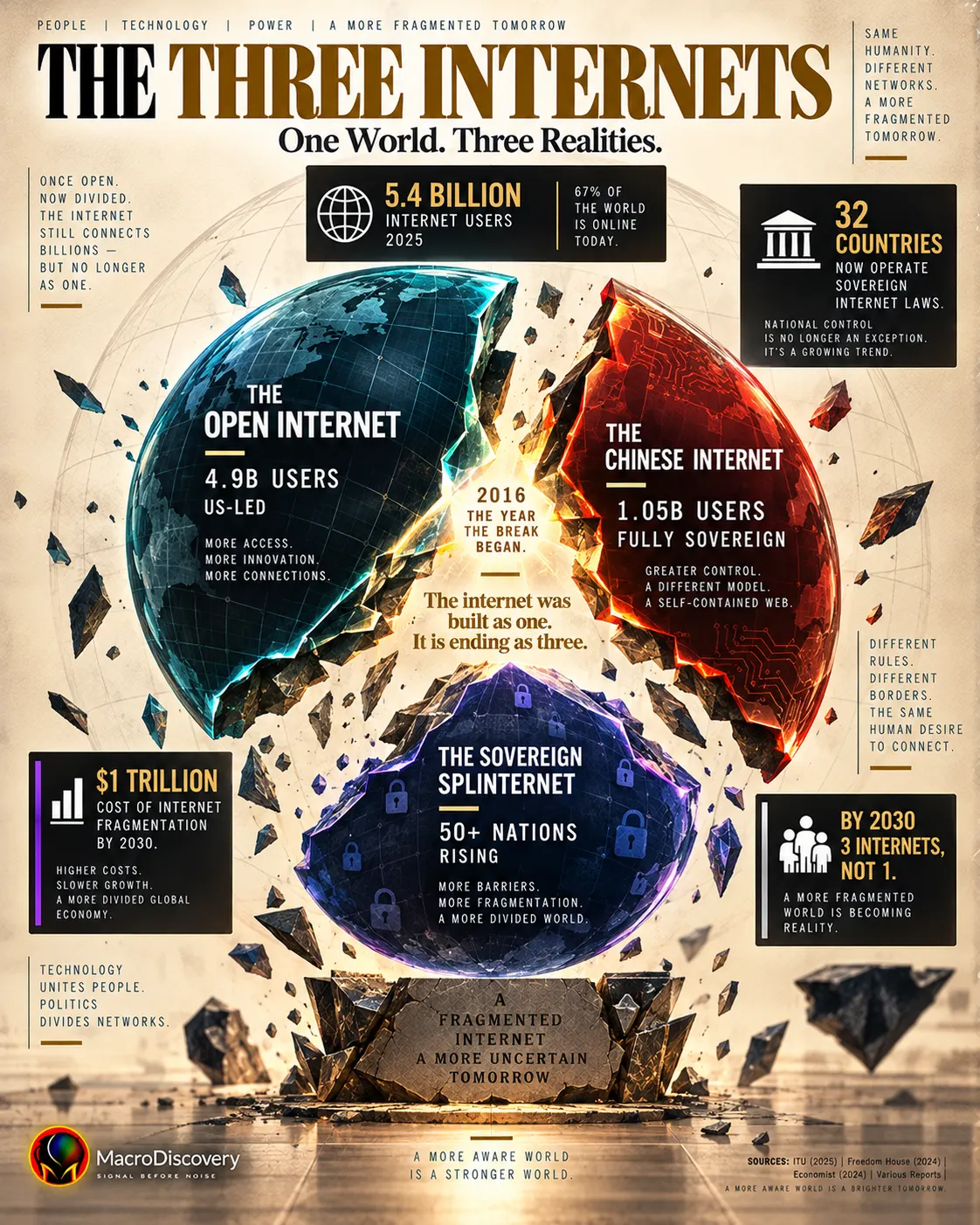
It is fracturing into three systems. The cables have not. The laws have.
Six billion people are online. Two billion are not. What they meet when they log on depends less on TCP/IP than on which capital wrote the terms of service.
Open the same address in California, in Guangdong, in Brussels. You may get a feed, a block page, or a cookie wall that wants a passport. The URL did not change. The jurisdiction did.
The Council on Foreign Relations framed this years ago as three internets: a United States model built on platforms and speech law, a Chinese model built on sovereignty and the Great Firewall, and a European model built on privacy statutes that travel with the market. That is a map of rulebooks. It is not three separate internodes.
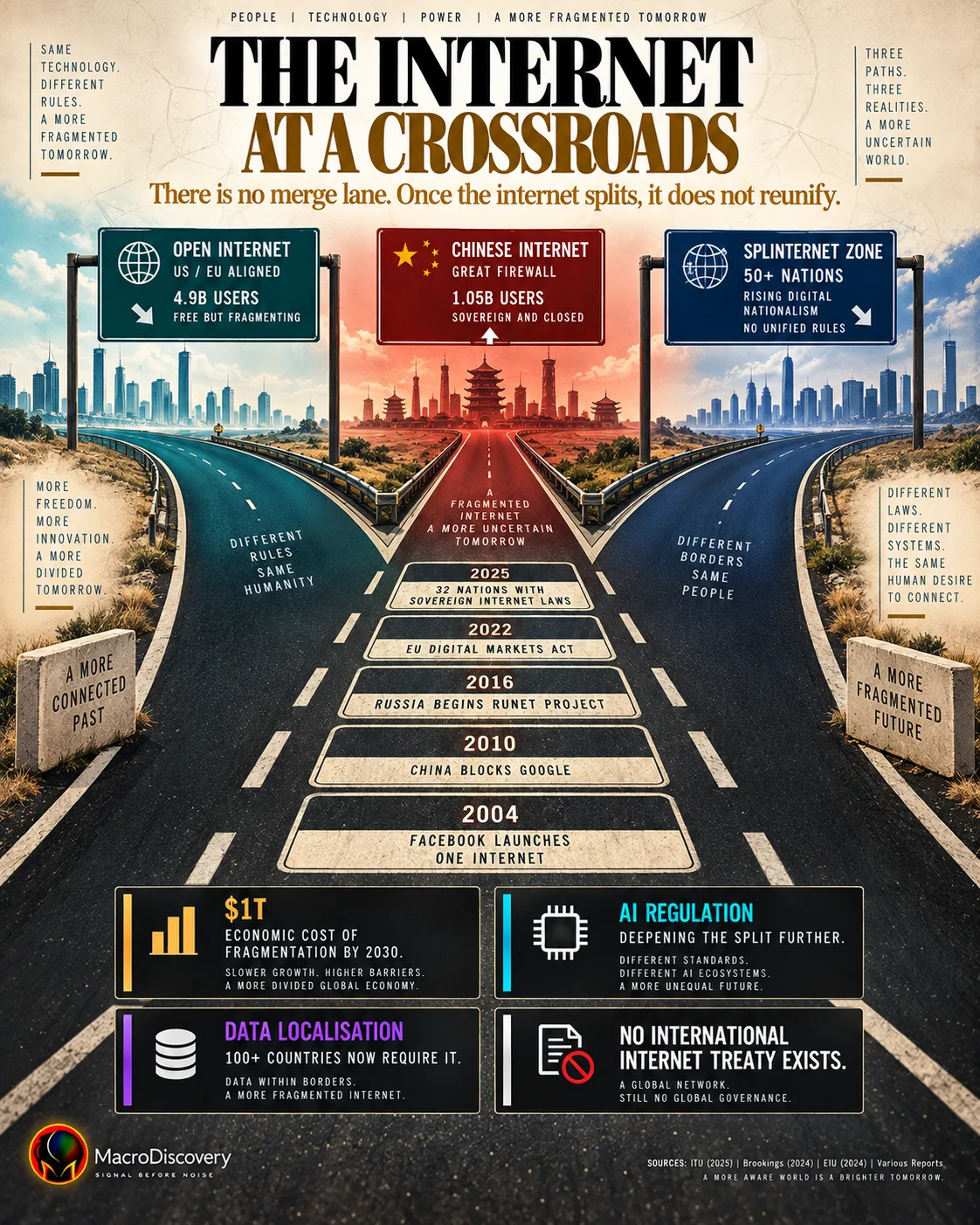
ITU’s 2025 count is the floor under the argument. About 6 billion people used the internet — 74% of the planet. 2.2 billion still do not. High-income countries sit at 94% use. Low-income countries sit at 23%. Fragmentation is a luxury argument until you are in the 2.2 billion.
Same packets. Different landlords.
Google, Apple, Amazon, Meta, Microsoft
Export controls and a forced TikTok split show Washington fragments too — it just calls it security.
WeChat, Alibaba, Baidu, ByteDance at home
A working domestic internet behind a filter. The kit is now an export product.
GDPR, DSA, DMA, AI Act
Few hyperscalers. A rulebook that follows the customer. “Brussels Effect,” not a wall.
India, Russia, the Gulf, Africa
Russia can legally isolate RuNet. India shutdowns and data rules sit between models. Do not pretend they vanish.
Three-quarters online is not three internodes
- —High-income countries94%
- —World74%
- —Low-income countries23%
6.0 billion users. 2.2 billion offline. 5G covers about 55% of people and about a third of mobile-broadband subscriptions. Quality is the new divide.
The internet is fracturing into three systems the way a language fractures into dialects. You can still hear the other room. You cannot always walk in.Macro Discovery reading of the CFR three-internets frame
Call them systems of law. Do not count three cables.
The subtitle is useful if it means power: who hosts, who filters, who fines. It is junk if it means the root servers have seceded. A video call from Nairobi to Shenzhen still traverses the same addressing scheme. What changed is the shopfront — which app is legal, which packet is inspected, which cloud is allowed to keep the log.
A fourth path keeps trying to enter the diagram: India’s non-alignment, Russia’s isolation switch (in force March 2026), satellite constellations that route around national choke points. Those are pressure on the three-way cartoon, not a reason to invent user tallies for “Internet A, B and C.” We do not have those tallies. Nobody honest does.
Editorial reading of ITU Facts and Figures 2025 and the CFR “Three Internets” framing. Those institutions did not write this box.If you remember two things
6 billion on. 2.2 billion off.
74% of humanity. The fracture debate is among people who already have a connection.
Three rulebooks, one protocol
U.S. platforms, Chinese sovereignty, EU statutes. Russia and India complicate the cartoon. Not three internodes.
Short answers
A user count and a policy cartoon
- Users: ITU Measuring digital development: Facts and Figures 2025 — 6 billion users (74%), 2.2 billion offline, 94% vs 23% by income, 5G covering ~55% of people.
- Three systems: Council on Foreign Relations “The Three Internets” — United States, China, European Union as regulatory models.
- Not claimed: headcount of users “on” each model; a technical split of TCP/IP; three cables.