Home AI Technology Gaming Future Automobile Geography Top 10 Trending How To Discover
---Advertisement---

Visualized: The Global Supply Chain

Macro Discovery
On: August 5, 2026 7:06 AM
Follow Us:
---Advertisement---
The Global Supply Chain , global supply chain risks chokepoints data , what is a global value chain and why does it matter, why did the Suez Canal crisis cause global supply chain problems , would reshoring supply chains make them more resilient , how concentrated is world trade data statistics , How fragile is the supply chain that runs the world? , what is global value chain , why is Taiwan so important to the global supply chain , how concentrated is world trade ,
The Global Supply Chain
Visualized: The Global Supply Chain — MacroDiscovery
MacroDiscovery
Trade & Economics · 5 min read · WTO · UNCTAD · OECD Primary
Global Trade Data — WTO GVC Report 2025 · UNCTAD · OECD
Global Trade & Supply Chain Risk

Visualized: The Global
Supply Chain

70% of all world trade runs through global value chains. Just 10 countries control 53.5% of what gets exported. One factory in Taiwan makes 64% of the world’s chips. When one link breaks — a canal, a war, a drought — the whole world feels it.

By MacroDiscovery
Sources: WTO · UNCTAD · OECD · World Bank · Dallas Fed
Data: 138 countries · 2024–2026
70%
of world trade runs through global value chains · OECD
50%
Suez Canal traffic dropped in Q1 2024 · one crisis, global impact
92%
of the world’s most advanced chips made in Taiwan · one island
10
countries control 53.5% of all global exports · WTO 2025
Visualization 01 — Chokepoint Risk Matrix
The World’s Most Fragile Nodes

Each row shows how dependent the world is on a single location or route. When these break, global trade breaks with them. Source: WTO · UNCTAD · OECD · CSIS · US EIA (2024–2025).

Critical — single point of failure
High — major disruption risk
Elevated — growing concentration
Monitored — manageable risk
🇹🇼 Taiwan — Advanced ChipsCritical
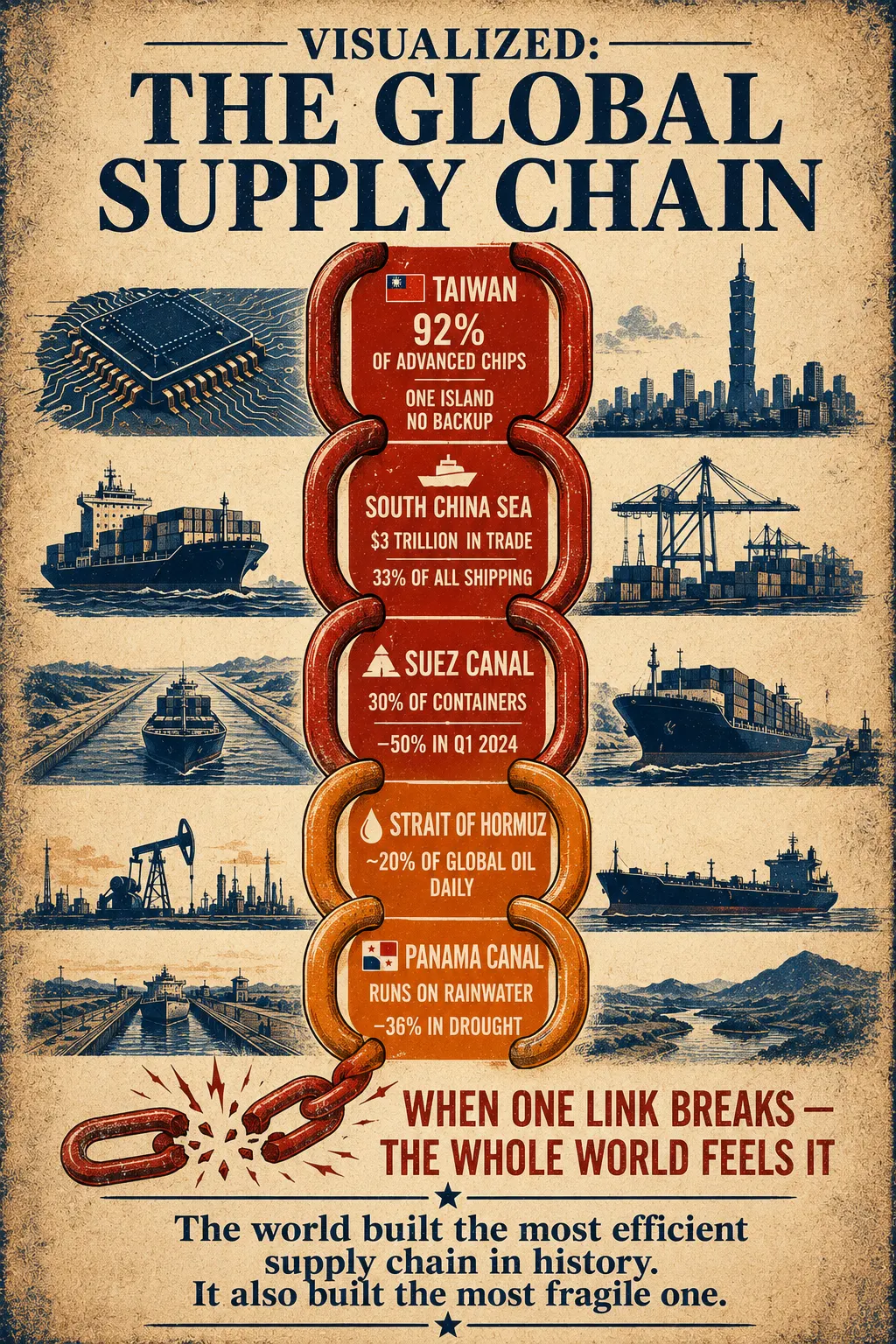
TSMC alone holds 64% of global chip foundry market · Taiwan makes 92% of the world’s most advanced logic chips · No alternative exists at scale
92% of adv. chips
🚢 South China SeaCritical
$3 trillion in trade passes through annually · ~33% of all global shipping · Territorial disputes between China, Vietnam, Philippines, and others
$3T / 33% shipping
🇪🇬 Suez CanalCritical
30% of all container traffic · 12% of global trade · Houthi attacks dropped throughput 50% in Q1 2024 · Ships rerouted adding 10–14 days
30% of containers
🛢️ Strait of HormuzHigh
~20% of global oil supply flows through it every day · Iran controls one shore · Any closure = instant global oil shock
~20% of global oil
🇵🇦 Panama CanalHigh
Runs on rainwater — El Niño drought cut crossings by ~36% in 2023–2024 · Climate change makes this worse every decade
−36% in drought
🌏 10 economies — exportsElevated
Just 10 countries produce 53.5% of the world’s export value · China, EU, US dominate · One disruption ripples everywhere · WTO 2025 primary
53.5% of exports
🇯🇵 Japan — PhotoresistHigh
Japan supplies ~80% of the world’s photoresist — the chemical that prints chip circuits · No chips get made without it · Almost no one else makes it
~80% of supply
🔄 Container shippingElevated
Capacity jumped ~10% in 2024 — biggest increase since 2008 · Oversupply + volatile demand = wild freight rate swings · Rates tripled during Red Sea crisis
+10% capacity 2024
Visualization 02 — Disruption Timeline
Every Shock That Hit the Global Supply Chain

From COVID to Houthi attacks to droughts — the supply chain has been hit again and again. Each time it gets a little harder to recover. Source: UNCTAD · WTO · World Bank GSCSI.

2020
Shutdown
COVID-19 — Factories Closed. Ships Stranded. Chips Vanished.
COVID shut factories worldwide overnight. Ships sat idle. The chip shortage hit cars, phones, and hospitals. The world learned it had built a supply chain with no backup plan.
Global factory shutdowns Chip shortage began
2021–2022
Boom
Shipping Companies Made Record Profits — Then Ordered Too Many Ships
Freight rates hit historic highs. Shipping companies made enormous profits. They used the money to order massive fleets of new vessels. Those ships arrived just as demand slowed down — creating a glut.
Record freight rates Cash-flow boom (UNCTAD)
2023
Double hit
Panama Canal Drought + Red Sea Attacks Begin
El Niño dried up the rainwater that fills the Panama Canal. Crossings fell 36%. Then Houthi attacks on Red Sea shipping began in late 2023. Two of the world’s most important trade routes under stress simultaneously.
Panama: −36% crossings Red Sea attacks start
Q1 2024
Crisis
Suez Canal Lost 50% of Traffic — Freight Rates Tripled
Container throughput through Suez dropped 50%. Ships rerouted around Africa. Every journey got 10–14 days longer. Asia-Europe freight rates tripled. Over 20% of global container traffic was disrupted at once.
Suez −50% containers Rates 3× on Asia-Europe 10–14 day delays
2025–2026
Rewiring
Trump Tariffs + Reshoring Race — But OECD Says Full Reshoring Backfires
US tariffs disrupted GVCs further. FDI in key supply chain sectors fell 25% (WTO). Countries rushed to reshore production. But OECD modelling shows full reshoring would cut global trade by 18% and shrink global GDP by 5% — more harm than good.
FDI in GVCs: −25% (WTO) CHIPS Act: US chips 10%→14% OECD: reshoring costs more

The global supply chain is the invisible infrastructure that connects every factory, port, and shop on earth. It works incredibly well — until it doesn’t. In 2024, just one conflict in the Red Sea disrupted over 20% of global container traffic. The world had built the most efficient supply chain in history. It had also built the most fragile one.

Global Trade · Scale of Dependence
70%
70% of all world trade now runs through global value chains.
A “global value chain” means a product is designed in one country, made from parts in ten others, assembled somewhere else, and sold worldwide. This system is incredibly efficient. It is also incredibly exposed. OECD analysis confirms that trying to fully reshore supply chains would cut global trade by over 18% and shrink world GDP by over 5%.
Source: OECD · WTO Global Value Chain Development Report 2025 (primary, December 2025)

“The world built the most efficient supply chain in history. It also built the most fragile one.”

One Canal Closes — The Whole World Waits

The Suez Canal carries about 30% of all container shipping. When Houthi attacks disrupted it in early 2024, ships couldn’t go through. They rerouted around Africa instead. Every journey got 10 to 14 days longer. Freight rates tripled on Asia-Europe routes. Over 20% of global container traffic was disrupted by one conflict in one region. That is how fragile the system is.

Why it matters: the global supply chain has almost no redundancy built in — efficiency was the goal, resilience was not.
Taiwan · The World’s Most Concentrated Risk
92%
Taiwan makes 92% of the world’s most advanced computer chips.
One company — TSMC — holds 64% of the global chip foundry market. It makes chips for Apple, Nvidia, AMD, and almost every major tech company. There is no viable alternative at scale. If Taiwan’s chip supply stopped, the global economy would feel it within weeks.
Source: Vision of Humanity (September 2025) · Global Taiwan Institute (March 2025) · US ITC Executive Briefing

The World Is Trying to Fix This — But It’s Harder Than It Looks

The US is investing to bring chip manufacturing home. TSMC is building a $65 billion plant in Arizona. With the CHIPS Act, the US chip share is projected to rise from 10% to 14% by 2032. But Taiwan’s advanced chip advantage won’t disappear soon. The gap in technology, skill, and scale is enormous. Reshoring takes decades, not years.

Why it matters: supply chain resilience is a 20-year project — not a political press release.
Reshoring Risk · OECD Warning
−18%
Full reshoring of global supply chains would cut world trade by over 18%.
OECD modelling shows that fully localising supply chains — making everything at home — would reduce global trade by more than 18% and lower world GDP by more than 5%. Resilience comes from diversification, not isolation. The answer is more suppliers in more places — not fewer connections.
Source: OECD Global Value Chain analysis · olimpwarehousing.com (July 2026) citing OECD directly

What Happens Next — The Supply Chain Is Being Rewired

The era of maximum efficiency is over. Companies now want resilience too. “Friendshoring” — moving supply chains to trusted allies — is growing fast. Vietnam, Mexico, and India are gaining manufacturing share. The WTO says globalisation is being rewired, not reversed. Trade is still happening. It’s just moving to different places, in more concentrated networks.

Why it matters: the supply chain isn’t breaking apart — it’s reorganising around geopolitics, and that reorganisation will take a generation.
Key Numbers at a Glance
Supply Chain · Trade Volume
$3T
Worth of trade that flows through the South China Sea every single year.
CSIS / US Defense Department
Supply Chain · Chip Risk
64%
TSMC’s share of global contract chip manufacturing. One company. One island. No real backup.
Vision of Humanity, Sept 2025
Supply Chain · Reshoring Cost
−18%
How much global trade would fall if countries fully reshored their supply chains. OECD modelling.
OECD global value chain analysis
Supply Chain · US Chips
14%
Projected US chip manufacturing share by 2032, up from 10% today, driven by the CHIPS Act.
Resilinc · SIA / CHIPS Act projections
Frequently Asked Questions
What is a global value chain?
A global value chain is how most modern products get made — designed in one country, using parts from ten others, assembled somewhere else, and sold worldwide. Around 70% of all world trade now works this way. Source: OECD · WTO Global Value Chain Development Report 2025 (primary).
Why did the Suez Canal crisis matter so much in 2024?
The Suez Canal carries 30% of all container shipping. When Houthi attacks forced ships to reroute in early 2024, throughput dropped 50%, freight rates on Asia-Europe routes tripled, and every shipment got 10–14 days longer. Source: UNCTAD · ResearchGate study (UNCTAD/IMF/WTO data basis).
Why is Taiwan so important to the global supply chain?
Taiwan makes 92% of the world’s most advanced computer chips. TSMC alone holds 64% of the global chip foundry market and makes chips for Apple, Nvidia, AMD, and most major tech companies. There is no viable alternative at scale. Source: Vision of Humanity (September 2025) · Global Taiwan Institute (March 2025).
Would reshoring supply chains make them safer?
Not necessarily — and the cost is enormous. OECD modelling shows full reshoring would cut global trade by over 18% and shrink world GDP by over 5%. The better answer is diversification: more suppliers in more countries, not fewer global connections. Source: OECD · olimpwarehousing.com (July 2026, citing OECD).
How concentrated is world trade?
Extremely concentrated. Just 10 economies produce 53.5% of all global domestic value-added on exports. China, the EU, and the US dominate — meaning a disruption in any one of them ripples through the entire world economy. Source: WTO Global Value Chain Development Report 2025 (primary, December 2025).
Sources
  • WTO — Global Value Chain Development Report 2025 (primary · 5th edition · December 15, 2025 · “10 economies = 53.5% of global domestic value-added on exports” · GVC participation decreasing · digitalisation focus · 73.4% of emissions in domestic chains)
  • UNCTAD — Review of Maritime Transport 2024 (primary · global seaborne trade 12.7 billion tons · +2.2% · container capacity +10% biggest since 2008 · post-pandemic boom/bust cycle)
  • WTO — Global Trade Outlook April 2025 (primary · merchandise trade volume 4.6% in 2025 · 1.9% projected 2026 · FDI in GVC-intensive sectors −25%)
  • World Bank — Global Supply Chain Stress Index (primary · worldbank.org · GSCSI developed 2021 · 1M TEU stress increase → $2,300/TEU freight rate impact)
  • ResearchGate — “The Impact of the Red Sea Crisis on Global Shipping” (UNCTAD/IMF/WTO data · Suez 50% throughput drop Q1 2024 · freight rates 3× · 10–14 day delays · 20%+ container traffic disrupted)
  • Vision of Humanity — “The World’s Growing Reliance on Taiwan’s Semiconductor Industry” (September 11, 2025 · TSMC 64% foundry share · Taiwan 92% advanced logic chip capacity · $165B output 2024 +22%)
  • Dallas Fed — Taiwan firms key to nearshoring (March 6, 2026 · TSMC Arizona $65B confirmed · Global Wafers $7.5B Texas · Taiwan FDI in US growing)
  • OECD (via olimpwarehousing.com July 2026) — full reshoring cuts global trade >18% and lowers GDP >5% · GVCs = ~70% of international trade at record levels 2024
  • CSIS / US Department of Defense — South China Sea $3 trillion in annual trade · ~33% of global shipping

Macro Discovery

Sukh Dhaliwal

Sukh Dhaliwal is the founder of Macro Discovery, an independent digital publication covering AI, technology, science, future trends, and global innovation through visual storytelling and data-driven analysis.

Join WhatsApp

Join Now

Join Facebook

Follow us

Leave a Comment