The Currencies That Will
Exist in 2050
The US dollar has ruled global finance for decades. But its share of world reserves has dropped from 72% to 56% since 2001. Meanwhile, 146 countries are building digital currencies — and China’s is already processing trillions.
Every country keeps a war chest of foreign currencies — called reserves — to protect its economy. For most of the last century, that war chest was filled almost entirely with US dollars. That is slowly changing. The dollar is still number one by far, but new rivals and digital currencies are reshaping the race.
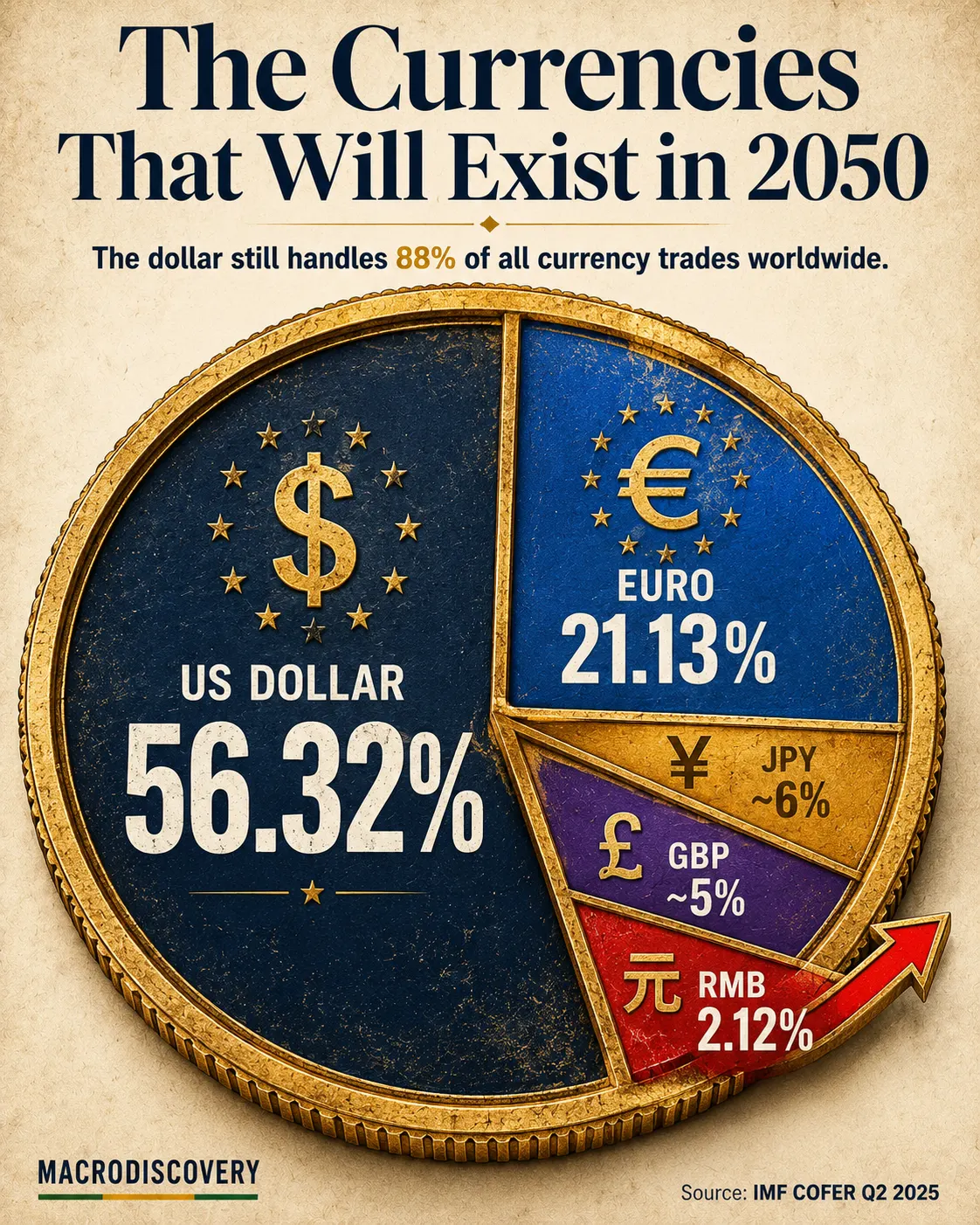
- The US dollar accounts for 56.32% of global reserves — down from 72% in 2001, but still by far the world’s most used currency.
- China’s renminbi holds just 2.12% of global reserves, even though China is the world’s largest trading nation.
- 146 countries are now building digital currencies — but only 3 have fully launched one, and the US has banned its own.
| Currency | Reserves Share | SWIFT Payments | FX Trading | Trend |
|---|---|---|---|---|
| 🇺🇸 US Dollar | 56.32% IMF COFER · Q2 2025 | 49.1% SWIFT · Aug 2024 | 88% BIS · 2022 | ↓ Slowly falling |
| 🇪🇺 Euro | 21.13% IMF COFER · Q2 2025 | 21.6% SWIFT · Aug 2024 * | 31% BIS · 2022 | → Holding steady |
| 🇯🇵 Japanese Yen | ~6% Federal Reserve · 2025 | ~4% Approx · 2024 | 17% BIS · 2022 | ↓ Slowly falling |
| 🇬🇧 British Pound | ~5% Federal Reserve · 2025 | 6.5% SWIFT · Aug 2024 | 13% BIS · 2022 | → Holding steady |
| 🇨🇳 Chinese Yuan | 2.12% IMF COFER · Q2 2025 | 4.7% SWIFT · Aug 2024 † | 7% BIS · 2022 | ↑ Rising slowly |
Sources: IMF COFER Q2 2025 · Federal Reserve 2025 Edition · BIS Triennial Survey 2022 · SWIFT August 2024
* Euro’s 21.6% SWIFT share includes payments between EU countries — adjusted for international use only, the real figure is closer to 9% (ECB). † China’s yuan share in SWIFT is understated — billions in daily yuan transactions go through China’s own CIPS system, which SWIFT doesn’t count (Federal Reserve, August 2024).
The Dollar Is Still King — but Slipping
In 2001, 72 cents of every dollar held in the world’s reserve tanks was a US dollar. Today that figure is 56 cents. That sounds like a big drop — but most of it happened because the euro and other currencies became more valuable against the dollar, not because countries deliberately stopped using it. The Federal Reserve said in 2025 that exchange-rate movements drove “nearly all” of the decline.
The dollar is still everywhere. It is used in 88% of all currency trades worldwide and handles 84% of global trade financing. Even in the crypto world, about 99% of stablecoins are pegged to the dollar. De-dollarisation — as it’s been called — is real, but it is moving slowly.
Why China’s Currency Isn’t Taking Over
China is the world’s biggest trading nation. You’d expect its currency — the yuan, also called the renminbi — to be widely used. But it only holds 2.12% of global reserves. The reason is simple: China keeps tight control over who can buy and sell yuan freely. Until that changes, other countries won’t trust it enough to stockpile it.
China has made real progress. Around a quarter of its own trade is now settled in yuan. It has signed currency deals with 40 countries. But its cross-border payment system ($60 billion a day) is tiny compared to the dollar system ($1,800 billion a day).
The Digital Currency Race
Almost every country on earth is now working on a digital version of its currency — called a CBDC. But only three small countries have actually launched one: the Bahamas, Jamaica, and Nigeria.
China is way ahead of everyone else. Its digital yuan has already processed the equivalent of $2.3 trillion in transactions. It is also running a cross-border system with Hong Kong, Thailand, UAE, and Saudi Arabia that has processed $55 billion so far.
The US is the odd one out. The government has actually banned the Federal Reserve from creating a digital dollar. Europe plans to launch a digital euro — but not before 2029 at the earliest.
The real battle is not just about which currency is most popular. It is about which payment system the world uses. Right now the dollar runs on US-controlled networks. China is quietly building alternatives.
What About a BRICS Currency?
You may have heard that Brazil, Russia, India, China, and South Africa — the BRICS countries — are planning a shared currency to challenge the dollar. The short answer: it is not happening. At their July 2025 summit in Rio, the official documents did not even mention de-dollarisation. India and South Africa have both said publicly there are no plans for a shared currency. What they did agree on was using their own national currencies more in trade with each other — which is much more modest.
So Which Currencies Will Exist in 2050?
Almost certainly all the ones that exist today — the dollar, euro, yen, pound, and yuan. What will change is how much each one is used, and how it moves around the world. No major international body — not the IMF, World Bank, or Federal Reserve — has published a forecast for 2050. That is because 25-year predictions about money are nearly impossible to get right.
What is clear is this: the dollar will likely still lead, but with a smaller share. The yuan will grow — especially if China opens its financial markets. Digital currencies will become normal. And the infrastructure through which money flows — the pipes, not the water — may matter more than which currency sits at the top.
- IMF — Currency Composition of Official Foreign Exchange Reserves (COFER) · Q2 2025
- Federal Reserve — “The International Role of the U.S. Dollar: 2025 Edition” · July 2025
- Federal Reserve — “Internationalization of the Chinese Renminbi” · August 2024
- BIS — “Advancing in tandem: 2024 CBDC Survey” · BIS Paper 159 · 2025
- BIS — Triennial Central Bank Survey of FX Markets · 2022
- SWIFT — Monthly Currency Share Data (MT103 + MT202) · August 2024
- Atlantic Council — CBDC Tracker · 2026
- BRICS — Official Rio de Janeiro Summit Declaration · July 2025
- Eichengreen, B. et al. — “The renminbi’s unconventional route to reserve currency status” · CEPR · 2022