India vs. Japan — The Economy That Overtakes First
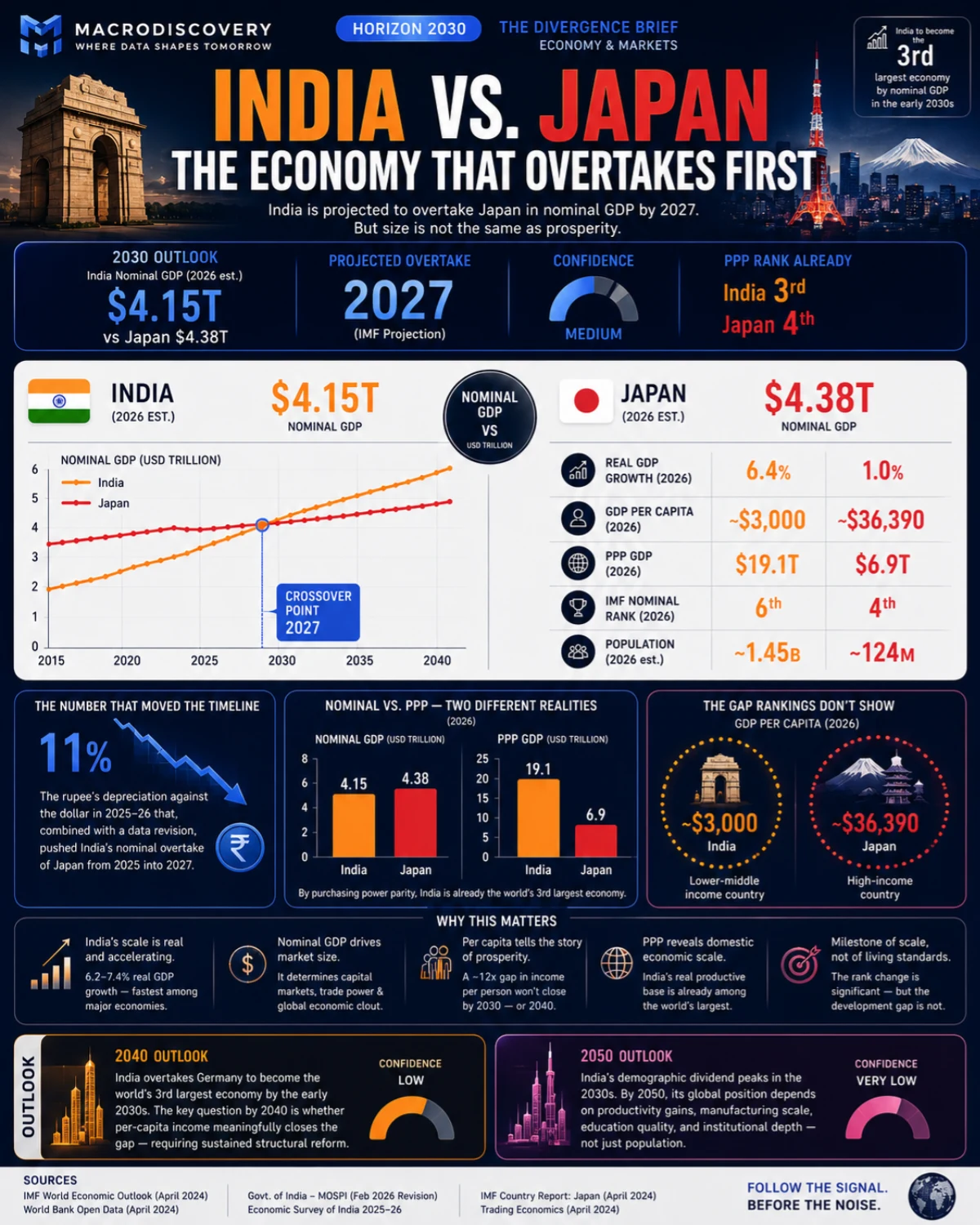
India is forecast to surpass Japan in nominal GDP by 2027. But what an economy’s size says about its citizens’ lives is a completely different — and far more uncomfortable — comparison.
2026 EST.
VS
The race between India and Japan for the world’s fourth-largest economy ranking turned out to be more complicated than the headline suggested. A February 2026 revision to India’s GDP data — using a new base year — knocked the figure down enough that instead of overtaking Japan in 2025 or 2026 as widely expected, the IMF now projects the crossing won’t happen until 2027. A story that was nearly written became a story still unfolding.
Known — India’s February 2026 GDP revision reduced nominal GDP from ₹357 trillion to ₹345.5 trillion in the new series — a 3-4% correction that, combined with an 11% rupee depreciation against the dollar, pushed the overtake date back materially. Japan’s 2026 nominal GDP stands at approximately $4.38 trillion; India’s at approximately $4.15 trillion.
Projected — the IMF projects India will overtake Japan in nominal terms by 2027, and Germany by 2031, to become the world’s third-largest economy. India is already the third-largest economy by purchasing power parity — a position it has held since before 2010.
Speculative — the exact timing of the nominal overtake remains sensitive to rupee-dollar exchange rate movements, which can shift the ranking without any change in real output on either side.
The Number That Actually Changed
The delay in India’s overtake of Japan is instructive precisely because it reveals the mechanics behind headline GDP rankings. India’s real GDP growth remains firmly in the 6.2-7.4% range — the fastest of any major economy globally. But nominal GDP in dollar terms is a product of both real output and exchange rates, and neither of those is fully under India’s control. The rupee’s 11% depreciation against the dollar in 2025-26 alone was enough to erase what would have been a clean crossing. Japan’s relatively stable yen position and higher base meant its dollar GDP held up better, despite near-zero real growth.
On PPP, India Already Won — Years Ago
The nominal ranking debate obscures a more durable fact: by purchasing power parity, which adjusts for what money actually buys inside each country rather than what it converts to at market rates, India is already the world’s third-largest economy with a PPP GDP of approximately $19.1 trillion in 2026. Japan’s PPP GDP, by contrast, sits at approximately $6.9 trillion — less than half. The PPP gap exists because the same basket of goods costs a fraction as much in India as in Japan, which means India’s domestic economic activity is far larger in real terms than the exchange-rate conversion suggests.
For investors comparing markets, the nominal GDP ranking is the more operationally relevant one — it’s what determines the dollar size of India’s capital markets, the scale of dollar-denominated corporate revenues, and the purchasing power of Indian consumers for internationally traded goods. But the PPP figure captures something nominal rankings miss: the scale of India’s domestic economy, which is already the third-largest productive base in the world. Both numbers are real. They’re measuring different things.
The Gap That Doesn’t Close by 2030
Here is the comparison that no headline about “India overtaking Japan” typically includes: India’s GDP per capita in 2026 is approximately $3,000. Japan’s is approximately $36,390. India’s population is roughly 10 times Japan’s, which means that even when total GDP crosses, the average Indian citizen’s economic output is roughly one-twelfth that of the average Japanese citizen. That gap doesn’t close by 2030, or 2040. The World Bank still classifies India as a lower-middle-income country. Surpassing Japan in total GDP is a milestone of scale, not prosperity — and the distinction matters for how useful the ranking actually is as a signal.
What This Actually Tells You
The India-Japan overtake is a real and meaningful shift — it reflects a genuine and durable change in where economic mass is concentrating globally, reinforced by demographic tailwinds, capital investment momentum, and India’s unique position as the only top-10 economy growing at both high speed and high absolute scale simultaneously. What it doesn’t tell you is anything about average living standards, purchasing power, or the development gap, which remains enormous and won’t be resolved by a rank change. The milestone is worth tracking. The number behind it — per capita income — is worth tracking more.

Sukh Dhaliwal
Sukh Dhaliwal is the founder of Macro Discovery, an independent digital publication covering AI, technology, science, future trends, and global innovation through visual storytelling and data-driven analysis.


Trending News

Funny Elephants: 13 Hilarious Moments That Will Make You Smile
What If Earth Were the Size of a Basketball?
Visualized: The Economics of Longevity
Ranked: The Countries Winning the Green Energy Race
Compared: The Future of Work From Home


©2026 MacroDiscovery.com • All rights reserved