The Economics of War
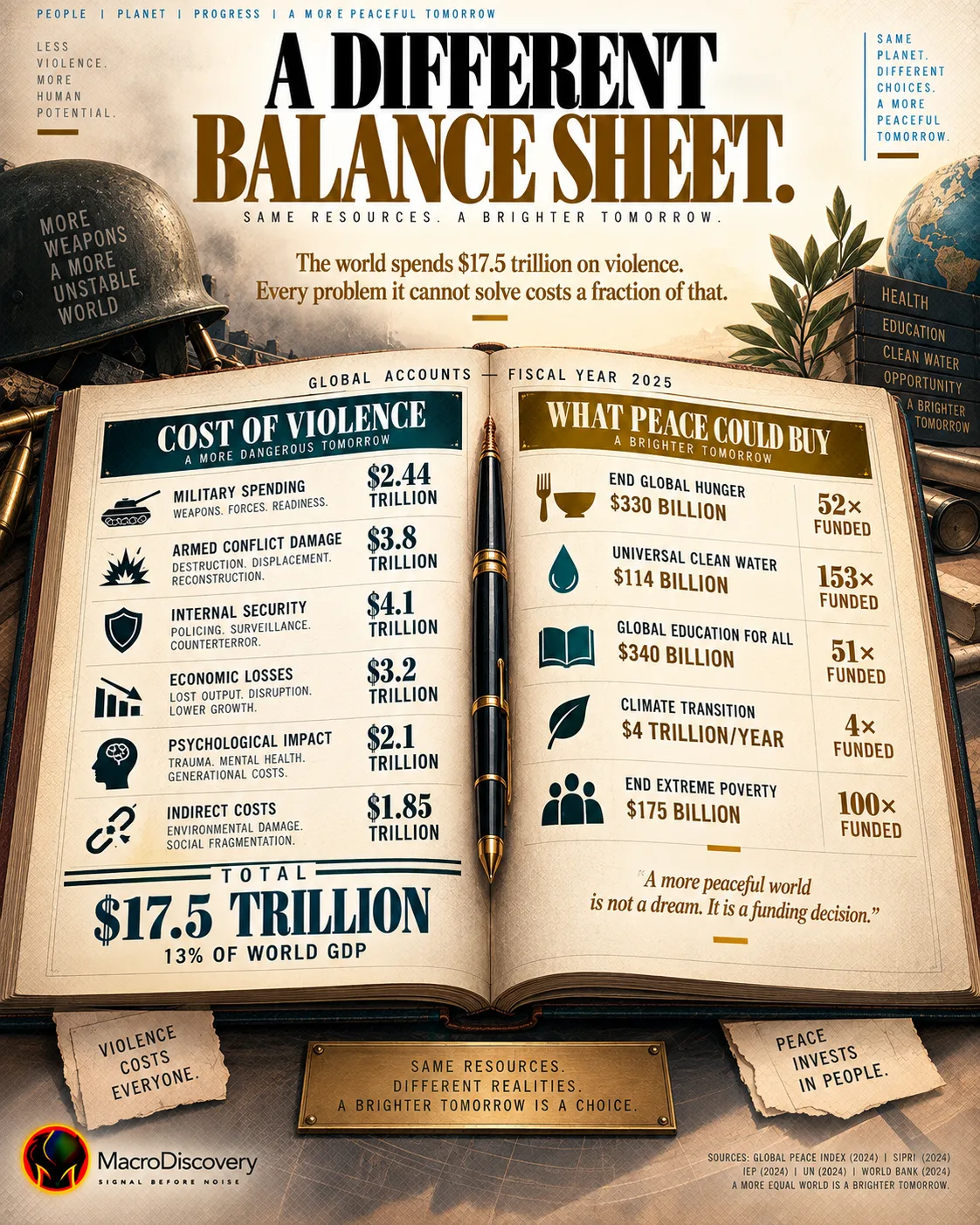
Violence cost the world $21.8 trillion in 2025 on the Institute for Economics and Peace’s ledger — 10.5% of global GDP. The $17.5 trillion / 13% line is last year’s postcard.
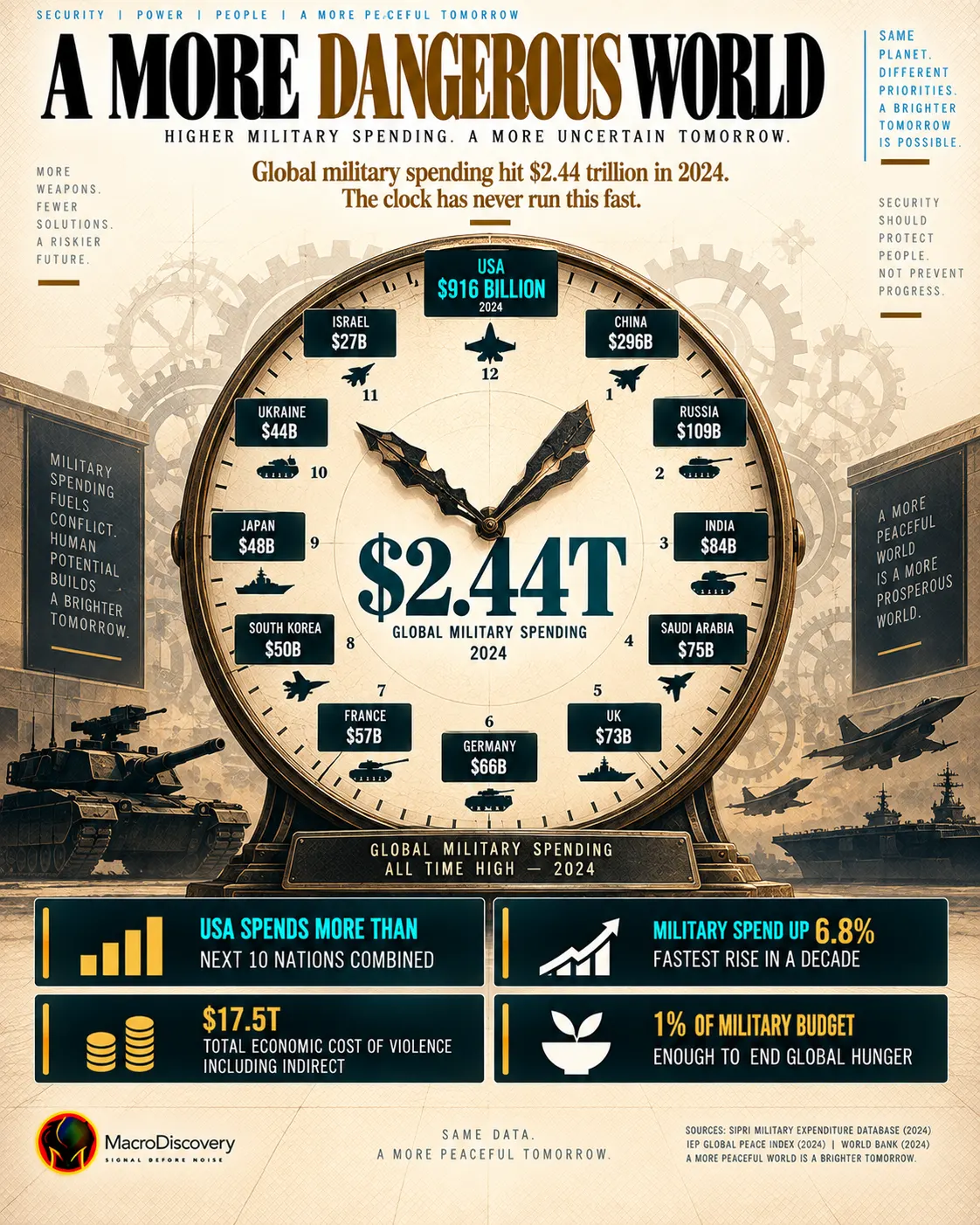
That $21.8 trillion is PPP, with multipliers. The cash military bill IEP cites for 2025 is about $2.9 trillion. Ukraine’s own burden: 46% of GDP. Peacekeeping got $49 billion — half a percent of the model’s military pile.
The number that still circulates is $17.5 trillion and 13% of world GDP. That was an earlier IEP vintage. The 2026 Global Peace Index, covering 2025, prints $21.8 trillion in constant PPP terms — 10.5% of global GDP, or $2,657 per person. Up 3.2% on the year, mostly because militaries spent more.
Read the composition before you treat $21.8 trillion as a war invoice. IEP’s model is containment plus harm plus a multiplier. Military spending is 43% of the pile ($9.5 trillion in the model). Internal security is another 29%. Together they are 73%. Homicide, fear, private guards and lost output fill the rest. The cash military budget IEP flags for 2025 is about $2.9 trillion — a different, smaller book. Do not add them.
Most of the “cost of war” is the security state
- —Military (in the model)$9.5T
- —Internal security$6.4T
- —Private security$1.5T
- —Homicide (model)$1.2T
- —All violence impact$21.8T
Military + internal security = 73%. Peacebuilding and peacekeeping: $49.2 billion — 0.5% of the model’s military spending.
Ukraine at 46%. The peaceful ten at 2%.
In the ten countries most chewed by violence, IEP’s cost averaged 23.4% of GDP in 2025. In the ten most peaceful, 2.2%. Ukraine sits at the top of the hurt list: 45.8% of its own output, after military outlays, deaths, lost GDP and displacement. Afghanistan, North Korea and Syria follow. That is a national-accounts wound, not a global average wearing a helmet.
10.5% of world GDP · PPP
Not $17.5T. Not 13%.
IEP / GPI briefing
The budget line. Not the $9.5T model slice.
Highest national burden
Then Afghanistan 31%, North Korea 27%, Syria 25%.
IEP
Six times the 2008 level on their series.
$21.8 trillion is a model of containment. $2.9 trillion is a budget. 46% of Ukrainian GDP is a country on fire. Keep the three sentences apart.Macro Discovery reading of GPI 2026
The economics of war is mostly the economics of standing armies.
People hear “cost of violence” and picture rubble. IEP’s biggest bars are salaries, jets and police — spending that exists in peacetime Switzerland too, just smaller. The multiplier then doubles a lot of it. That is a legitimate way to price containment. It is not a receipt from a front. If you want the receipt, use the $2.9 trillion cash military figure, or Ukraine’s 46%, or the 181,000 dead.
Peacekeeping at $49 billion against a $9.5 trillion military bar in the same model is the other sentence. The world does not have a peace budget. It has a security budget with a rounding-error for repair.
Editorial reading of GPI 2026 economic-impact tables. IEP did not write this box.If you remember two things
$21.8 trillion PPP. 10.5% of GDP.
The $17.5T / 13% postcard is retired. Per person: $2,657.
Model $9.5T military ≠ cash $2.9T military
73% of the impact model is military plus internal security. Ukraine: 46% of its GDP.
Short answers
One IEP model. One cash budget. One national wound.
- Headline: GPI 2026 — $21.8 trillion PPP economic impact of violence in 2025; 10.5% of world GDP; $2,657 per person; +3.2% year on year.
- Composition: military 43% / $9.5T in the model; internal security 29%; together 73%. Peacebuilding $49.2B.
- Cash military: about $2.9 trillion in 2025 as cited in the GPI briefing (not added to the $21.8T).
- National: Ukraine 45.83% of GDP; 10-most-affected average 23.4%; 10-least 2.2%.
- $17.5T / 13%: prior IEP vintage. Not used as current.