The Global Child Labor Map
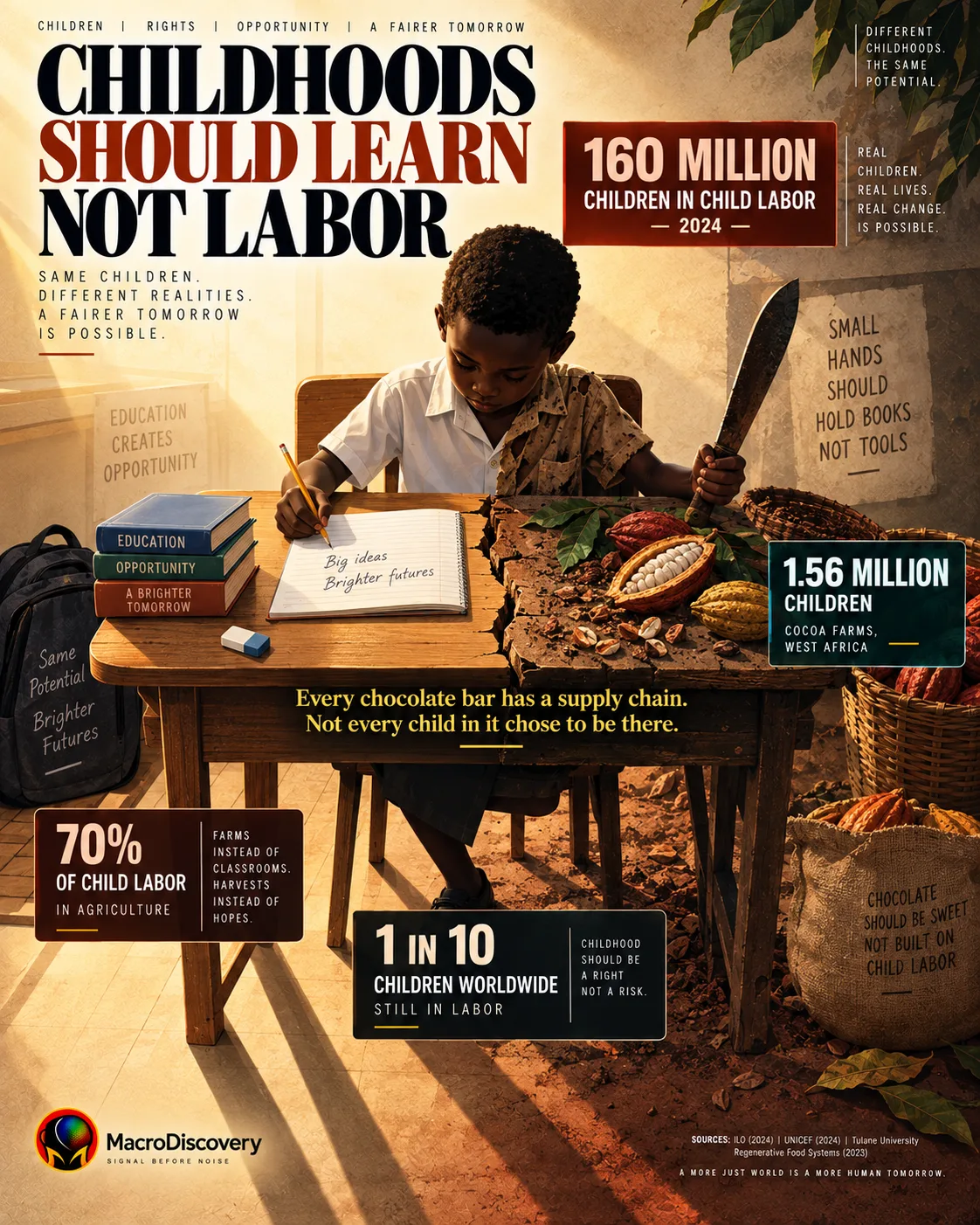
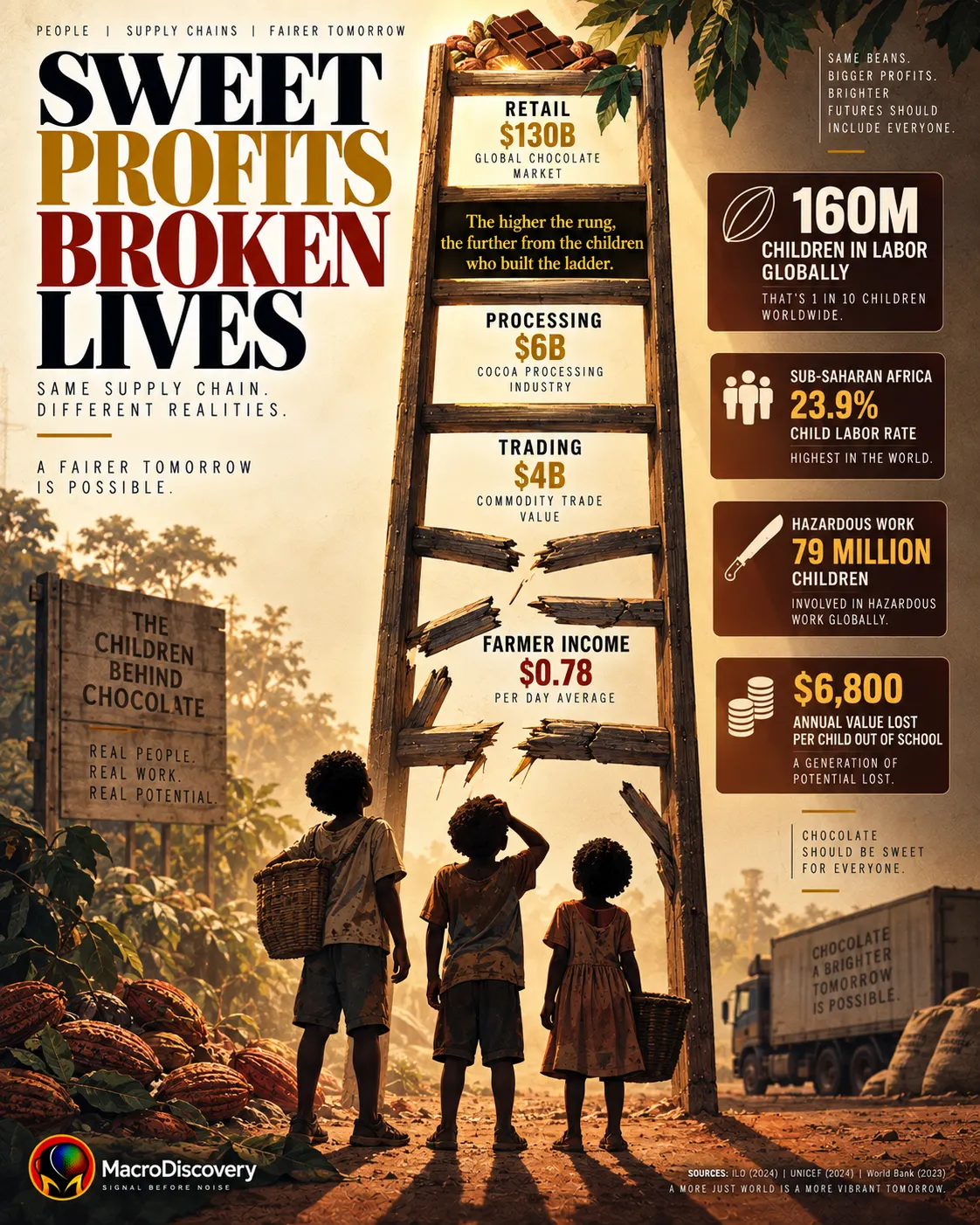
160 million was the 2020 count. The new estimate is 138 million. Cocoa is one reason — not the map.
Most of these children are not in a factory with a brand on the gate. They are on a family plot, carrying a load that is too heavy, missing a school day that will not come back.
The number people still quote is 160 million. That was the ILO–UNICEF estimate for 2020, after a bad four-year rise. The 2024 estimate, published in 2025, is lower: nearly 138 million children aged 5 to 17 — 7.8% of that age group. About 54 million of them do hazardous work.
That is progress. It is not the finish line the world promised. SDG Target 8.7 said child labour would be gone by 2025. The year ended. The work did not.
Cocoa belongs on this map. It does not fill the map. In Côte d’Ivoire and Ghana — which grow most of the world’s cocoa — a U.S.-funded NORC study counted about 1.56 million children in cocoa-related child labour in the 2018/19 season. That is a serious industry problem. It is roughly one child in ninety on the global list.
Sub-Saharan Africa holds the headcount. Asia cut faster.
Sub-Saharan Africa has 86.6 million children in child labour — about two-thirds of the world total. Prevalence there is still about one child in five (21.5%), down from 23.9% in 2020. The rate fell. Population growth kept the headcount stuck.
Asia and the Pacific halved prevalence. Latin America edged down. Europe and North America sit at 1.8%. The map is not even.
- 01Sub-Saharan Africa86.621.5%
- 02Central & Southern Asia17.06.3%
- 03Eastern & SE Asia13.25.5%
- 04Latin America & Caribbean7.35.4%
- 05N. Africa & W. Asia6.38.3%
- 06Europe & N. America2.31.8%
Badges are prevalence — share of children aged 5–17 in that region. Africa leads on both headcount and rate.
Agriculture holds 61%. A chocolate bar is not the typical job.
About 84 million children in child labour work in agriculture — farming, herding, fishing, forests. That is 61% of the global total. Services hold 27%. Industry, including mines and workshops, holds about 13%.
Most of the agricultural work is unpaid family labour on a small plot. The child is not on a contract with Nestlé. The child is carrying water, swinging a tool, missing class because the harvest does not wait.
The main sector
Farms, herds, fishing. In Sub-Saharan Africa the farm share rises toward 70%.
NORC, 2018/19 season
45% of children in agricultural households in those cocoa areas. Most of them did a hazardous task.
Tools, loads, chemicals
Work that can hurt health, safety, or morals. Down 25 million since 2020.
160 million → 138 million
The 160 million headline is four years old. Use it as history, not as today’s count.
West Africa grows most of the chocolate. It does not grow most of the child labour.
Côte d’Ivoire and Ghana produce about 60% of the world’s cocoa. The NORC study for the U.S. Department of Labor, covering 2018/19, found 1.56 million children in cocoa-related child labour there — about 790,000 in Côte d’Ivoire, 770,000 in Ghana. Among children in agricultural households in those cocoa areas, prevalence was 38% in Côte d’Ivoire and 55% in Ghana. Almost all of those children did at least one hazardous task: a blade, a heavy sack, a chemical.
That study is older than the new global estimate. It is still the best public headcount for those two cocoa belts. It is not a 2024 world total. And it is not proof that “chocolate causes 160 million child workers.” Family grain, livestock, domestic service, and small workshops hold far more children than the chocolate aisle.
Cocoa is a spotlight. Agriculture is the stage. Confusing the two makes a grocery problem look like the whole labour map.Macro Discovery reading of ILO–UNICEF 2024 and NORC 2018/19
The cheap story is the branded crop. The expensive story is the family farm.
A chocolate company can be named. A millet plot cannot. That is why cocoa owns the headline and sorghum does not. The 1.56 million cocoa figure matters for anyone who sells a bar. It does not explain the other 136 million.
Africa’s rate fell and its headcount did not. That is demography meeting a farm. More children were born into the same thin livelihood. Asia cut faster because school and wages moved. The missed 2025 deadline is not a rounding error. It is what happens when the target is global and the work is unpaid and rural.
Keep three clocks: 160 million (2020), 138 million (2024), 1.56 million cocoa (2018/19, two countries). None of them add.
Editorial reading of ILO–UNICEF Child Labour Global Estimates 2024 and NORC/USDOL cocoa research. Those agencies did not write this box.If you remember two things
138 million now. 160 million then.
Down more than 22 million since 2020. Hazardous work down 25 million, to 54 million. The 2025 elimination target was missed.
1.56 million in two cocoa countries
2018/19 season, Côte d’Ivoire and Ghana. One reason on a map that is mostly other farms.
Short answers
A new global count and an older cocoa study
- World total: ILO–UNICEF Child Labour: Global estimates 2024. ~137.6 million; we say 138 million as the agencies do in headlines. Hazardous work: 54 million.
- 160 million: the 2020 estimate, kept as the previous peak, not as today’s figure.
- Regions: Sub-Saharan Africa 86.6M (21.5%); other regions as published in the 2024 FAQ / figures note.
- Sectors: agriculture 61% (~84 million); services 27%; industry ~13%.
- Cocoa: NORC at the University of Chicago for the U.S. Department of Labor, 2018/19 cocoa season, Côte d’Ivoire and Ghana: 1.56 million.
- Bars: regional headcounts scaled to 86.6 million = 100%.