Life at $1, $10, $100
Life at $1, $10, and $100 a day. Three worlds, one chart.
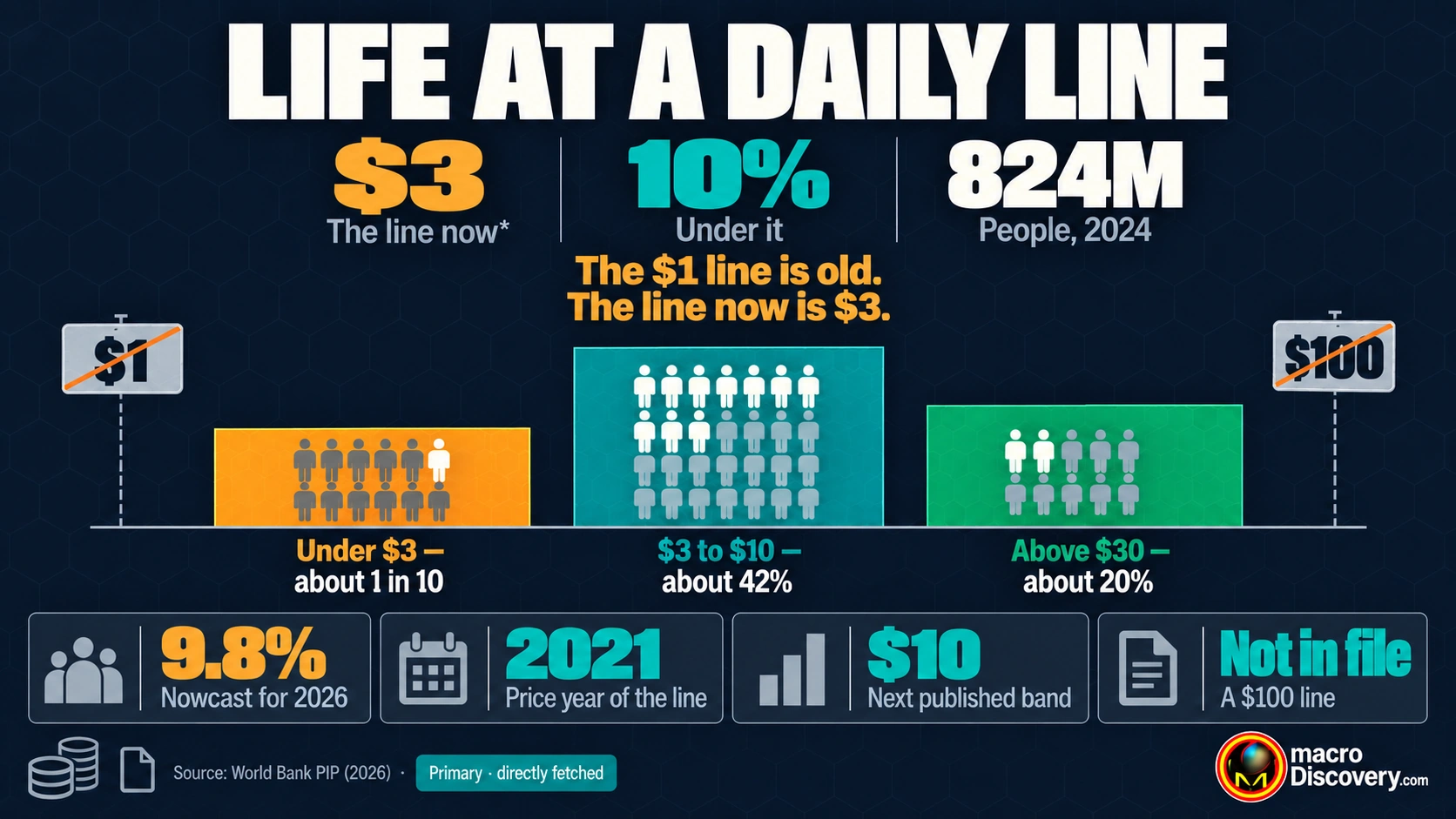
A dollar a day is a 1990 slogan. The line is now $3. About 824 million people were under it in 2024. Ten dollars is above the upper-middle line.
Three numbers
- $3 a day — the World Bank’s extreme-poverty line, in 2021 purchasing-power prices. Set in June 2025. Source: World Bank.
- 824 million — people under that line in 2024, about 10.1% of the world. Source: World Bank, September 2026.
- $8.30 a day — the upper-middle international line, revised from $6.85. Ten dollars is above it. Source: World Bank.
What the data shows
A common claim is that life splits cleanly at $1, $10, and $100 a day. The fact is that $1 is a slogan from 1990, and $100 is not a poverty line at all. The World Bank’s extreme-poverty line started as a dollar a day. It became $1.25, then $1.90 in 2011 prices, then $2.15 in 2017 prices. In June 2025 it was reset at $3 a person a day in 2021 purchasing-power prices. The two lines used for lower-middle and upper-middle countries moved from $3.65 to $4.20 and from $6.85 to $8.30. The dollars are a common price unit. They are not cash in a pocket in New York.
The count under $3 is about 824 million people in 2024, or 10.1% of the world. The September 2026 update projects 9.8% by 2026. The move from $2.15 to $3 was not only inflation. Our World in Data noted that an inflation-only update would have put the line near $2.38 and the 2024 count near 540 million. The revised line put it near 817 million, later 824 million in the September release. About 125 million people were added by the new yardstick, not by a fall in income. Rates are under 5% in most regions. They remain high in sub-Saharan Africa, and they are rising in the Middle East, North Africa, Afghanistan, and Pakistan.
Ten dollars and a hundred dollars are not the other two lines. The upper-middle international line is $8.30. Ten dollars a day is above it. A hundred dollars a day is about $36,500 a year, far above any line the World Bank uses to count the poor. Putting it on the same chart as $1 makes a rich-country income look like a third rung of poverty. The three rungs in the data are $3, $4.20, and $8.30. The headline rungs are a slogan, a number above the top line, and a salary.
$100 a day is about $36,500 a year. It is not a poverty line.
| Count | Figure | What it is |
|---|---|---|
| Old slogan | $1 a day | 1990 line. Retired |
| Extreme line | $3 a day | 2021 prices. Set June 2025 |
| People under it, 2024 | 824 million | 10.1% of the world |
| Lower-middle line | $4.20 | Was $3.65 |
| Upper-middle line | $8.30 | $10 is above it |
How it was measured
The extreme line is the median national poverty line of low-income countries, converted to a common price year. The June 2025 reset used 2021 purchasing-power rates. A higher dollar figure can be a new price year, not a harder life. Our World in Data separated the inflation piece from the line change. Most of the added count was the yardstick.
Survey coverage is not complete every year. The 2024 figure is the latest with enough surveys. The 2025 and 2026 shares are nowcasts from growth projections. A nowcast is not a household interview. Purchasing-power dollars are not what a market stall charges in local notes.
What it means
It is settled that the extreme line is $3 in 2021 prices, that about 824 million people were under it in 2024, and that the upper-middle line is $8.30. It is not settled that $1, $10, and $100 are the three worlds. Use $3 for the extreme line. Use 824 million for the count. Use $8.30 for the top international line. Do not use $1 as the current line, or $100 as a poverty rung.
Common misreadings
- $1 a day is a 1990 slogan. The line is $3 in 2021 prices.
- The jump from $2.15 to $3 added people by changing the yardstick.
- $10 is above the $8.30 line. $100 a day is not a poverty category.
Where the numbers come from
How we built this
- Dataset: World Bank poverty lines in 2021 prices; September 2026 headcount; Our World in Data split of the line change.
- Scope: International lines only. $1 and $100 kept as the slogan and a non-line.
- Figures: $3 is the extreme line. 824 million is the 2024 count. $8.30 is the upper-middle line. $1 is treated as retired.