The 10 Most Powerful
Supercomputers on Earth
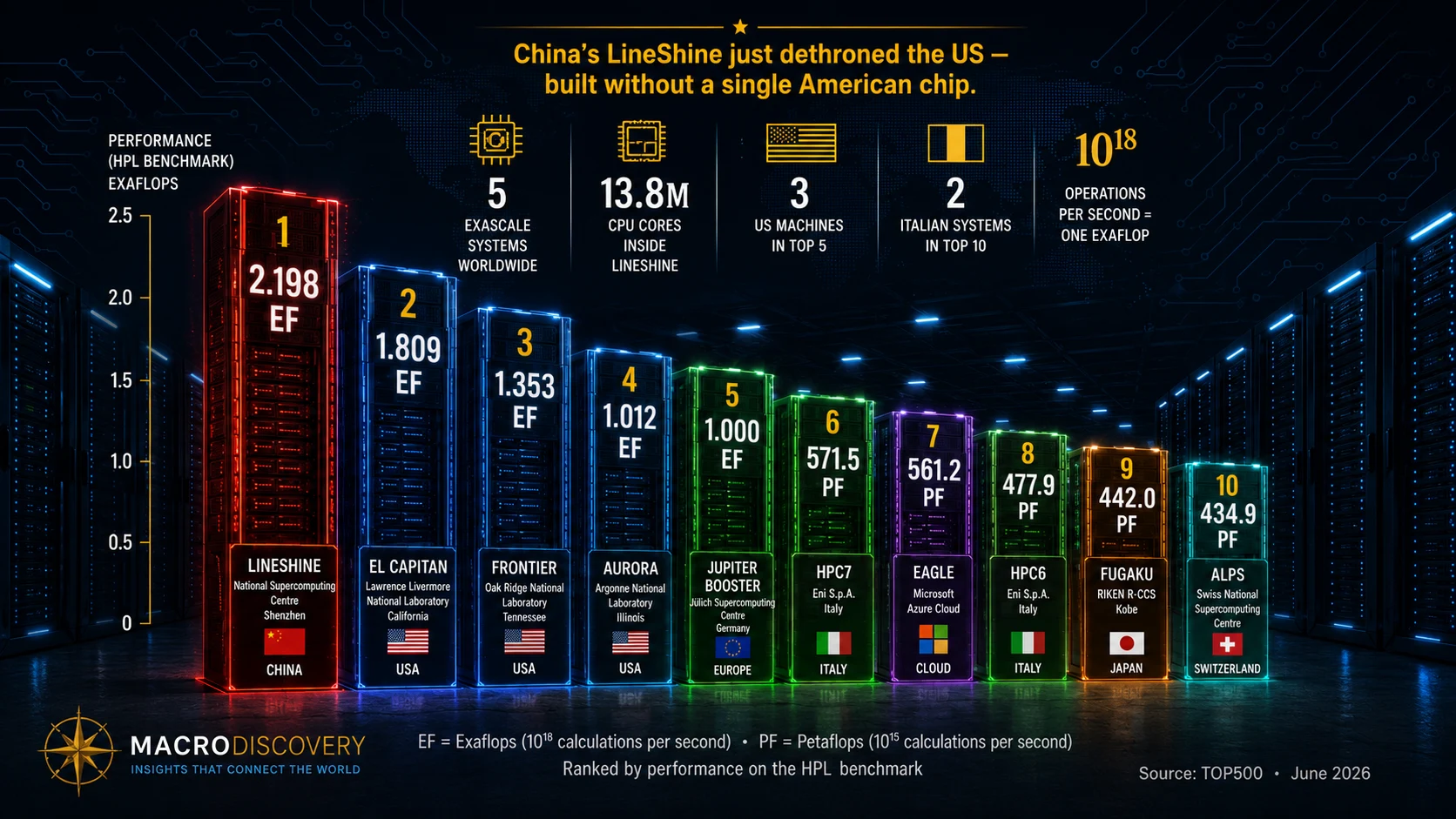
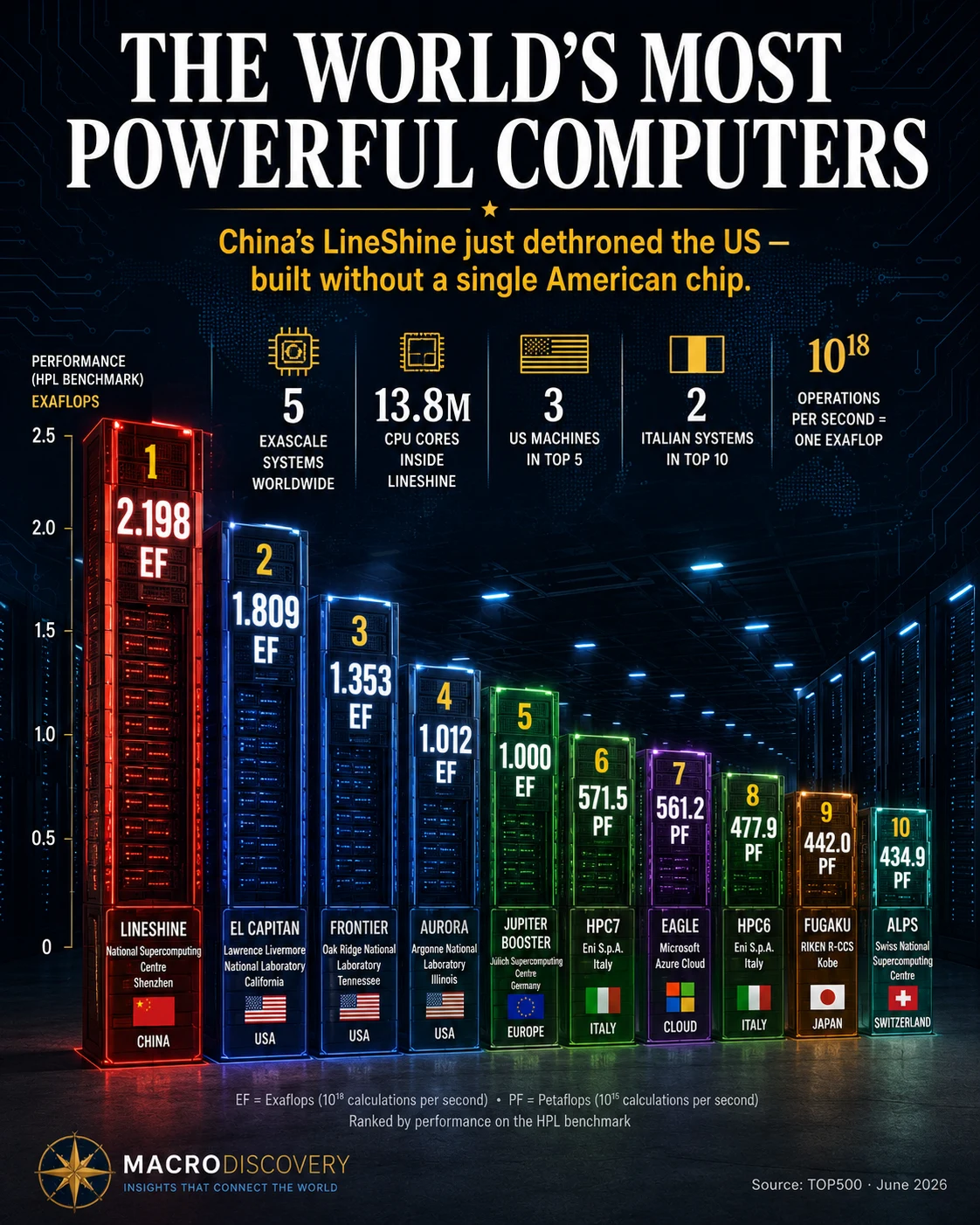
China’s LineShine just took the number one spot — built entirely from domestic chips, with no American technology inside. Five machines now exceed one quintillion calculations per second. And the real fastest computers on Earth aren’t even on this list.
The world’s most powerful supercomputers are used to simulate nuclear weapons, model the climate, fold proteins, crack encryption, design drug candidates, and run the physics of the universe backward to understand the Big Bang. They are civilization’s most extreme tools. The list of who has them — and who just took the top spot for the first time in nine years — tells you something important about where global power is actually moving.
- China’s LineShine debuted at #1 on June 23, 2026 — the first Chinese system to lead the TOP500 since Sunway TaihuLight in 2017. It uses no US-made chips, built entirely on domestic Chinese processor technology.
- Five machines now exceed one exaflop — one quintillion (10¹⁸) calculations per second. A year ago there were four. The exascale era has arrived and is expanding.
- The US holds three of the top five — El Capitan (#2), Frontier (#3), and Aurora (#4) — all at Department of Energy national laboratories. El Capitan leads on the AI benchmark despite being #2 overall.
- Italy has two systems in the top 10 — both operated by Eni, an oil and gas company, for seismic imaging and energy research. Industrial supercomputing is now elite-tier.
- The fastest computers on Earth are probably not on this list. AI hyperscalers like xAI, Google, Amazon, and Microsoft have systems that experts believe would dominate the rankings — but they don’t submit to TOP500.
Source: TOP500 67th Edition · Published June 23, 2026 at ISC 2026, Hamburg, Germany · top500.org (primary) · HPCwire (citing official TOP500 press release) · Al Jazeera · Lawrence Livermore National Laboratory. Performance measured by HPL (High Performance LINPACK) benchmark. 1 Exaflop = 1,000 Petaflops = 10¹⁸ floating-point operations per second.
LineShine: China’s Comeback — Built Without American Chips
China had not led the TOP500 since Sunway TaihuLight in 2017. In the years that followed, US export controls steadily restricted China’s access to leading-edge semiconductors — first Nvidia’s high-end GPUs, then Intel’s advanced chips. Many analysts assumed these controls would prevent China from reaching the frontier of supercomputing.
LineShine answers that assumption directly. The system achieves 2.198 exaflops — more than 20% ahead of the #2 machine — using custom Chinese processors (the 304-core LX2 chip), a proprietary interconnect (LingQi), and a Chinese operating system (Kylin OS). There are no American components inside it. Jack Dongarra, the University of Tennessee professor who co-founded the TOP500 in 1993, told Al Jazeera: “Export controls may slow China’s access to certain advanced components, but they also provide a strong incentive to develop domestic alternatives.” LineShine is that alternative, made real.
There is one important caveat: LineShine ranks only 4th on the AI-focused benchmark (HPL-MxP, which measures mixed-precision performance). Its CPU-only design excels at traditional scientific computing but is less suited to AI training than GPU-accelerated machines. El Capitan at #2 leads that benchmark at 16.7 exaflops. For scientific simulation, LineShine is the world’s fastest. For AI workloads, the picture is more complicated.
The US Still Dominates — Just Not at #1
Despite losing the top spot, the United States runs the most powerful supercomputing ecosystem on earth. El Capitan (#2, 1.809 exaflops) at Lawrence Livermore National Laboratory is a classified national security machine — built to simulate nuclear weapons without underground testing, maintaining the US stockpile without detonations. Frontier (#3, 1.353 exaflops) at Oak Ridge National Laboratory was the world’s first exascale machine when it debuted in 2022. Aurora (#4, 1.012 exaflops) at Argonne rounds out three US exascale systems in the top four.
All three are operated by the Department of Energy. All three are built by HPE/Cray. The US holds 37.5% of total computing power across all 500 systems on the list — by far the largest national share. China, despite having #1, accounts for just 2% of aggregate TOP500 performance due to its years-long gap in submissions.
Five Machines Now Exceed One Quintillion Calculations Per Second
The exascale threshold — one quintillion (10¹⁸) floating-point operations per second — was, for decades, a theoretical target that most engineers believed was still years away. Frontier crossed it in 2022. El Capitan crossed it in late 2024. Aurora and JUPITER Booster followed. LineShine now joins them.
Five exascale machines now operate simultaneously, spanning three continents: Asia (LineShine), North America (El Capitan, Frontier, Aurora), and Europe (JUPITER Booster at the Jülich Supercomputing Centre in Germany, operated under the EuroHPC Joint Undertaking). This has never happened before. For the first time in the history of computing, exascale is not a singular achievement — it is a tier.
Oil Companies, A Cloud Giant, and the Hidden Machines
Two of the top 10 are operated by Eni, an Italian oil and gas company, for seismic imaging and reservoir simulation. HPC7 (#6, 571.5 petaflops) and HPC6 (#8, 477.9 petaflops) together exceed one exaflop in combined performance — making a private energy company one of the largest supercomputing operators in the world. The same architecture that models nuclear weapons at Lawrence Livermore also maps oil fields under the Adriatic Sea.
Microsoft’s Eagle (#7, 561.2 petaflops) is the only cloud-hosted system in the top 10 — running on Azure infrastructure, combining Intel Xeon CPUs with NVIDIA H100 accelerators. It is also a reminder of what Dongarra raised at ISC 2026: hyperscalers like Microsoft, Amazon, Google, and xAI have AI compute clusters that would likely dominate the TOP500 rankings if they chose to submit. They don’t. The TOP500 is a list of what its participants want you to know. The machines that are not on it may be the most powerful of all.
Fugaku — The Machine That Peaked, Stayed, and Still Matters
Japan’s Fugaku (#9, 442 petaflops) was the world’s most powerful supercomputer from June 2020 to June 2022. It has since been surpassed by four US exascale machines, a European system, two Italian oil company clusters, a cloud machine, and now China’s new #1. And yet it remains in the global top 10 — four years after leading the list.
Fugaku, built by Fujitsu using ARM-based A64FX processors, holds the third-highest score on the HPCG benchmark — a test of real-world application performance rather than raw mathematical throughput. On that measure, it outperforms Aurora, both Eni systems, and JUPITER Booster. The machine that no longer leads on raw speed is still one of the most capable for actual scientific work. That gap — between benchmark performance and scientific utility — runs through the entire TOP500 story.
- TOP500 — 67th Edition List, June 2026 (primary · top500.org)
- TOP500 — “LineShine Debuts at No. 1 as the TOP500 Enters a New Global Exascale Era” · June 23, 2026 (official press release)
- HPCwire — “Surprise! Chinese LineShine Takes Number 1 on TOP500” · June 23, 2026
- Al Jazeera — “China takes US crown for world’s fastest supercomputer” · June 24, 2026 (Dongarra quote source)
- Lawrence Livermore National Laboratory — El Capitan TOP500 coverage · November 2025 (primary)
- Tom’s Hardware — LineShine technical analysis · June 2026
- Network World — “China’s LineShine dethrones El Capitan” · June 2026
- Wikipedia — TOP500 (updated June 2026 · historical #1 holders confirmed)