Cities Where
Millionaires
Are Moving
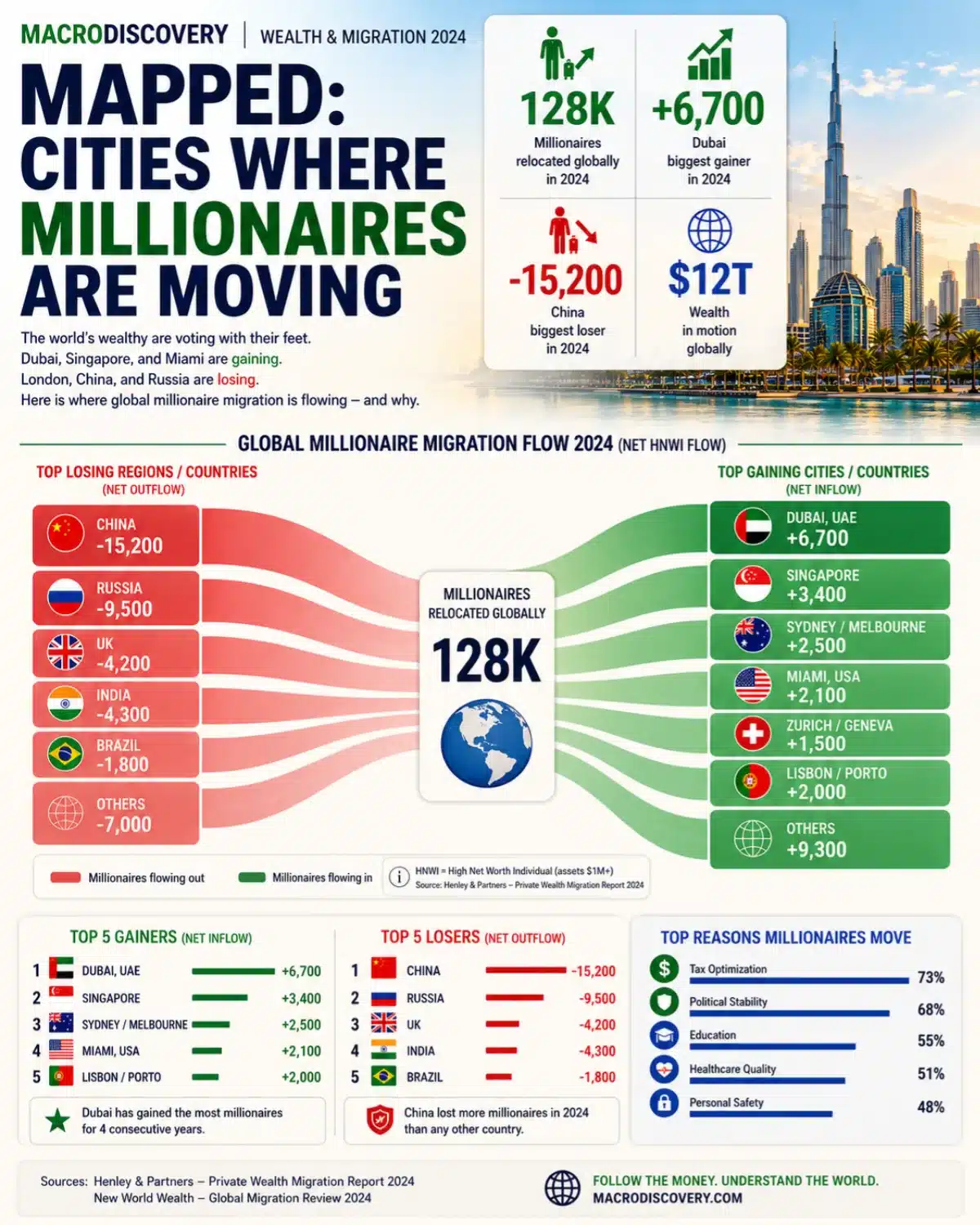
Dubai gained 6,700 millionaires in a single year. London lost 4,200. China lost 15,200. The world’s wealthy are in motion — and where they land reshapes property markets, tax revenues, and economic power across continents.
Net HNWI (High Net Worth Individual) migration flows, 2024. Green = net gain cities. Red = net loss countries. Arrow weight = volume of movement.
Net number of millionaires (HNWI, assets $1M+) gained or lost by country/city in 2024. Source: Henley & Partners.
What is driving HNWI inflows in the world’s top gaining cities — and what each destination offers that others don’t.
Ranked by frequency cited in HNWI migration surveys. Source: Henley & Partners Global Mobility Report 2024.
Every year, Henley & Partners and New World Wealth publish the most closely watched numbers in the global wealth management industry: how many millionaires moved, where they came from, and where they went. The 2024 figures show the largest movement of high-net-worth individuals ever recorded in a single year — 128,000 people with investable assets over $1 million permanently relocating across borders.
This is not a rounding error. This is a structural shift in where the world’s privately held wealth is domiciled — and it has direct consequences for property prices, tax revenues, startup ecosystems, and the economic trajectory of every city on both sides of the ledger.
“China lost 15,200 millionaires in 2024 — more than in any previous year. The figure is not a panic. It is a deliberate, decade-long trend of Chinese HNWI building offshore insurance against domestic political and economic risk.”
The Losers
The Winners
What Follows the Money
Millionaire migration is not simply a lifestyle story. It reshapes the economies it touches. When 6,700 millionaires move to Dubai in a single year, they bring an average net worth of approximately $4 million each — representing roughly $26 billion in new wealth domiciled in the emirate. They purchase property, fund startups, open businesses, hire staff, and pay consumption taxes. They bring their families, who fill international schools and private hospitals. Their presence attracts wealth management firms, private banks, and family offices — which in turn attract more HNWI.
The cities losing millionaires experience the inverse. London’s loss of 4,200 HNWI represents not just lost income tax — the non-dom regime raised approximately £3.2 billion annually according to HMRC estimates — but lost consumption, lost property demand, and lost entrepreneurial activity. Several of Britain’s most prominent tech founders and venture capitalists have publicly relocated to Dubai or the US in the past 24 months.
The global millionaire migration data tells a consistent story across three years: wealth is flowing from high-tax, high-uncertainty environments toward low-tax, high-stability ones. The definition of stability has broadened — it now includes not just political stability but property rights stability, regulatory predictability, and the ability to transmit wealth to the next generation without government interference.
The cities winning this competition have figured out that attracting one millionaire is worth more than taxing ten. Dubai’s $0 in income tax is not a revenue sacrifice — it is an investment in attracting capital that generates consumption tax, property transfer fees, business licensing fees, and the economic multiplier of a wealthy population spending locally.
The cities losing are in a more difficult position. Raising taxes on the wealthy to fund public services is a legitimate policy choice. But the data consistently shows that above a certain tax pressure threshold, those with the highest mobility exercise it. The question for London, Paris, and other high-tax capitals is not whether this is fair — it is whether the current trajectory of HNWI outflow is sustainable, and what policies could reverse it without compromising the public finances that depend on progressive taxation.