The Economics of Climate Migration
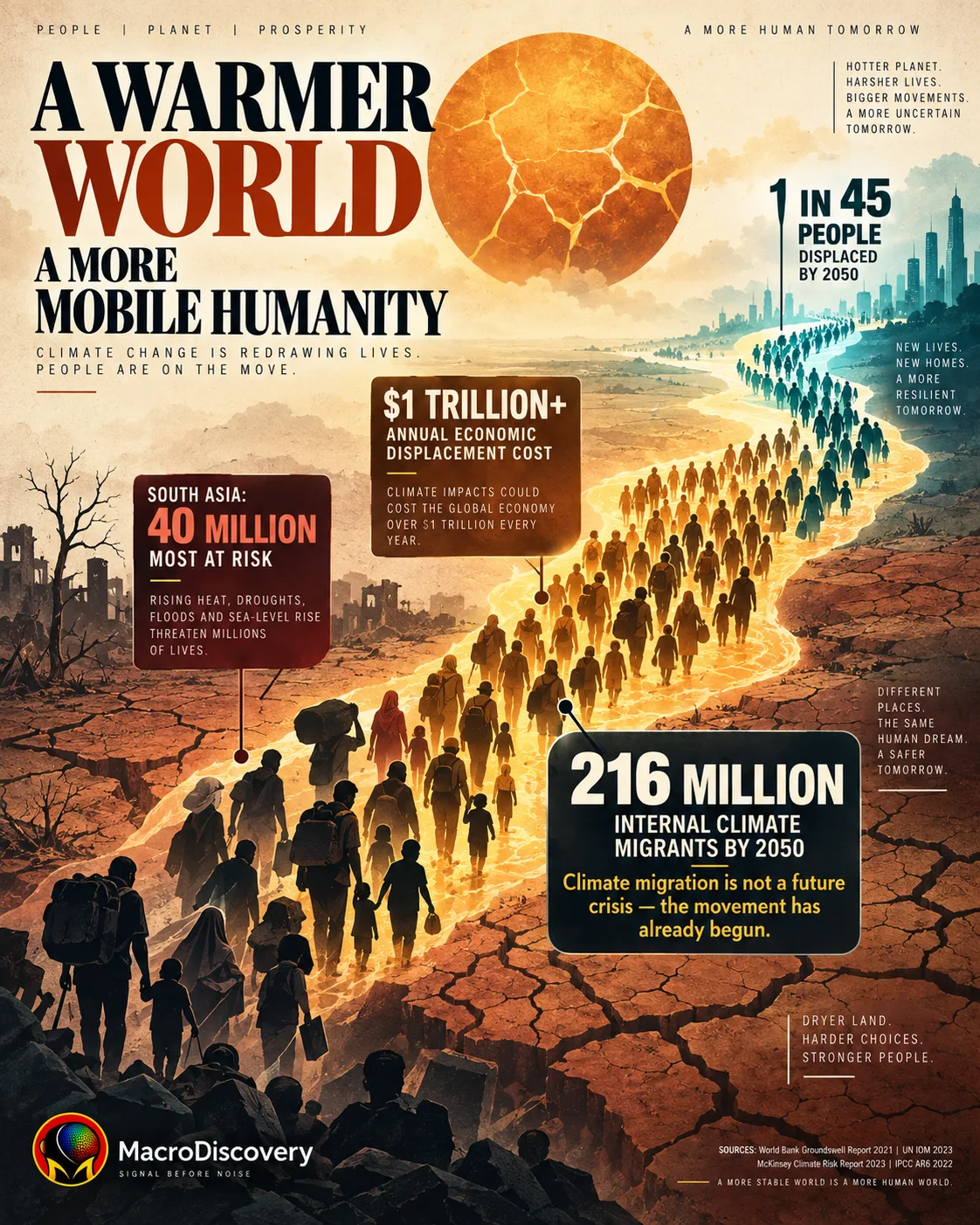
Climate change could push 216 million people to move by 2050 — inside their own countries, on the World Bank’s high-end path.
That number is a ceiling, not a booking. Most of the move is not a boat to Europe. It is a family leaving a drying field for a crowded city in the same country.
Picture a farm that used to drink two rains a year and now drinks one. The well drops. The crop thins. Nobody books a flight. They walk to the next town that still has work. Multiply that picture, under a harsh climate and weak development path, and the World Bank’s model reaches 216 million people by 2050.
Read the small print. That is internal climate migration across six World Bank regions. It is the high end of a pessimistic scenario. It is slow change — water, harvests, rising seas — not every flood evacuation this year. And the same report says early climate and development action could cut the total by as much as 80%, down to about 44 million.
A ceiling on a map, not a passport stamp
Groundswell Part 2, published by the World Bank in 2021, added East Asia and the Pacific, North Africa, and Eastern Europe and Central Asia to an earlier three-region study. Together the six regions produce the headline: as many as 216 million internal climate migrants by 2050 — almost 3% of those regions’ projected population.
The model is not “everyone who ever flees a storm.” It tracks people leaving places where water and crops fail, or where the sea takes the edge of the land. Hotspots, the Bank said, could show up by 2030 and thicken by 2050.
- 01Sub-Saharan Africa85.74.2%
- 02East Asia & Pacific48.42.5%
- 03South Asia40.51.8%
- 04North Africa19.39.0%
- 05Latin America17.12.6%
- 06E. Europe & C. Asia5.12.3%
Badges are share of that region’s projected population. North Africa’s share is the highest. Africa’s headcount is the largest. These are not international refugee forecasts.
The bill lands on the city that did not cause the drought
Climate migration is cheap at the start and expensive at the arrival. A household leaves because a harvest no longer pays. That is a private loss. The public bill shows up where they go: water pipes, school seats, slum land, wages pushed down in the informal job pile.
North Africa’s 19 million on the high-end path is “only” a mid-table headcount. It is 9% of that region’s people — the steepest share on the map. A coastal city that already rationed water does not get a new aquifer because the model added a million neighbors.
The Bank’s other number is the one headlines skip. Cut emissions, close development gaps, restore land, help people adapt — and the same model falls toward 44 million. That is the economics of prevention versus the economics of a swollen city.
Slow-onset, inside countries
Water, crops, sea level. Six World Bank regions. Not a global refugee count.
Up to 80% fewer people moving
Same report. Different policy path. The headline is not locked.
IDMC — one year of movements
Storms, floods, fires. Many people go home. This is not the 216 million.
Living away from home, end-2025
IDMC stock. Conflict still accounts for most of the 82 million IDPs.
This year is not 2050. This year still moves tens of millions.
IDMC’s 2026 Global Report counted 82.2 million people living in internal displacement at the end of 2025. Most of that stock — 68.6 million — was conflict. Disasters held 13.6 million people away from home.
Movements in 2025: 62.2 million internal displacements. Conflict set a record at 32.3 million. Disaster movements fell to 29.9 million after a brutal 2024 (45.8 million), but stayed above the ten-year average. Storms alone drove about 18 million of those disaster moves.
UNHCR adds a different overlay. Three-quarters of forcibly displaced people already live in countries highly exposed to climate hazards. Weather disasters caused some 250 million internal displacements over the last decade — about 70,000 a day. That is a count of moves, including repeats. It is not 250 million unique climate refugees.
216 million is a warning on a dry field. 29.9 million is last year’s storm. Do not staple them into one parade.Macro Discovery reading of Groundswell and IDMC GRID 2026
The expensive migrant is the one who arrives with no plan waiting
The politics talk as if 216 million people will knock on rich-country doors. The model says most of them will knock on a provincial capital that already rationed taps. That is a housing and jobs problem in Dakar, Dhaka, or Alexandria — not a Channel crossing.
Two ledgers sit side by side. Groundswell is a slow-onset forecast to 2050. IDMC is a yearbook of floods and fights. Adding 216 to 29.9 is a category error. What is fair to say: the people who move because the well failed will land in cities that already take the storm evacuees.
The 80% cut is the only cheap line in the report. Prevention is a development budget. Arrival is an urban budget that never voted for the drought.
Editorial reading of World Bank Groundswell Part 2 (2021), IDMC GRID 2026, and UNHCR climate-displacement notes. Those agencies did not write this box.If you remember two things
216 million is the high-end internal path
Six regions. Slow climate stress. Could fall to 44 million with early action. Not a count of people crossing borders.
Last year already moved tens of millions
29.9 million disaster displacements in 2025. 13.6 million people still displaced by disasters at year-end. Different ruler from Groundswell.
Short answers
A forecast and a yearbook
- 2050 path: World Bank Groundswell Part 2 (2021). High end of the pessimistic scenario = 216 million internal climate migrants across six regions.
- Action path: same report, up to 80% reduction → about 44 million.
- Observed displacement: IDMC GRID 2026 for 2025 (82.2 million IDPs; 29.9 million disaster movements; 13.6 million still displaced by disasters).
- Exposure overlay: UNHCR — three-quarters of forcibly displaced people in climate-exposed countries; ~250 million weather-related internal displacements over ten years.
- Bars: regional Groundswell totals scaled to Sub-Saharan Africa 85.7 million = 100%.