The Water Wars
Nobody Is Talking About Yet
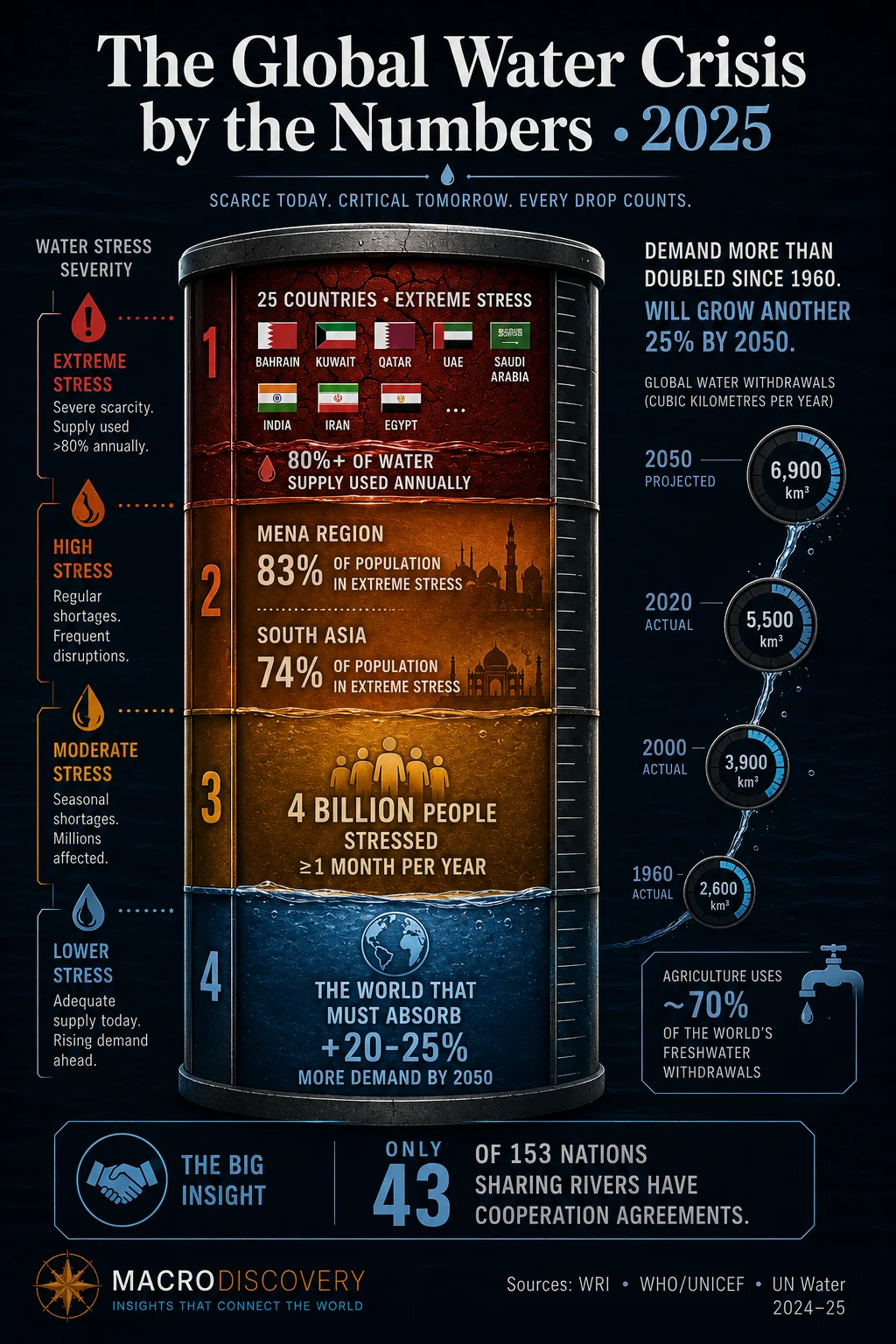
25 countries housing one-quarter of humanity already use up almost their entire water supply every year. Only 43 of 153 nations sharing rivers have cooperation agreements. India suspended the Indus Waters Treaty with Pakistan in 2024. The data shows a collision course between rising demand, shrinking supply, and geopolitical frameworks that were not built for what is coming.
- One in four people on earth lacks safely managed drinking water — 2.1 billion people as of 2024, including 106 million who drink directly from untreated surface water. The SDG target of universal water access by 2030 would require an eightfold acceleration from the current rate of progress.
- The Middle East and North Africa is the world’s most water-stressed region — 83% of its population already faces extreme water stress. By 2050, 100% of MENA’s population will face extreme stress regardless of climate scenario, according to WRI projections.
- Only 43 of 153 nations sharing transboundary rivers have cooperation agreements covering 90% or more of their shared resources. Over 20 countries have no arrangements at all. 63% lack drought alarm systems for shared water bodies. This governance gap is the geopolitical time bomb.
- India suspended the Indus Waters Treaty with Pakistan in September 2024 — the first formal suspension of a major transboundary water treaty since the treaty was signed in 1960. India and Pakistan are both nuclear-armed states. This is the clearest signal yet that water competition is entering a new phase.
- By 2050, $70 trillion — 31% of global GDP — will be exposed to high water stress, up from $15 trillion in 2010, according to WRI. India, Mexico, Egypt, and Turkey alone account for over half of this exposed economic output.
| # | Country / Region | Stress Level | Key Driver | 2050 Outlook | Severity |
|---|---|---|---|---|---|
| ▲ | 🌍MENA Region |
Extreme | 83% of population already in extreme stress. Arid climate, high demand, minimal rainfall. | 100% by 2050 | |
| ▲ | 🌏South Asia |
Extreme | 74% of population in extreme stress. India = most populous stressed country globally. | Worsening | |
| 1 | 🇧🇭Bahrain |
Extreme (5.0) | No significant freshwater sources. Near-total reliance on desalination and groundwater. | Critical | |
| 2 | 🇰🇼Kuwait |
Extreme (5.0) | No rivers, minimal rainfall. Oil wealth funds desalination — without it, uninhabitable. | Critical | |
| 3 | 🇶🇦Qatar |
Extreme (5.0) | One of the driest countries on earth. Imports most food (virtual water). 100% desalination. | Critical | |
| 4 | 🇦🇪UAE |
Extreme (5.0) | Among lowest per-capita renewable water in world. World’s highest per-capita consumption. | Critical | |
| 5 | 🇸🇦Saudi Arabia |
Extreme | Fossil aquifers being depleted — non-renewable ancient groundwater. No major rivers. | Fossil water depletion | |
| 6 | 🇮🇳India |
Extreme | Most populous country in extreme stress. Northern groundwater depletion severe. Monsoon irregularity rising. | GDP loss 7-12% by 2050 | |
| 7 | 🇮🇷Iran |
Extreme | Decades of poor water management. Water scarcity protests already occurring. WRI flags as high conflict risk. | Social instability risk | |
| 8 | 🇪🇬Egypt |
Extreme | ~97% of freshwater from the Nile. GERD dam in Ethiopia threatens supply. No alternative. | Nile dispute escalating | |
| 9 | 🇲🇽Mexico |
Extreme | Top 4 in GDP exposed to water stress by 2050. Northern states face severe aquifer depletion. | $70T GDP exposure | |
| 10 | 🇸🇬Singapore |
Extreme (5.0) | Highest stress score — but exemplary management. 40% imported, 30% recycled, 20% rainwater. | Model: Managed well | |
| — | 🌍Sub-Saharan Africa |
High · Growing | ~400 million lack basic water access. Water demand projected +163% by 2050 — fastest of any region. | +163% demand by 2050 |
Source: WRI Aqueduct 4.0 Water Risk Atlas (August 2023, primary — directly fetched). Stress score 0-5; scores above 4.0 = “extremely high” (>80% of available water withdrawn annually). Singapore noted as highest stress score but exceptional management. Regional figures for MENA and South Asia represent % of regional population facing extreme stress. Sub-Saharan Africa demand projection from WRI directly. Click column headers to sort.
Sources: UN SDG Report 2024 Goal 6 · WRI Aqueduct 4.0 (2023) · academic peer-reviewed literature (PMC) · India Indus Waters Treaty suspension: widely reported September 2024. Nile/GERD dispute: active diplomatic dispute confirmed via multiple primary sources.
Source: WHO/UNICEF Joint Monitoring Programme — “Progress on Household Drinking Water and Sanitation 2000–2024: Special Focus on Inequalities” (released August 26, 2025, during World Water Week 2025). Data covers 160 countries.
How Many People Currently Lack Safe Water — and Are Things Getting Better or Worse?
In August 2025, WHO and UNICEF published the most comprehensive global water access assessment ever produced. The headline: 2.1 billion people — one in four globally — still lack safely managed drinking water, defined as water that is available at home, free from contamination, and reliably accessible. This includes 106 million people still drinking directly from rivers, ponds, and other untreated surface sources.
The picture is genuinely mixed. Between 2015 and 2024, 961 million people gained access to safely managed water — real progress at scale. Global coverage rose from 68% to 74%. Rural coverage rose from 50% to 60%. These are not trivial improvements. But the trajectory is too slow. The WHO/UNICEF report concluded that the SDG target of universal water access by 2030 would require an eightfold acceleration in the current rate of progress. At the current pace, the 2030 deadline is effectively unachievable.
The inequalities are stark. People in the least developed countries are more than twice as likely as those in other countries to lack basic drinking water, and more than three times as likely to lack basic hygiene. Sub-Saharan Africa carries the heaviest burden — nearly 400 million people without basic water services — in a region where water demand is projected to grow 163% by 2050, the fastest rate of any region on earth, according to WRI.
Which Countries Face the Most Extreme Water Stress — and What Does That Mean?
Water stress and water access are different problems that can occur independently. A country like the UAE faces extreme water stress — more than 80% of its annual water supply is withdrawn each year — but has invested in desalination to ensure most of its population has safe drinking water. Conversely, many Sub-Saharan African countries face relatively lower water stress by the WRI metric but have poor infrastructure, meaning millions lack access despite physical water being present.
The WRI Aqueduct 4.0 tool, updated in 2023, identifies 25 countries facing extreme water stress — where demand routinely exceeds 80% of available renewable supply, leaving essentially no buffer against droughts, population growth, or supply disruptions. Middle East and North Africa dominates this list: 83% of its entire population already lives under extreme water stress. Countries including Bahrain, Kuwait, Qatar, and the UAE have essentially no renewable freshwater — they exist on desalination and fossil groundwater drawn from ancient aquifers that will not refill in human timescales.
India is in a different category. With 1.4 billion people, it is by far the most populous country in extreme water stress — with more people affected than all other extremely stressed countries combined. Northern India faces severe groundwater depletion: the great aquifers beneath the Indo-Gangetic Plain are being drawn down faster than monsoons can recharge them. WRI projects that water mismanagement could cost India 7–12% of its GDP by 2050. Water shortages have already caused 8.2 TWh of lost electricity generation between 2017 and 2021.
Why Is Transboundary Water the Next Geopolitical Flashpoint?
There are 286 transboundary rivers in the world, shared by 151 countries. Roughly 42% of the global population lives in river basins that cross national borders. The water flowing through these basins accounts for 54% of global river flow. These are not marginal resources — they are the backbone of global freshwater supply.
The governance picture is alarming. The UN SDG Report 2024 found that of 153 Member States sharing transboundary waters, only 43 have operational cooperation arrangements covering 90% or more of their shared resources. More than 20 countries have no arrangements at all. 63% of countries lack drought alarm systems for shared water bodies. 59% have no joint climate adaptation strategies for any transboundary basin.
This governance gap matters because water competition between neighbours tends to follow a predictable pattern: upstream countries build infrastructure (dams, diversions) that reduces flows to downstream countries, which lack legal recourse if no treaty governs the relationship. Turkey builds dams on the Euphrates; Iraq’s rivers run lower. China builds dams on the Lancang; Vietnam’s Mekong Delta receives less water. Ethiopia fills the GERD; Egypt faces existential anxiety. The asymmetry of power between upstream and downstream countries — and the absence of binding international water law with real enforcement mechanisms — is the structural flaw that makes water the most underestimated geopolitical risk of the coming decades.
What Is Happening to the World’s Groundwater — the Crisis Beneath the Surface?
Surface water — rivers, lakes, reservoirs — is the visible face of the water crisis. Groundwater is the invisible one, and in many ways the more dangerous. Groundwater supplies roughly half the world’s drinking water and about 40% of irrigation water. Many of the world’s most productive agricultural regions — northern India, the US High Plains (Ogallala Aquifer), parts of China and the Middle East — are sustained by underground reservoirs that accumulated over thousands of years and cannot be meaningfully recharged on human timescales.
Saudi Arabia’s agricultural sector, built in the 1980s with fossil groundwater to achieve food self-sufficiency, is being scaled back because the aquifers are running out. There is no replenishment mechanism. Northern India’s groundwater levels have been falling measurably for decades, tracked by NASA’s GRACE satellite mission. Iran has experienced substantial land subsidence — the ground itself sinking — in areas where groundwater has been over-extracted. Gaza’s coastal aquifer, already over-stressed before the recent conflict, has 97% of its groundwater failing WHO standards for human consumption due to salinity and nitrate contamination.
Agriculture is the dominant driver: 72% of all freshwater withdrawals globally go to agriculture, according to FAO. And 60% of the world’s irrigated agriculture faces extremely high water stress, according to WRI — including the production chains for sugarcane, wheat, rice, and maize, the four crops that between them supply the caloric foundation of global food security. Water, food, and energy are not separate crises. They are the same crisis from different angles.
Will Water Scarcity Lead to Conflict — or Cooperation?
The historical record is more optimistic than the headlines suggest. Despite regular predictions of “water wars” since the 1990s, large-scale interstate armed conflict specifically over water has been rare. Water scarcity more commonly drives political instability, migration, and economic disruption than direct military confrontation. The 2011 Syrian civil war had complex contributing causes — but years of severe drought and the displacement of rural agricultural communities into cities were among them.
The cooperation side of the ledger exists too. The Nile Basin Initiative, the Mekong River Commission, and the Indus Waters Treaty (before its 2024 suspension) all represent genuine attempts to manage shared water diplomatically. Singapore — the country with the world’s highest WRI water stress score — has become a global model for water management: recycling grey water, capturing rainwater at scale, importing 40% from Malaysia under a long-term agreement, and investing heavily in desalination technology. High water stress does not inevitably mean water crisis, if management, investment, and cooperation are in place.
The WRI estimates that solving the world’s water challenges costs approximately 1% of GDP, or 29 cents per person per day. That is not a large number relative to the cost of inaction — which WRI estimates at GDP losses of 7–12% for India and China, and 6% for Africa by 2050. The arithmetic of investment versus inaction is not close. What is missing is not money or technology. It is political will, governance frameworks, and the recognition that water is the resource without which all other economic activity stops.
Is the World on Track to Solve the Water Crisis by 2030?
No. The WHO and UNICEF were direct in their August 2025 report: achieving the SDG water targets by 2030 would require an eightfold increase in the current rate of progress on drinking water and a sixfold increase on sanitation. Neither trajectory is remotely plausible at current investment rates.
The economic stakes of failure are enormous. By 2050, WRI projects that $70 trillion — 31% of global GDP — will be exposed to high water stress, up from $15 trillion in 2010. India, Mexico, Egypt, and Turkey alone account for more than half of that exposed economic output. The water crisis is not a humanitarian issue that sits separately from the global economy. It is the global economy’s most underpriced risk.
Water demand has more than doubled since 1960. Global population has grown from 3 billion to 8 billion in the same period, and is expected to reach 9–10 billion by 2050. Water demand is projected to grow another 20–25% by 2050. The gap between supply and demand will close in one of two ways: through investment, cooperation, and technology — or through conflict, displacement, and economic contraction. The choice is still being made.
- WRI — “25 Countries, Housing One-Quarter of the Population, Face Extremely High Water Stress” (August 16, 2023 · Aqueduct 4.0 primary · directly fetched · all stress figures, GDP projections, regional data, India energy losses, Singapore case study)
- WHO — “1 in 4 people globally still lack access to safe drinking water” (August 26, 2025 · WHO/UNICEF JMP primary · 2.1 billion · 3.4 billion sanitation · 961 million gained · SDG 8× acceleration)
- UNICEF — “Fast facts: 1 in 4 people globally still lack access to safe drinking water” (August 26, 2025 · WHO/UNICEF JMP 2025 data · rural 60% · urban 83% · least developed countries 2×/3× gap)
- UN Statistics Division — SDG Report 2024, Goal 6: Clean Water and Sanitation (transboundary cooperation: 43/153 countries · 20 with no arrangements · 63% lack drought systems · 72% agriculture share)
- UNICEF — Water Scarcity (700 million displacement by 2030 projection · 1 in 4 children in high stress by 2040)
- United Nations — Water (global issues page · 10% of population in high/critical stress · 44% wastewater untreated · 70% of disaster deaths · human right to water 2010)
- WRI — “Ranking the World’s Most Water-Stressed Countries in 2040” (2015 · 33 countries extremely high stress by 2040 · 14 in MENA · Chile/Namibia/Botswana escalating)
- UN SDG Report 2024 Goal 6 — Transboundary water data: “Only one region on track to cover all transboundary rivers with cooperation by 2030” (sub-Saharan Africa progress noted)