The Global Loneliness Epidemic in Data
How many people in the world are lonely? , Is loneliness really getting worse, or does it just get more attention? , Why are young people lonelier than elderly people? , Is social media making loneliness worse? , Why does Vietnam have the world’s lowest loneliness rate? , What can be done to reduce loneliness?
The Global
Loneliness Epidemic
in Data
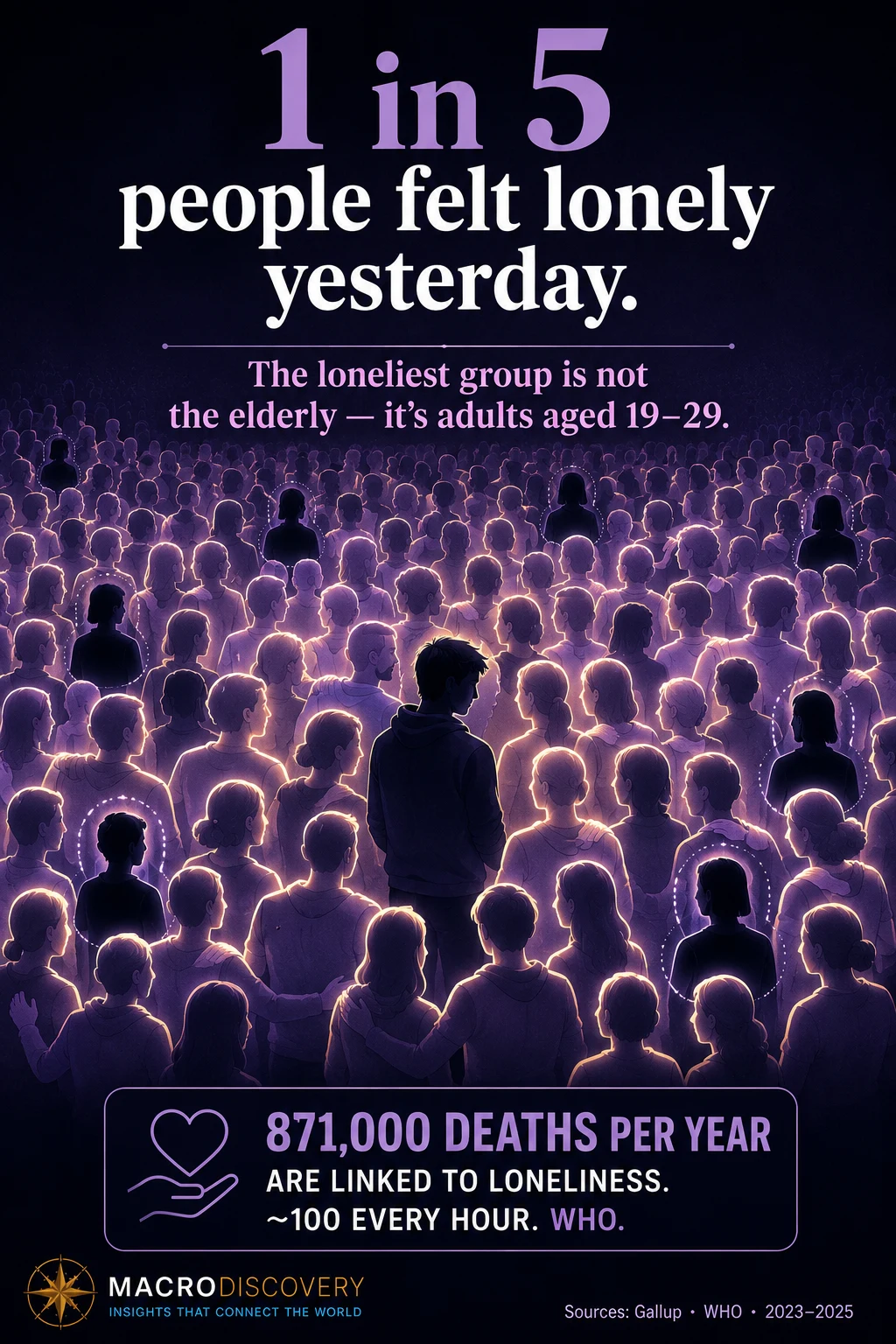
One in five people on earth felt lonely yesterday. Loneliness raises the risk of premature death by more than 60% — comparable to smoking 15 cigarettes a day. The loneliest people are not the elderly. They are young adults. And the countries with the lowest loneliness rates are not the richest ones.
In 2023 the World Health Organization declared loneliness a global public health threat and launched a commission to address it. That same year, the US Surgeon General called it a national epidemic. The data that prompted those responses came from the first-ever global survey of loneliness across 142 countries — and what it found upended several assumptions about who is lonely, where, and why. Loneliness is not primarily a condition of old age, poverty, or isolation. It is universal, surprisingly concentrated among young adults, and physically dangerous in ways that rival smoking.
- 23% of adults worldwide felt lonely “a lot of the day yesterday” in 2023, according to the Gallup World Poll across 142 countries. A separate Meta-Gallup survey using a different question found 24% felt “very or fairly lonely.” The WHO Commission estimates 1 in 6 people experience chronic social disconnection — a stricter, narrower definition.
- Loneliness is not an old-age problem. In the Meta-Gallup global survey, adults aged 19–29 reported the highest loneliness rate at 27%. Adults 65 and older reported the lowest at 17%. The common image of the isolated elderly person is statistically backward.
- Young American men are an outlier. Among 38 OECD countries, the US stands out: 25% of American men aged 15–34 report daily loneliness — well above the OECD median of 15% for young men and significantly above their own female peers at 18%.
- The physical health consequences are severe. Loneliness is associated with a 29% higher risk of heart disease, 32% higher risk of stroke, 50% higher risk of dementia in older adults, and more than 60% higher risk of premature death — a mortality risk the US Surgeon General compared to smoking up to 15 cigarettes a day.
- Vietnam, Estonia, Kazakhstan, Finland, and Denmark report the lowest loneliness rates in the world — all under 12%. These countries share high social trust, strong community ties, and in some cases, cultural norms around collective life that appear to buffer isolation.
| Country | Lonely % | Region | Context | Rate |
|---|---|---|---|---|
🇻🇳Vietnam |
6% | Southeast Asia | World’s lowest. Also lowest Negative Experience Index score globally (Gallup 2023). | |
🇪🇪Estonia |
10% | Northern Europe | Consistently low across multiple Gallup negative experience measures. | |
🇰🇿Kazakhstan |
10% | Central Asia | Strong extended-family social structures typical of Central Asian cultures. | |
🇫🇮Finland |
11% | Northern Europe | High social trust; consistently ranks at or near top of World Happiness Report. | |
🇵🇱Poland |
11% | Central Europe | Strong community and family ties; low rate despite economic transition pressures. | |
🇩🇰Denmark |
12% | Northern Europe | High social trust; strong civil society. Young men (15%) lonelier than average (9%). | |
🇯🇵Japan |
14% | East Asia | Appointed world’s second Minister for Loneliness (2021). Ageing population policy focus. | |
🇳🇴Norway |
14% | Northern Europe | High social trust and community cohesion despite geographic dispersal. | |
🇳🇱Netherlands |
14% | Western Europe | Dense urban networks; high civic participation; robust mental health infrastructure. | |
🇸🇪Sweden |
14% | Northern Europe | Strong welfare state and social safety nets support connection across life stages. | |
🇦🇺Australia |
18% | Oceania | Below global average despite geographic isolation and dispersed urban centres. | |
🇩🇪Germany |
20% | Western Europe | Slightly above global average; declining social participation noted post-pandemic. | |
🇺🇸United States |
20% | North America | Young men (15–34) at 25% — highest gap vs peers of any OECD country. SG declared epidemic 2023. | |
🇬🇧United Kingdom |
21% | Western Europe | First country to appoint a Minister for Loneliness (2018). Dedicated national strategy in place. | |
🇫🇷France |
23% | Western Europe | Young men notably high at 24% — second only to Turkey among OECD young men. | |
🇹🇷Turkey |
30% | Middle East / Europe | Highest young male loneliness in OECD at 29%. Social and economic pressures significant. | |
🇵🇭Philippines |
33% | Southeast Asia | High despite strong family culture — economic migration and urban fragmentation factors. | |
🇲🇬Madagascar |
40% | Africa | High rate may partly reflect physical aloneness vs emotional loneliness — see data note. | |
🇰🇲Comoros |
45% | Africa | Highest in world. Gallup notes: high African rates may partly reflect physical, not emotional, aloneness. |
Source: Gallup World Poll 2023 — “Did you experience loneliness a lot of the day yesterday?” 142 countries · ~1,000 adults aged 15+ per country. Published March 2026. Click column headers to sort. Note: Gallup has flagged that high loneliness rates in some African countries may partly reflect physical rather than emotional aloneness, given how the question is interpreted locally. African figures should be read with this caveat in mind.
Note: The Gallup World Poll 2023 (daily loneliness question) shows virtually no age difference globally — 22% for ages 15–29, 23% for 30–49, 22% for 50+. The age gap above comes from the Meta-Gallup survey using a different question (“very or fairly lonely”). Both are primary sources; they measure different intensities. The finding that young adults report higher loneliness on “very or fairly” measures is consistent across multiple studies.
The US Surgeon General’s 2023 Advisory described the mortality risk of lacking social connection as comparable to smoking up to 15 cigarettes a day — a comparison drawn from research summarising decades of epidemiological studies. This is a mortality risk analogy, not a statement of physiological equivalence. The WHO Commission’s June 2025 report estimated loneliness contributes to approximately 871,000 deaths per year globally — roughly 100 per hour.
Source: Gallup World Poll 2023. People who felt lonely were substantially more likely to also experience each negative emotion listed above compared to those who did not feel lonely. Figures are global averages across 142 countries.
The Age Paradox: Young Adults Are the Loneliest Group
The most persistent myth about loneliness is that it is a condition of old age — of widows, of people in care homes, of those whose friends have died. The data says otherwise. In the Meta-Gallup Global State of Social Connections survey, adults aged 19 to 29 reported the highest loneliness rates globally at 27%. Adults 65 and older reported the lowest at 17%.
The explanation is structural, not emotional. The years from 19 to 29 are a period of near-constant social rearrangement: people leave school, move for work or study, lose the built-in social scaffolding of shared institutions, and must rebuild their circles of close relationships more than once. The challenge is not finding people — it is sustaining connection through repeated disruption. Older adults, by contrast, have typically built stable social networks over decades. The relationships they have, though fewer, tend to be deeper and more durable.
One important caveat: the daily loneliness measure from the Gallup World Poll 2023 shows virtually no age difference globally — 22% for under-30s, 23% for 30–49, 22% for 50+. The age gap appears more clearly in the Meta-Gallup measure, which asks about self-assessed loneliness intensity rather than a specific day’s experience. Both findings are from primary sources; they measure slightly different things. What is consistent across both is that older adults are not disproportionately lonely in the way the conventional image suggests.
Young American Men: An OECD Outlier
Within the overall picture of youth loneliness, one demographic stands out sharply: young men in the United States. Based on aggregated 2023 and 2024 Gallup data, 25% of American men aged 15 to 34 reported feeling lonely a lot of the day — significantly above the US national average of 18%, above their female peers of the same age at 18%, and well above the OECD median of 15% for young men.
Nowhere among the 38 OECD countries is the gap between young men’s loneliness and the rest of the adult population as large as in the US. In most peer countries, young men’s loneliness tracks the national average closely. In the US, it is 7 percentage points above it. Gallup’s analysis points to a convergence of factors: the decline of traditional male social institutions (team sports, religious organisations, trade unions), rising rates of men living alone into their 30s, and a cultural reluctance among men to seek or express emotional support. Young men in Turkey (29%), France (24%), Ireland (23%), and Canada (22%) also show elevated rates — suggesting this is not exclusively an American phenomenon, but the US version is the most pronounced.
What Countries With Low Loneliness Have in Common
Vietnam, Estonia, Kazakhstan, Finland, Poland, Denmark, and Norway all report loneliness rates below 14% — roughly half the global average. They are not a culturally or economically homogeneous group: Vietnam is a middle-income Southeast Asian country with collectivist social norms; Estonia is a small Northern European digital democracy; Kazakhstan is a Central Asian country with strong extended-family traditions; Finland and Denmark are Nordic welfare states with high institutional trust.
What they share, according to researchers studying social cohesion, is a combination of: strong default social structures (family networks, community institutions, or shared civic life) that reduce the effort required to maintain connection; relatively high trust in other people and institutions; and in the Nordic cases, welfare systems that reduce the economic precarity that doubles loneliness rates among those who are financially struggling. The Gallup data shows clearly that people under financial stress are approximately twice as likely to feel lonely as those who are financially comfortable — 32% versus 15%. Inequality and loneliness are linked.
Vietnam’s 6% is the world’s lowest and warrants a methodological note: Gallup itself acknowledges that self-reported loneliness rates may be shaped by how openly people name negative emotions, and that Vietnam consistently scores the lowest on Gallup’s entire Negative Experience Index — not just loneliness. Cultural norms around expressing negative states may partially explain the number, not just lower actual loneliness. The same caveat applies to several African countries at the high end of the scale, where high rates may partly reflect people affirming that they spent time physically alone rather than that they felt emotionally isolated.
Loneliness Kills — and the World Is Starting to Treat It That Way
The WHO Commission on Social Connection’s June 2025 report estimated that loneliness and social isolation contribute to approximately 871,000 deaths per year — about 100 every hour. The physical mechanisms are multiple: chronic loneliness elevates cortisol and inflammatory markers, disrupts sleep, reduces motivation for health-protective behaviours, and delays access to care. People who are lonely are twice as likely to develop depression, according to the WHO Commission; they are also more likely to experience anxiety, cognitive decline, diabetes, and cardiovascular disease.
The US Surgeon General’s 2023 Advisory summarised the mortality risk as comparable to smoking up to 15 cigarettes a day — a framing drawn from epidemiological studies aggregating decades of research. It is a mortality risk comparison, not a physiological one, but the underlying research is consistent: social connection behaves like a determinant of health on par with diet and exercise. Lonely teenagers are 22% more likely to achieve lower educational qualifications, according to the WHO Commission. Adults who are lonely find it harder to maintain employment and may earn less over time. The costs extend to economies through healthcare expenditure and lost productivity.
The policy response is accelerating. The UK appointed the world’s first Minister for Loneliness in 2018 under Prime Minister Theresa May, following the Jo Cox Commission on loneliness. Japan appointed its own Minister for Loneliness in February 2021 under Prime Minister Yoshihide Suga — driven by data showing particular isolation among elderly men and young women. The WHO established its Commission on Social Connection in November 2023 with a three-year mandate — the first time a UN body had formally institutionalised the fight against loneliness as a global health priority. More countries are now embedding social connection into national health strategies, school curricula, and urban planning.
- Gallup — “Over 1 in 5 People Worldwide Feel Lonely a Lot” (March 2026 · Gallup World Poll 2023 · 142 countries · full country table · directly fetched)
- Meta-Gallup — “Almost a Quarter of the World Feels Lonely” (Gallup.com · Global State of Social Connections survey 2022–23 · 142 countries · ages 19-29 = 27%)
- WHO — “Social Connection Linked to Improved Health and Reduced Risk of Early Death” (June 30, 2025 · Commission on Social Connection flagship report · 871,000 deaths/year · +29/32/50% risks)
- WHO Commission on Social Connection (established November 2023 · three-year mandate · 1 in 6 affected)
- Gallup — “Younger Men in the U.S. Among the Loneliest in West” (March 2026 · US men 15-34 = 25% · OECD median young men = 15%)
- US Surgeon General — “Our Epidemic of Loneliness and Isolation” Advisory 2023 (HHS.gov · +60% premature death · 15 cigarettes comparison · +50% dementia)
- WashU School of Public Health — “Nearly half of young adults report loneliness in eight-country study” (March 2026 · Abdalla & Galea · Social Psychiatry and Psychiatric Epidemiology · Feb 2026)
- Meta-Gallup — Global State of Social Connections interactive (gallup.com · methodology · 142 countries · 2022–23)