Home AI Technology Gaming Future Automobile Geography Top 10 Trending How To Discover
---Advertisement---

Visualized: The Future of Artificial Intelligence

Macro Discovery
On: August 9, 2026 6:48 AM
Follow Us:
---Advertisement---
The Future of Artificial Intelligence , How much is being invested in AI globally? , How widely is AI being adopted by businesses? , Will AI create or destroy more jobs? , Is the US still ahead of China in AI? , What is the “jagged frontier” in AI? , The Future of AI — Data, Jobs & Investment 2026 , future of artificial intelligence , AI investment statistics 2025 2026 , global AI investment corporate spending $581 billion 2025 , AI jobs impact 2030 WEF created displaced statistics , AI adoption rate businesses organisations 2025 2026 , how much money is being invested in artificial intelligence globally 2025 2026 statistics , will artificial intelligence create or destroy more jobs by 2030 WEF , what is the jagged frontier in AI capabilities limitations explained , is the US still ahead of China in artificial intelligence 2026 data , how many people use ChatGPT weekly active users 2026 statistics,
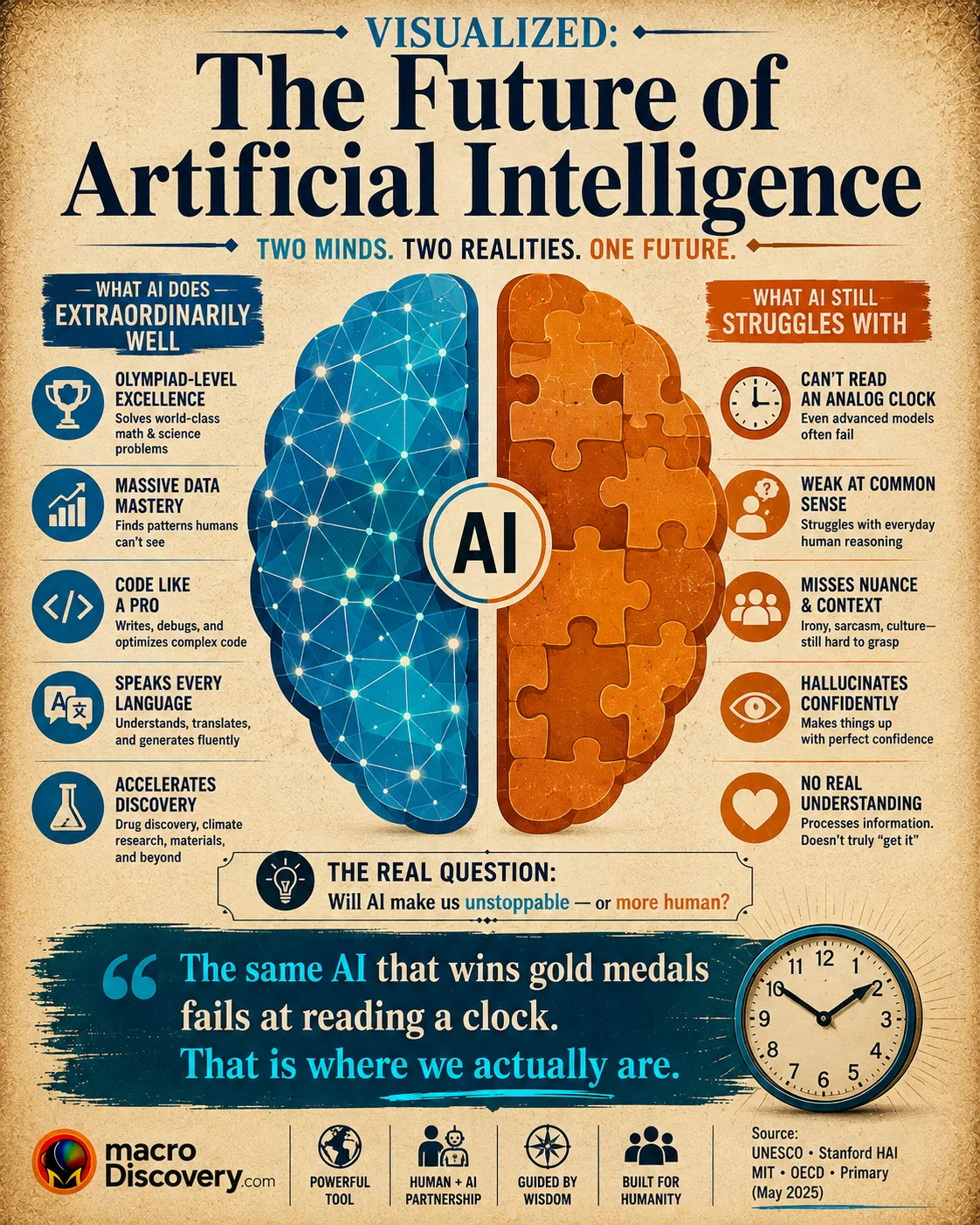
Premium editorial infographic showing
a split-brain concept illustrating
AI's "jagged frontier" — the left half
lists AI capabilities including gold
medal mathematics and near-perfect
coding, while the right half shows
AI failures including reading an
analog clock correctly only 50% of
the time. Key stat callouts include
$581.7 billion in 2025 corporate
investment and 88% organizational
adoption. Part of MacroDiscovery's
"Visualized: The Future of Artificial
Intelligence" article based on Stanford
HAI AI Index 2026 primary data. The Future of Artificial Intelligence.
The Future of Artificial Intelligence
Visualized: The Future of Artificial Intelligence — MacroDiscovery
MacroDiscovery
Technology & AI · 5 min read · Stanford HAI 2026 · WEF · McKinsey · Primary
Stanford HAI AI Index 2026 (Primary · April 13, 2026) · WEF Future of Jobs 2025 · McKinsey · PwC · Goldman Sachs
Artificial Intelligence & The Future of Work

Visualized: The Future of
Artificial Intelligence

Global corporate AI investment hit $581.7 billion in 2025 — doubling in one year. 88% of organisations now use AI. ChatGPT has 900 million weekly users. And yet the same AI that wins gold medal mathematics reads an analog clock correctly only 50% of the time. Here is where AI actually stands.

By MacroDiscovery
Sources: Stanford HAI AI Index 2026 (primary) · WEF · McKinsey · PwC · Goldman Sachs
Latest data: March–April 2026
$581.7B
global corporate AI investment 2025 · up 130% · Stanford HAI primary
88%
of organisations use AI in at least one function · Stanford HAI 2026
900M
ChatGPT weekly active users · February 2026 · fastest-growing product ever
$15.7T
AI’s projected GDP contribution by 2030 · PwC Sizing the Prize primary
Visualization 01 — The AI Investment Race
How Much Money Is Pouring Into AI

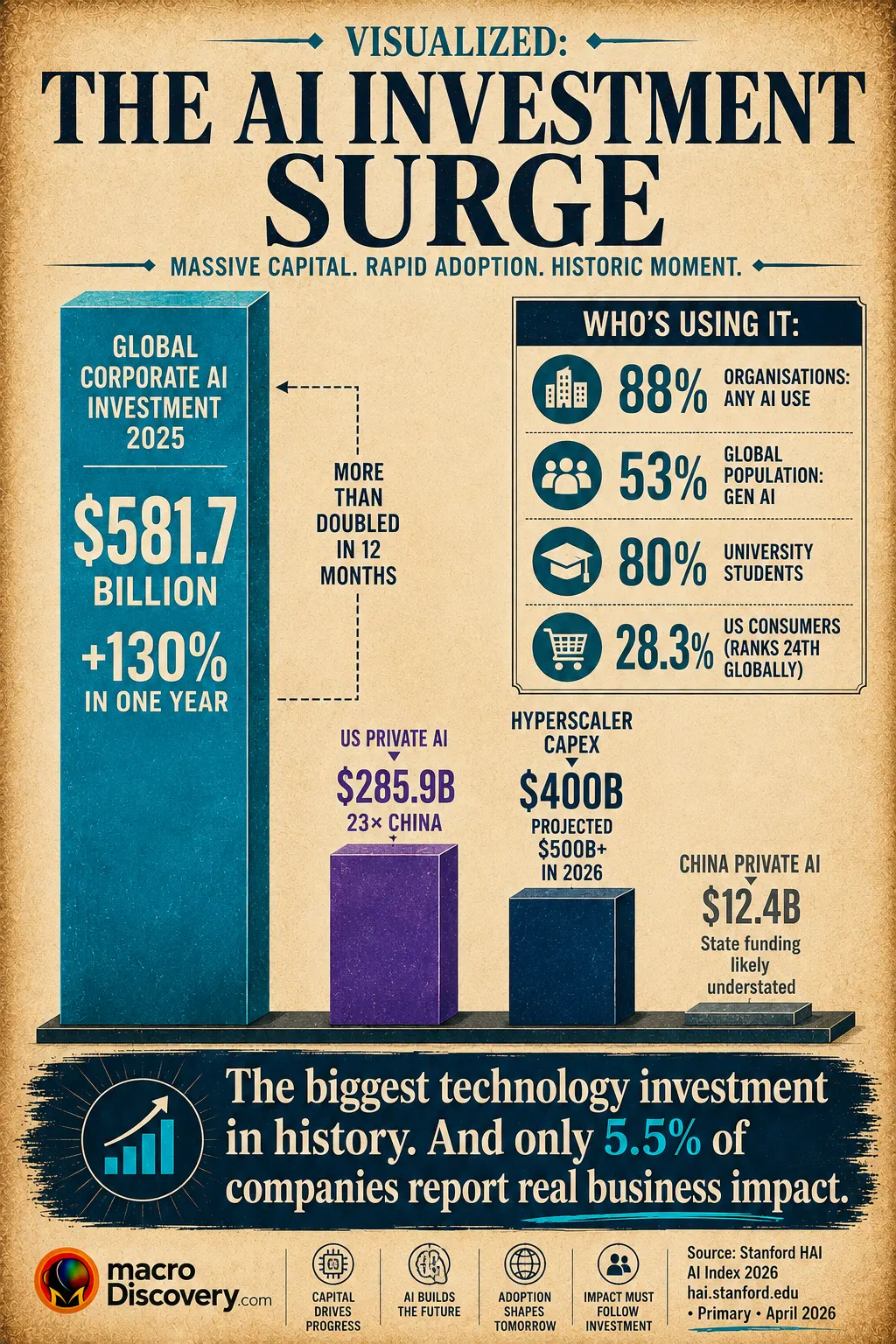
AI investment figures 2025. Bars scaled to total global corporate AI investment of $581.7B. Source: Stanford HAI AI Index 2026 (primary · hai.stanford.edu · April 13, 2026) · Goldman Sachs · NVIDIA official results · Microsoft earnings.
Massive scale — sets the pace
Fast-growing segment
Country leader
Rising
Distant second
🌍 Global corporate AI investmentTotal 2025
$581.7 billion in 2025 · +130% YoY · includes private funding + M&A + minority stakes · more than doubled in a single year · Stanford HAI AI Index 2026 (primary)
$581.7B
🏢 Hyperscaler AI capexInfrastructure
Amazon, Microsoft, Google, Meta combined AI infrastructure spend · $400B in 2025 · projected to exceed $500B in 2026 (Goldman Sachs) · AI data centres are the new oil refineries
$400B
🇺🇸 US private AI investmentDominant
$285.9 billion in private AI investment in 2025 · 23 times China’s $12.4 billion · US dominates AI software, models, and research
$285.9B
🎯 Private AI investment total+127.5%
$344.7 billion in 2025 (+127.5% YoY) · GenAI captured $170.9 billion of that total · GenAI private investment up 404% from prior year
$344.7B
🟢 NVIDIAQ1 FY2026
Q1 FY2026 revenue: $44.1 billion (+69% year-over-year) · The world’s #1 beneficiary of the AI infrastructure build-out · chips power most of the world’s AI training
$44.1B/qtr
🔵 Microsoft AI+123% YoY
Annual AI revenue run rate: $37 billion (early 2026) · +123% year-on-year · largest corporate AI revenue outside of chip sales
$37B/yr
🇨🇳 China private AI investmentvs US
$12.4 billion in private AI investment (2025) = 23x less than US · BUT: Stanford HAI notes Chinese state funding via guidance funds is likely understated · China leads in industrial ROBOTS (295K installed 2024)
$12.4B
Note on figures: “$581.7B” = total corporate investment (private funding + M&A + minority stakes) per Stanford HAI AI Index 2026. “$344.7B” = private investment only. These are different measures of the same build-out, not double-counted. Source: Stanford HAI AI Index 2026 (primary · hai.stanford.edu).
Premium editorial infographic with a bold vertical bar chart showing the scale of global corporate AI investment in 2025 at $581.7 billion — up 130% in one year — towering above comparison bars for US private investment ($285.9 billion), hyperscaler capex ($400 billion), and China's private AI investment ($12.4 billion). A sidebar adoption scorecard shows 88% of organisations and 53% of the global population now use AI. Based on Stanford HAI AI Index 2026, published April 13, 2026. The Future of Artificial Intelligence
The Future of Artificial Intelligence
Visualization 02 — The AI Race Timeline
How Fast AI Actually Moved — Year by Year

From a research curiosity to a $581 billion industry in under four years. Each milestone reset what people thought was possible. Source: Stanford HAI AI Index 2026 (primary) · WEF · NVIDIA official results.

2022
Launch
ChatGPT Launches — 100 Million Users in 60 Days
OpenAI released ChatGPT in November 2022. It reached 100 million users faster than any product in history — faster than Instagram, TikTok, or YouTube. Most people’s first real encounter with AI. The race began immediately.
100M users in 60 daysFastest product adoption in history
2023–2024
Build
Investment Explodes · AI Coding, Image, and Video Go Mainstream
Tech giants poured hundreds of billions into AI infrastructure. GitHub Copilot hit 20 million users. AI image and video generators went from experiments to widely used tools. 88% of organisations began using AI in some form. The adoption wave hit business faster than any prior technology.
88% org adoptionGitHub Copilot: 20M usersGenAI: $170.9B investment
Feb 2025
Shock
DeepSeek-R1: China Briefly Matches the Best American AI Model
Chinese lab DeepSeek released R1 in early 2025 and briefly matched the performance of the top US model. It was built at a fraction of the cost. The long-held assumption that the US had an uncloseable lead in AI capabilities collapsed overnight. The race became genuinely global.
DeepSeek-R1 matches US bestBuilt at fraction of US costUS-China gap: just 2.7% now
2025
Records
$581.7B Invested · AI Solves PhD Science · SWE-bench Hits Near 100%
2025 was the year AI stopped being experimental. Industry released 87 notable models. AI reached or exceeded human baselines on PhD-level science, competition mathematics, and multimodal reasoning. On a key coding benchmark (SWE-bench Verified), AI performance jumped from 60% to near 100% in a single year. Corporate AI investment more than doubled.
SWE-bench: 60%→~100% in 1 yearPhD science: human-level87 industry model releases
2026
Agentic
ChatGPT: 900M Weekly Users · Agentic AI Takes Over From Chatbots
ChatGPT reached 900 million weekly active users in February 2026 — roughly double the prior year. The focus shifted from chatbots to “agentic AI” — systems that take action independently, not just answer questions. Mentions of agentic AI skills in job postings rose 280% in a single year. The next phase began.
ChatGPT: 900M WAUAgentic AI skills: +280% in postingsHyperscaler capex: $500B+ forecast

The numbers are extraordinary. The investment is real. The adoption is real. But the Stanford HAI AI Index 2026 — the most rigorous annual accounting of the field — makes something else equally clear: AI is simultaneously more capable than most people realise, and less reliable than most headlines suggest. Both things are true at the same time. That tension is where the actual story lives.

Stanford HAI AI Index 2026 · Primary · April 2026
53%
Generative AI reached 53% global population adoption within three years — faster than the personal computer or the internet.
But here is the nuance: the US ranks only 24th globally in consumer GenAI adoption at 28.3%. Singapore leads at 61%. UAE is second at 54%. The places adopting AI fastest are not always the places spending most on building it. Consumer adoption and investment leadership are different races.
Source: Stanford HAI — AI Index 2026 (primary · hai.stanford.edu · April 13, 2026 · 9th edition · “Inside the AI Index: 12 Takeaways”)

“The same AI that wins a gold medal at the International Mathematical Olympiad reads an analog clock correctly only 50% of the time. That is where we actually are.”

The “Jagged Frontier” — AI Is Brilliant and Broken at the Same Time

Stanford HAI 2026 introduced the concept of the “jagged frontier.” The same top AI model that can win a gold medal at the International Mathematical Olympiad reads an analog clock correctly only 50.1% of the time. It struggles with multi-step planning, video generation, and certain expert-level exams. 88% of organisations use AI. But only 39% report any measurable business impact. And just 5.5% qualify as genuine AI “high performers” with more than 5% EBIT improvement. The gap between adoption and actual value is enormous.

Why it matters: headline benchmark scores are a poor proxy for real-world performance — the same AI that seems superhuman on tests can fail at things a child does easily.
Public Opinion · Stanford HAI 2026
50 pts
There is a 50-point gap between how AI experts and the American public see AI’s impact on jobs.
73% of AI experts think AI will positively impact how people do their jobs. Only 23% of the US public agrees. 64% of Americans expect AI to lead to fewer jobs. Only 39% of AI experts predict that. The same technology is being seen completely differently by the people building it and the people worried about it.
Source: Stanford HAI AI Index 2026 (primary · Public Opinion chapter · hai.stanford.edu)

Jobs: Who Gets Helped and Who Gets Hurt

The WEF Future of Jobs Report 2025 (primary) projects 170 million new jobs created and 92 million displaced by 2030. Net: +78 million jobs. But these are not the same people. The 92 million displaced are mostly clerical and administrative workers. The 170 million created skew toward technical roles requiring advanced training. Entry-level software developer employment for workers aged 22–25 already fell nearly 20% since 2024 (Stanford HAI 2026). AI-skilled workers earn a 56% wage premium. The gap between AI winners and AI losers is growing fast.

Why it matters: “net positive” job numbers hide the disruption — the people losing jobs and the people gaining them are largely different people in different places.
Economic Impact · PwC + Goldman Sachs
$15.7T
PwC projects AI will add $15.7 trillion to global GDP by 2030 — equivalent to 14% of world output.
China gains the most in absolute terms: +$7 trillion (26% of its GDP). North America gains +$3.7 trillion (+14.5%). The countries that benefit most are not necessarily the ones spending most on AI. McKinsey estimates AI will make 57% of current US work hours technically automatable — not the same as saying those jobs will disappear, but that the nature of every job will change.
Source: PwC — “Sizing the Prize” Global AI Study (primary) · Goldman Sachs Research · McKinsey Global Institute (November 2025)

The US vs China — Two Different Races

The US leads decisively in AI software, models, and private investment. US private AI investment in 2025 was $285.9 billion — 23 times China’s $12.4 billion. But China leads in industrial robots: it installed 295,000 in 2024, versus 34,200 in the US. And PwC projects China gains more GDP from AI (+26%) than North America (+14.5%) — because it has more automatable labour. The US is winning the software race. China is winning the robots race. Both matter enormously.
Why it matters: AI leadership is not one race — it is several simultaneous competitions, and different countries are ahead in different ones.
Key Numbers at a Glance
AI · Investment 2025
$581.7B
Global corporate AI investment in 2025 — up 130% in one year. The biggest annual technology build-out ever recorded.
Stanford HAI AI Index 2026 (primary)
AI · Adoption Speed
53%
Generative AI reached 53% global population adoption in 3 years — faster than the PC or the internet. 88% of organisations use AI somewhere.
Stanford HAI AI Index 2026 (primary)
AI · Economic Impact
$15.7T
PwC projects AI adds $15.7 trillion to global GDP by 2030 — a 14% boost. China gains the most: +$7 trillion.
PwC Sizing the Prize (primary)
AI · Jobs by 2030
+78M
WEF: 170M new jobs created, 92M displaced — net +78M. But different people gain and lose. The disruption is uneven.
WEF Future of Jobs Report 2025 (primary)
Frequently Asked Questions
How much is being invested in AI globally?
$581.7 billion in global corporate AI investment in 2025 — up 130% from the prior year, according to the Stanford HAI AI Index 2026. This figure covers private investment plus M&A and minority stakes. Private investment alone was $344.7 billion (+127.5%). Hyperscaler AI infrastructure spending hit $400 billion in 2025 and is projected to exceed $500 billion in 2026. Source: Stanford HAI AI Index 2026 (primary · hai.stanford.edu).
How widely is AI being adopted by businesses?
88% of organisations use AI in at least one business function — but only 39% report measurable business impact and just 5.5% qualify as AI “high performers” with more than 5% EBIT improvement. Consumer GenAI adoption reached 53% of the global population within three years — faster than the PC or internet. Source: Stanford HAI AI Index 2026 + McKinsey State of AI 2025 (both primary).
Will AI create or destroy more jobs?
The WEF projects a net gain of 78 million jobs by 2030 — 170 million created, 92 million displaced. But the same people are not gaining and losing. Those displaced are mainly in clerical and administrative roles; those gaining are in technical roles. Entry-level software developer employment already fell ~20% since 2024. Source: WEF Future of Jobs Report 2025 (primary) · Stanford HAI AI Index 2026.
Is the US still ahead of China in AI?
In AI software and private investment, yes — decisively. US private AI investment ($285.9B) was 23 times China’s ($12.4B) in 2025. But as of March 2026, the best US model (Anthropic) leads the best Chinese model by only 2.7%. China leads in industrial robots (295,000 installed in 2024 vs 34,200 in the US) and may gain more GDP from AI than the US by 2030. Source: Stanford HAI AI Index 2026 (primary) · IFR · PwC.
What is the “jagged frontier” in AI?
The “jagged frontier” describes AI’s uneven capability profile — the same top model that wins a gold medal at the International Mathematical Olympiad reads an analog clock correctly only 50.1% of the time. AI also struggles with multi-step planning and certain expert academic exams. Benchmark scores are a poor proxy for real-world reliability. Source: Stanford HAI AI Index 2026 (primary · hai.stanford.edu · April 13, 2026).
Sources
  • Stanford HAI — AI Index Report 2026 (primary · hai.stanford.edu · released April 13, 2026 · 9th edition · $581.7B corporate investment +130% · private $344.7B +127.5% · GenAI private $170.9B · US private $285.9B = 23x China $12.4B · 88% org adoption · GenAI 53% global pop in 3 years · US ranks 24th at 28.3% · SWE-bench 60%→~100% · US-China gap 2.7% March 2026 · DeepSeek-R1 Feb 2025 · 90%+ industry models · 87 releases · jagged frontier · analog clock 50.1% · devs 22-25: −20% · 50-pt expert/public gap · agentic AI +280% · US consumer surplus $172B)
  • Stanford HAI — “Inside the AI Index: 12 Takeaways from the 2026 Report” (primary companion · hai.stanford.edu/news · Singapore 61% genAI adoption · UAE 54% · US 28.3% ranks 24th · $172B consumer surplus · value per user tripled)
  • WEF — Future of Jobs Report 2025 (primary · weforum.org · 170M new roles created / 92M displaced / net +78M by 2030 · 22% of jobs disrupted · 59% workforce needs reskilling · 39% core skills change)
  • McKinsey Global Institute — State of AI 2025 + November 2025 automation report (primary · 88% org adoption / 39% EBIT impact / 5.5% high performers · 57% of US work hours technically automatable with current technology · 44% via AI agents · 13% via robots)
  • PwC — “Sizing the Prize” Global AI Study (primary · $15.7T GDP contribution by 2030 = 14% boost · China +$7T (+26%) · North America +$3.7T (+14.5%) · Northern Europe +$1.8T)
  • Goldman Sachs Research (primary · 7% global GDP boost from AI · 300M jobs globally exposed to automation · hyperscaler capex $400B 2025 / projected >$500B 2026)
  • NVIDIA — Official Q1 FY2026 Earnings Results (primary · $44.1B revenue · +69% YoY · workforce 42,000) · Microsoft Earnings (primary · $37B AI annual run rate · +123% YoY)
  • International Federation of Robotics — 2024 Data (primary · China 295,000 industrial robots installed 2024 · Japan ~44,500 · US 34,200)
Macro Discovery

Sukh Dhaliwal

Sukh Dhaliwal is the founder of Macro Discovery, an independent digital publication covering AI, technology, science, future trends, and global innovation through visual storytelling and data-driven analysis.

Join WhatsApp

Join Now

Join Facebook

Follow us

Leave a Comment