The Countries Where the Middle Class
Is Growing — and Where It’s Disappearing
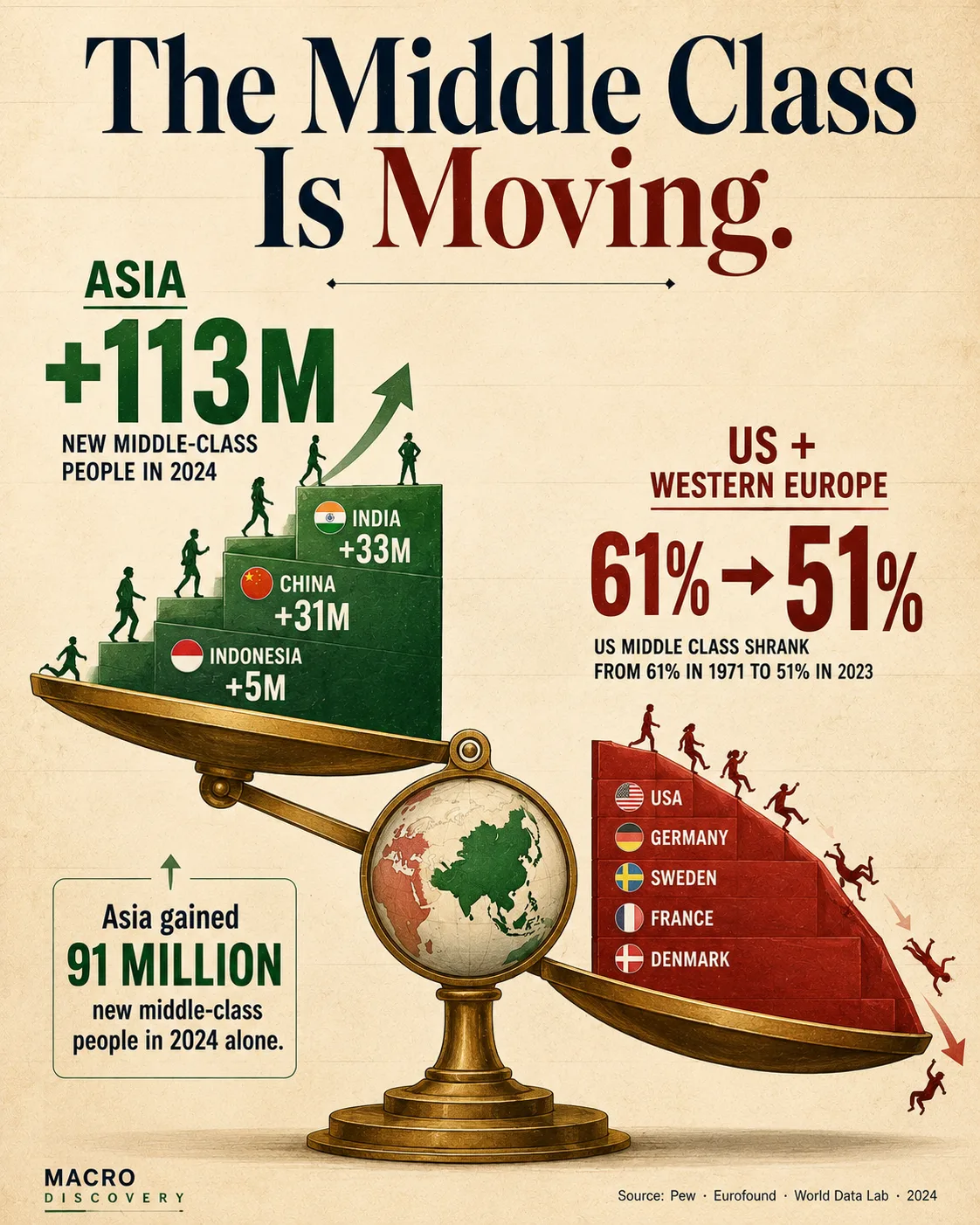
113 million people joined the global middle class in 2024 — almost all in Asia. At the same time, the middle class is shrinking in the US, Germany, Sweden, and most of Western Europe. Two very different stories are playing out at the same time.
The global middle class is growing fast in some places and quietly collapsing in others. In Asia, hundreds of millions of people are crossing into the middle class for the first time. In the US and Western Europe, people who were already there are falling out — or moving up. Where you live determines whether the middle class is a destination or a memory.
- 113 million people are projected to join the global middle class in 2024 — and 81% of them live in Asia.
- In the US, the middle class fell from 61% of adults in 1971 to 51% in 2023 — the lowest share on record (Pew Research Center, 2024).
- In the EU, the middle class shrank in nearly two-thirds of member states between 2007 and 2022, including Germany, Sweden, France, and Denmark (Eurofound, 2024).
| Country | Region | Status | Key Figure | Source |
|---|---|---|---|---|
🇮🇳India |
Asia | ↑ Growing | +33Mprojected new entrants 2024 | World Data Lab 2024 |
🇨🇳China |
Asia | ↑ Growing | +31Mprojected new entrants 2024 | World Data Lab 2024 |
🇮🇩Indonesia |
Asia | ↑ Growing | +5Mprojected new entrants 2024 | World Data Lab 2024 |
🇧🇩Bangladesh |
Asia | ↑ Growing | +5Mprojected new entrants 2024 | World Data Lab 2024 |
🇻🇳Vietnam |
Asia | ↑ Growing | +4Mprojected new entrants 2024 | World Data Lab 2024 |
🇷🇴Romania |
Eastern EU | ↑ Growing | Significant expansion2007–2022 | Eurofound 2024 |
🇵🇱Poland |
Eastern EU | ↑ Growing | Significant expansion2007–2022 | Eurofound 2024 |
🇭🇷Croatia |
Eastern EU | ↑ Growing | Significant expansion2007–2022 | Eurofound 2024 |
🇵🇹Portugal |
Southern EU | ↑ Growing | Expanding2007–2022 | Eurofound 2024 |
🇮🇪Ireland |
Western EU | ↑ Growing | Expanding2007–2022 | Eurofound 2024 |
🇺🇸United States |
North America | ↓ Shrinking | 61% → 51%share of adults 1971–2023 | Pew Research 2024 |
🇩🇪Germany |
Western EU | ↓ Shrinking | Contracting2007–2022 · Gini +2.8pts | Eurofound 2024 |
🇸🇪Sweden |
Northern EU | ↓ Shrinking | Fastest Gini rise in EU2007–2022 | Eurofound 2024 |
🇫🇷France |
Western EU | ↓ Shrinking | Contracting2007–2022 | Eurofound 2024 |
🇩🇰Denmark |
Northern EU | ↓ Shrinking | Contracting2007–2022 | Eurofound 2024 |
🇫🇮Finland |
Northern EU | ↓ Shrinking | Contracting2007–2022 | Eurofound 2024 |
🇦🇹Austria |
Western EU | ↓ Shrinking | Contracting2007–2022 | Eurofound 2024 |
🇳🇱Netherlands |
Western EU | ↓ Shrinking | Contracting2007–2022 | Eurofound 2024 |
Sources: World Data Lab / Visual Capitalist (Jan 2025) for Asia figures · Eurofound (2024), “Developments in income inequality and the middle class in the EU,” Publications Office of the EU · Pew Research Center (May 2024), “The State of the American Middle Class”
Asia figures are 2024 projections using World Data Lab’s definition ($12+/day, 2017 PPP). EU figures cover 2007–2022 using EU-SILC household income data and the OECD definition (75%–200% of national median). US figures use Pew’s definition (67%–200% of US median household income). These definitions are not directly comparable across regions.
Asia Is Building a Middle Class at Historic Speed
In 2024, India added more new middle-class people than any other country — 33 million, roughly the population of Peru. China added 31 million. Indonesia and Bangladesh each added 5 million. Vietnam added 4 million. Together, Asia accounted for 91 million of the 113 million new entrants globally.
This is not a new trend — Asia has driven global middle-class growth since 2000. But the scale in 2024 is striking. For the first time in history, more than half of Asians are now middle class or above, according to World Data Lab. A continent that was largely poor two generations ago is becoming the world’s largest consumer market.
In the US, the Middle Class Is Hollowing Out — From Both Ends
In 1971, 61% of American adults lived in middle-class households. By 2023 that had fallen to 51% — the lowest share ever recorded, according to Pew Research Center’s analysis of US Census data.
But here is the nuance: people did not only fall down. The share of Americans in upper-income households also grew — from 11% to 19%. The share in lower-income households grew too, from 27% to 30%. The middle class is being squeezed from both sides at once. People are leaving it by getting richer and by getting poorer. That bidirectional squeeze is what makes it feel so unstable.
In Europe, It’s the Richest Countries Losing Ground Fastest
The European picture is the most counterintuitive. Eurofound’s 2024 report — the most comprehensive study of its kind, covering all 27 EU countries from 2007 to 2022 — found the middle class shrinking in nearly two-thirds of member states. The steepest declines were in some of Europe’s wealthiest countries.
- Romania
- Poland
- Croatia
- Portugal
- Ireland
- Slovakia
- Latvia
- Sweden
- Germany
- Denmark
- Finland
- France
- Austria
- Netherlands
The pattern is striking: Eastern European countries are growing, largely catching up after decades of lower incomes. Western and Nordic countries are shrinking, squeezed by housing costs, inequality in asset ownership, and wages that have not kept pace with prices at the top. In Sweden — one of the most equal countries in the world just two decades ago — the middle class shrank faster than almost anywhere else in Europe.
The Middle-Income Trap — Why Growth Does Not Guarantee Arrival
Even for countries where the middle class is growing fast, staying there is hard. The World Bank’s 2024 World Development Report found that 108 countries are currently classified as middle-income — and since 1990, only 34 have successfully made it to high-income status. Most of those 34 either joined the European Union or discovered oil.
Countries tend to hit a wall at around $8,000 per person per year — about 10% of the US level. Growth slows, inequality rises, and the political will for further reform weakens. China, India, Brazil, and South Africa are all at or approaching this trap. Breaking through it requires a different kind of growth — not just cheap manufacturing, but innovation, education, and strong institutions.
Two Worlds, Moving in Opposite Directions
The global picture is a tale of two trends. In Asia, hundreds of millions of people are entering the middle class for the first time — gaining economic security, spending power, and opportunity that their parents never had. In the West, people who were already there are finding it harder to stay. Housing costs, stagnant wages, and rising inequality are pushing people out of the middle and toward either end.
These trends are happening simultaneously, and they are reshaping the global economy. By 2030, Asia will be home to the world’s largest consumer market. At the same time, the political instability that tends to follow a shrinking middle class in wealthy democracies is already visible in the US, Germany, France, and Sweden. The middle class is not disappearing globally — it is moving.
- Pew Research Center — “The State of the American Middle Class” (Kochhar, 2024)
- Eurofound — “Developments in income inequality and the middle class in the EU” · 2024 · Publications Office of the EU
- Visual Capitalist / World Data Lab — “113 Million People Will Join the Global Middle Class in 2024” · Jan 2025
- World Bank — World Development Report 2024: The Middle-Income Trap · August 2024
- Pew Research Center — “The Pandemic Stalls Growth in the Global Middle Class” · 2021
- CEPR VoxEU — “A picture of income inequality and middle classes across the EU” · Oct 2024
- World Data Lab — Middle class definition: individuals spending $12+/day (2017 PPP). Data via blog.worlddatalab.com