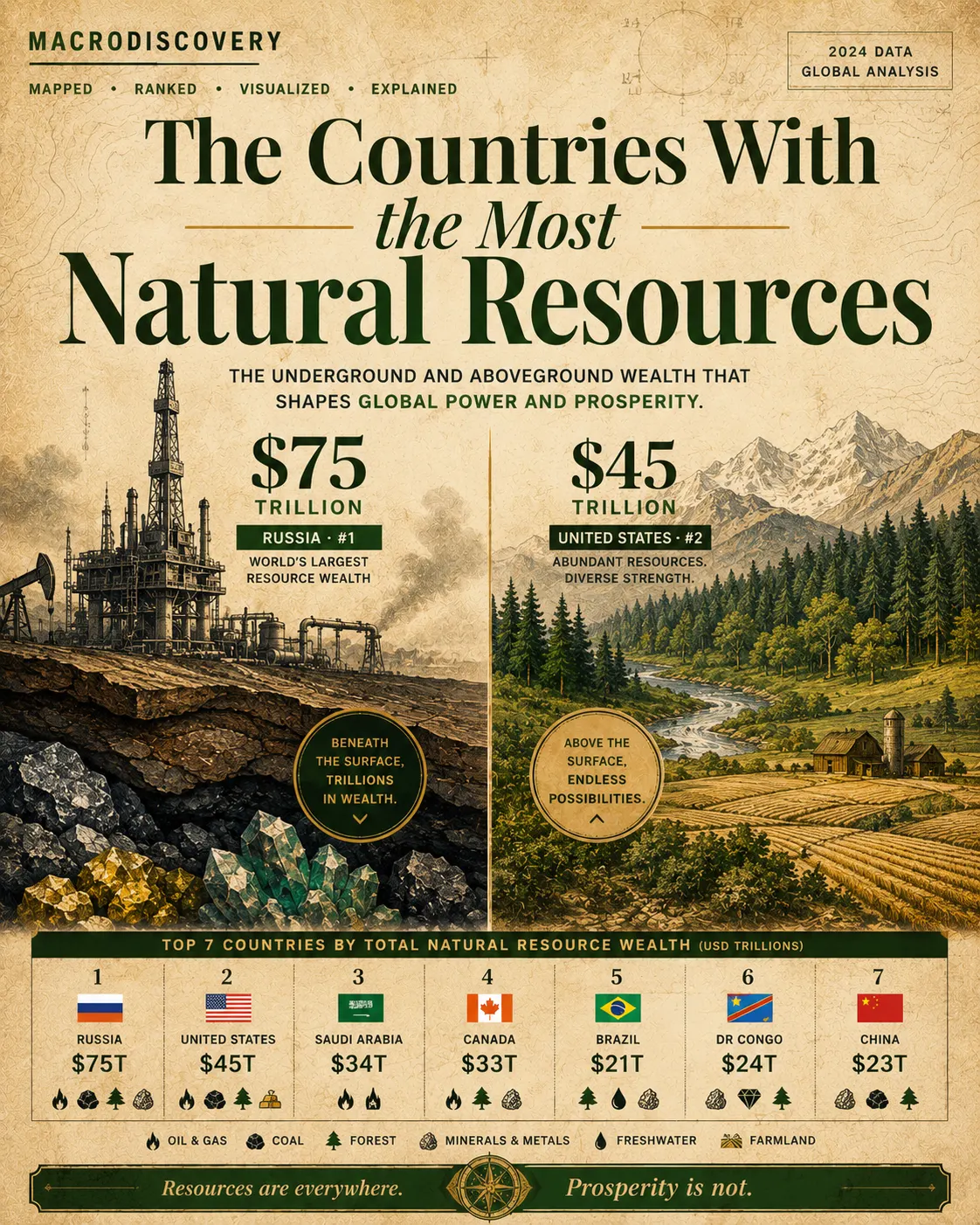
The Countries With
the Most Natural Resources
Russia holds $75 trillion in natural resources. The United States $45 trillion. Saudi Arabia $34 trillion. The geography of underground wealth is not where most people think it is — and having it does not guarantee prosperity.
Color intensity = total estimated natural resource wealth (oil, gas, coal, minerals, forest, freshwater). Darker green = higher value. Source: World Bank Wealth of Nations 2024, USGS Mineral Resources, Visual Capitalist 2024.
Estimated total value of oil, gas, coal, minerals, forests, and freshwater. USD trillions. Source: World Bank Wealth of Nations 2024, Visual Capitalist, USGS 2024.
Share of total resource wealth by type for each top nation. Concentration = vulnerability. Source: USGS, World Bank, BP Statistical Review 2024.
Countries with enormous resource wealth but poor human development outcomes — the “resource curse” paradox. Source: IMF, UNDP Human Development Index 2024.
Why Having It Doesn’t Mean Keeping It
Resource wealth and economic prosperity have an inconsistent relationship — institutions determine which way it goes.
- The Dutch Disease effect: Resource export revenues strengthen national currencies, making manufactured goods uncompetitive and hollowing out non-resource industries.
- Elite capture: In countries with weak institutions, resource rents concentrate in the hands of small political and business elites — never reaching population-level wealth.
- Conflict financing: In fragile states, mineral wealth funds armed groups. The DRC’s cobalt, Angola’s diamonds, and Sierra Leone’s blood diamonds all financed devastating civil wars.
Resources are a lottery ticket — institutions determine whether you cash it.
The Transition Reshuffles the Deck
The energy transition is changing which resources matter — and which countries win.
Saudi Arabia’s $34 trillion is 90% oil. As EV adoption accelerates, that asset base becomes structurally less valuable. Meanwhile, the DRC’s cobalt, Australia’s lithium, and South Africa’s platinum group metals — previously secondary resources — are becoming critical transition minerals.
The energy transition is not just a climate story — it is the biggest geopolitical resource reshuffle since the oil era began.
The Invisible Resource: Freshwater
Water is the most undervalued resource on every ranking — and the one most threatened by climate change.
Brazil holds 12% of all global freshwater. Canada holds another 9%. As climate change tightens water availability across the Middle East, North Africa, and South Asia, freshwater will be reclassified from infrastructure to strategic resource — with profound implications for food security and geopolitics.
The countries with the most water today hold the most agricultural and economic leverage of 2050.
Russia’s Resource Wealth Is Becoming a Liability
$75T in the ground means little if sanctions block access to capital and technology.
Russia’s resource wealth requires Western technology to extract and Western financial systems to monetize. Sanctions have structurally reduced the convertible value of that $75T. Resource wealth without institutional access is stranded wealth.
The DRC Is the Most Important Country Nobody Watches
$24T in transition minerals — right as demand for those minerals goes vertical.
Cobalt demand is projected to increase 19× by 2040. The DRC holds most of it. Chinese firms already control 15 of the DRC’s top 19 cobalt mines. Who controls DRC’s mineral extraction will shape who leads the clean energy transition.
The New Wealth Map Is Being Drawn Now
Transition minerals, freshwater, and arable land are the 21st century’s oil.
By 2035, lithium, cobalt, copper, nickel, and rare earths will rank alongside oil in geopolitical significance. The countries that diversify away from fossil-fuel wealth while securing transition mineral supply chains — Australia, Canada, Norway — are the best-positioned resource economies of the next generation.