Where a $100M
Athlete’s Money Goes
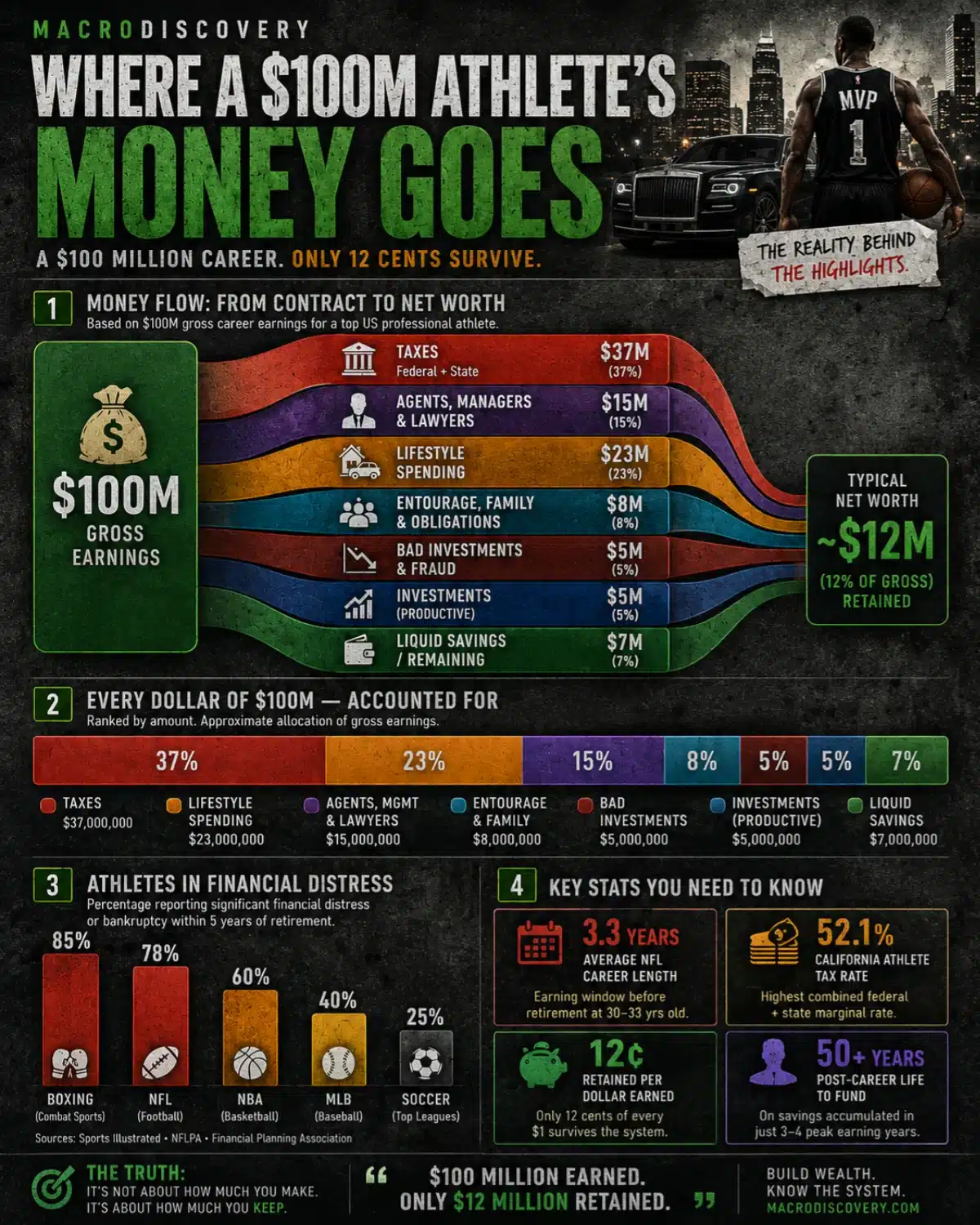
A $100 million career. 37% to taxes before anything else is touched. 15% to agents, managers, and lawyers. What remains — and why most athletes are broke within years of retirement — is a data story about financial systems, not personal failure.
Approximate flow of $100M gross career earnings for a top US professional athlete. Based on US federal + state tax rates, standard agent structures, and reported spending patterns.
Ranked by amount. Based on average US professional athlete earning $100M gross over an 8–12 year career.
Percentage reporting significant financial distress or bankruptcy within 5 years of retirement. Source: Sports Illustrated, NFLPA, Financial Planning Association.
Typical allocation of the $23M lifestyle spend for a major US professional athlete earning $100M career gross.
The most counterintuitive data point in professional sports finance is this: **78% of NFL players** are in financial distress within two years of retirement, according to a landmark investigation by **Sports Illustrated**. Not 78% of undrafted players. Not 78% of minimum-salary earners. 78% of players — including many who earned tens of millions of dollars.
The reason is structural. A **$100 million career** in the United States begins with an immediate 37% reduction to federal and state taxes — before any lifestyle decision is made. California athletes (Lakers, 49ers, Rams) face a combined marginal rate of **up to 52.1%**. Then come agents, typically charging **3–5% of contracts**, plus lawyers, financial advisors, and business managers collectively taking another 5–10%. The athlete has not spent a dollar on themselves, and they are already down to **$48 million**.
“Mike Tyson earned an estimated $400 million in career earnings. He filed for bankruptcy in 2003. The money didn’t disappear. It was systematically extracted — by taxes, promoters, managers, spending, and fraud — faster than it arrived.”
What compounds the problem is the **earning window vs. spending window mismatch**. The average NFL career lasts **3.3 years**. The athlete must fund 50+ years of post-career life on earnings concentrated in that window — after taxes and agents have already taken more than half. The lifestyle established during peak earning years — the houses, the entourage, the travel — does not compress when the contracts stop. According to **CNBC’s analysis of NFLPA data**, the average NFL player’s spending actually increases in the first two years after retirement as they process the identity shift away from professional sport.
The **entourage economy** is a separate and underreported drain. Most high-earning athletes support extended networks of family members, childhood friends, and social circles who depend on the athlete’s income. Research by the **Financial Planning Association** found that the average professional athlete financially supports **5–10 additional people** beyond their immediate household. When income stops, these obligations do not — creating immediate cash flow crises even for athletes who retained modest savings.
The systemic nature of athlete financial distress is increasingly recognized as a structural problem, not a personal failure. The **NBPA and NFLPA** have both expanded mandatory financial education requirements in recent collective bargaining agreements. Several states have passed legislation capping agent commissions. Fintech platforms specifically targeting athlete financial management — including **Greenlight, Cantaloup, and Athlean Invest** — have raised over $200 million collectively since 2020 targeting this demographic.
The underlying economics, however, are not easily changed. Short careers, complex tax structures, peer spending pressure, and predatory financial advisors are structural features of professional sport — not bugs. Until the earning window is longer, the tax structure is more favorable to career averaging, and financial literacy is embedded earlier in athletic development pipelines, the **12-cents-on-the-dollar retention rate** will remain the defining statistic of professional athlete wealth.