Where 90% of the
World’s Population Lives
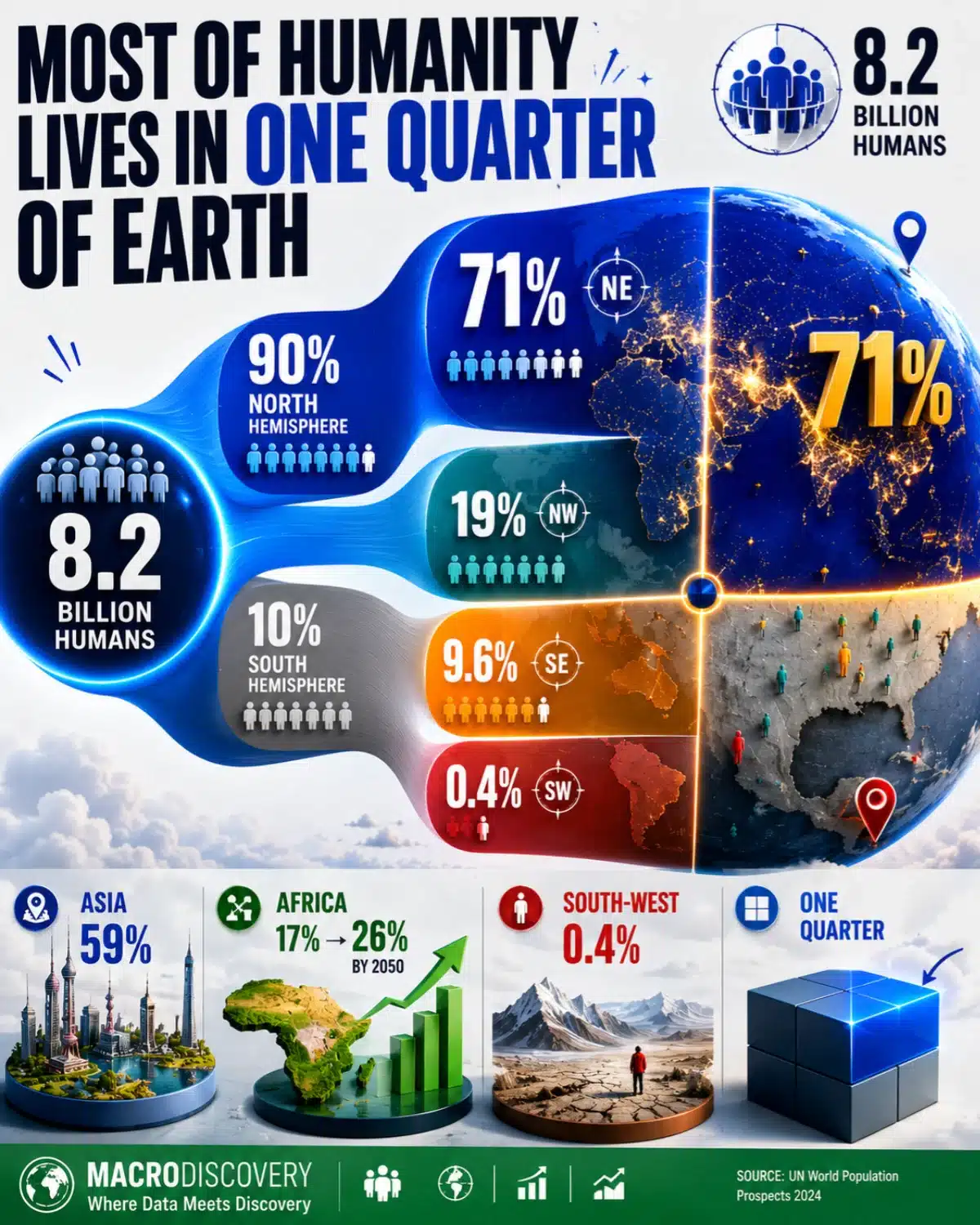
90% of all humans live in the Northern Hemisphere. 90% live in the Eastern Hemisphere. Put those two facts together and you find one quadrant of Earth that holds most of civilization — while vast territories sit nearly empty.
Whether you divide by North/South or East/West, approximately 90% of humanity is on one side.
When you divide Earth into four quadrants by equator and prime meridian, the North-East quadrant contains 71% of all humans. The South-West contains 0.4%.
Area is proportional to population share. Asia alone holds 59% of all humanity.
People per square kilometer, city-state and island nations included. The density contrast between countries is extreme.
If you drew a line around the equator and another along the prime meridian, you would divide Earth into four quadrants. One of those quadrants — the upper right, covering Europe, Asia, and northern Africa — contains 71% of all humans. The opposite quadrant — the lower left, covering the southern half of the Western Hemisphere — contains 0.4%.
This is not a statistical artifact. It is one of the most fundamental facts about the physical distribution of civilization — and most people have never seen it visualized clearly. The world feels evenly distributed. It is not, by a factor of roughly 175 to 1 between the most and least populated quadrants.
“Asia alone holds more people than the rest of the world combined. Europe, Africa, and the Americas together cannot match the population of a single continent that runs from Turkey to Japan.”
Why the North?
The Shift Coming by 2050
The current distribution of humanity is not static. The population geography of 2050 will look noticeably different from today’s — with Africa’s share rising substantially, Asia’s share peaking and beginning to decline as China’s population shrinks, and Europe’s share continuing its long-term decline.
The biggest single shift: Africa moves from 17% to approximately 26% of world population in 25 years. This is not a projection that depends on optimistic assumptions — it follows directly from current fertility rates and age structures already embedded in Africa’s population pyramid. The young people who will have children in 2035 are already born. The demographic momentum is locked in.
The geographic center of humanity — the point that minimizes the total travel distance to reach all humans — currently sits in South Asia, near the India-Bangladesh border. By 2050, it is projected to shift further south and west, toward central Africa, as that continent’s population growth outpaces Asia’s.
The distribution of humanity across the Earth’s surface is one of the most important and least discussed facts in global affairs. It determines where economic growth happens, where natural resources are demanded, where cities expand, and where geopolitical power concentrates — not in the abstract future but right now.
The North-East quadrant dominance — Europe, Asia, northern Africa — is the geographic foundation of most of what humans have built. The world’s largest economies, most of its megacities, most of its military power, and most of its cultural output originate within an area that covers roughly a quarter of the planet’s surface.
The change coming in the next 25 years is that Africa will add a billion people to the map — concentrated in cities, young, and representing the largest expansion of the global consumer class since Asia’s rise in the 1990s and 2000s. Where those people live, how they are governed, and how connected they are to the global economy will be among the defining questions of the second half of the 21st century.