Three Futures of Trade
Three futures of global trade. The paths are already priced.
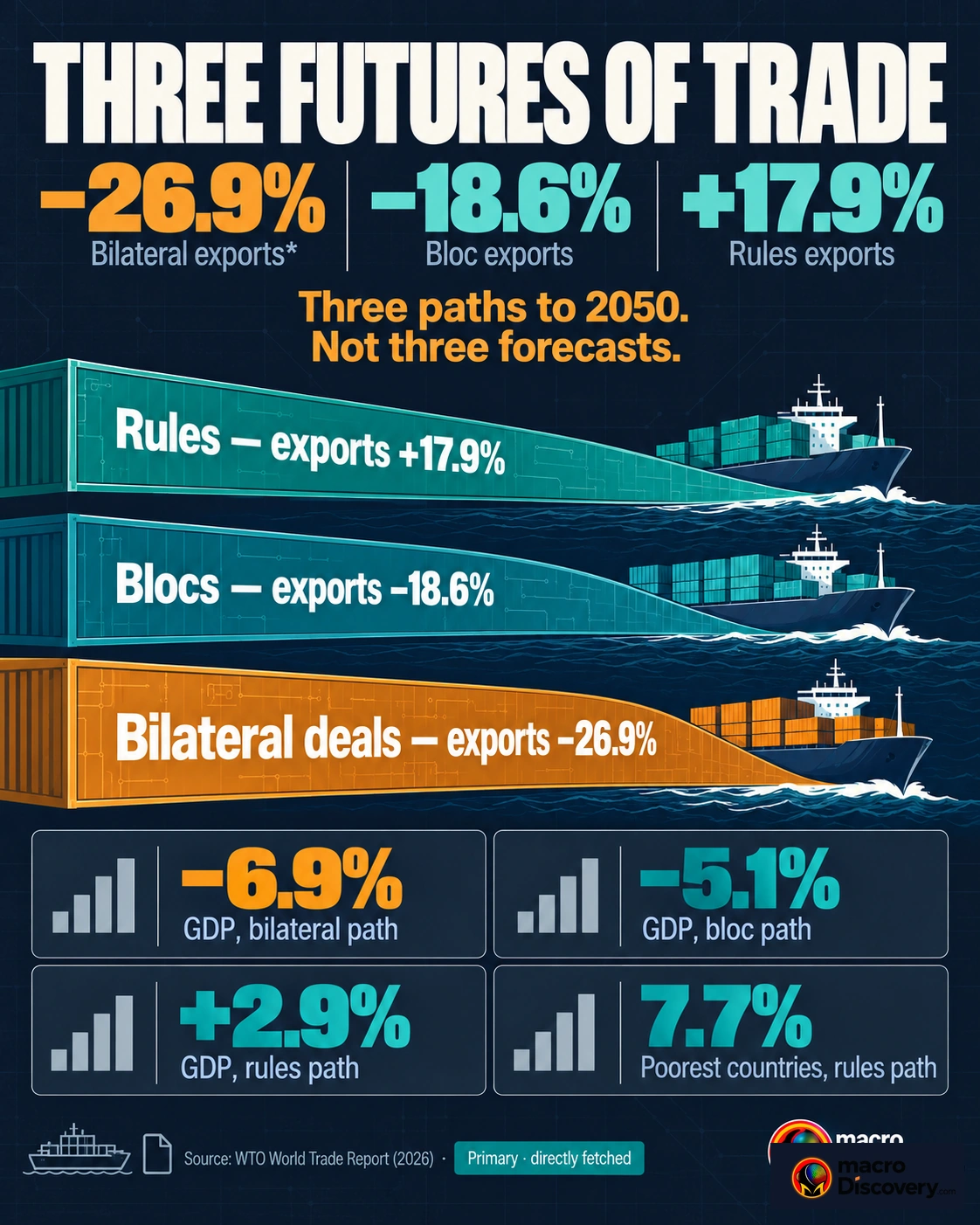
The three futures are 2050 simulations, not booked paths. A stronger system is +2.9% of GDP. A bloc world is −5.1%. This year’s goods-trade forecast is 1.9%.
Three numbers
- +2.9% — modeled gain in global GDP by 2050 if multilateral rules are strengthened. Exports +17.9%. Source: WTO World Trade Report 2026.
- −5.1% — modeled GDP loss by 2050 in a world of geopolitical blocs. Exports −18.6%. An FTA-only world is −6.9%. Source: WTO.
- 1.9% — forecast growth in merchandise-trade volume in 2026, down from 4.6% in 2025. Source: WTO, March outlook.
What the data shows
A common claim is that global trade has three futures, and that the paths are already priced. The fact is that the three futures are simulations for 2050, and the near-term number is a slowdown, not a fork. The WTO World Trade Report, issued on 15 September 2026, runs three cases against a baseline. A stronger multilateral system is modeled at +2.9% of global GDP and +17.9% of exports by 2050. A world split into geopolitical blocs is −5.1% of GDP and −18.6% of exports. A world of bilateral deals in place of multilateral rules is −6.9% of GDP and −26.9% of exports. The gap between the best and worst case is about 5 to 10 percent of output. That is a model spread. It is not a price.
The year in front of the model is still one path. Merchandise-trade volume grew 4.6% in 2025. The March outlook put 2026 at 1.9% and 2027 at 2.6%. A case with lasting high energy prices trimmed 2026 to 1.4%. A case with AI-related goods as strong as 2025 added 0.5 point. The September goods-trade barometer was 102, above the trend line of 100. First-quarter volume was 3.2% above a year earlier. About 72% of merchandise trade still moves on most-favoured-nation terms. A slower year with most trade still on the common tariff is not a bloc world.
A second list is easy to mix in. A WTO staff paper dated 15 September 2026 runs four cases: restructuring, geo-fragmentation, breakdown, and reform. It says reform could raise global GDP by 2% to 3%, restructuring could cut it by about 1%, geo-fragmentation by about 6%, and a breakdown by almost 10%. The paper says the views are the authors’, not the WTO’s. The official report uses three. Counting four and three as separate futures double-counts one model family. Least-developed countries, under 1% of world trade, are modeled at +7.7% of GDP in the stronger-rules case. That is the same simulation, not a fourth path.
The 1.9% goods-trade forecast for 2026 is not on this chart. It is a year, not a 2050 path.
| Count | Figure | What it is |
|---|---|---|
| Stronger rules, 2050 | +2.9% GDP | Exports +17.9%. A simulation |
| Bloc world, 2050 | −5.1% GDP | Exports −18.6% |
| FTA-only world, 2050 | −6.9% GDP | Exports −26.9% |
| Goods trade, 2026 | 1.9% | Forecast. Was 4.6% in 2025 |
| MFN share | about 72% | Merchandise trade still on common terms |
How it was measured
The 2050 figures are model runs against a baseline path. They are not a probability and not a market price. A +2.9% gain is the difference from that baseline, not from today’s GDP. The staff paper uses a related model and says it is not a WTO position. The official report is the three-case set.
The 1.9% figure is a volume forecast for merchandise trade in one year. The barometer is a composite of orders, freight, and components, indexed so that 100 is recent trend. A reading of 102 says trade is a bit above that trend. It does not assign the year to a 2050 case.
What it means
It is settled that the WTO’s 2026 report models +2.9%, −5.1%, and −6.9% of global GDP by 2050 for three rule sets, and that the 2026 goods-trade forecast is 1.9%. It is not settled that one of the three paths is already priced. Use +2.9% for the stronger-rules case. Use −5.1% for blocs. Use 1.9% for this year’s volume. Do not treat the simulations as bookings.
Common misreadings
- The three futures are 2050 simulations. They are not booked paths.
- A 1.9% goods-trade year is a slowdown. It is not a bloc split.
- A staff paper with four cases is not a second official set of futures.
Where the numbers come from
How we built this
- Dataset: WTO World Trade Report 2026 scenarios; March goods-trade outlook; September barometer; staff paper kept separate.
- Scope: Simulations against a baseline. The 2026 volume forecast is not assigned to a 2050 case.
- Figures: +2.9% is the stronger-rules case. −5.1% is blocs. 1.9% is this year’s goods-trade forecast. The paths are treated as unpriced.