World Sized by Population
The world sized by population. The map China still leads.
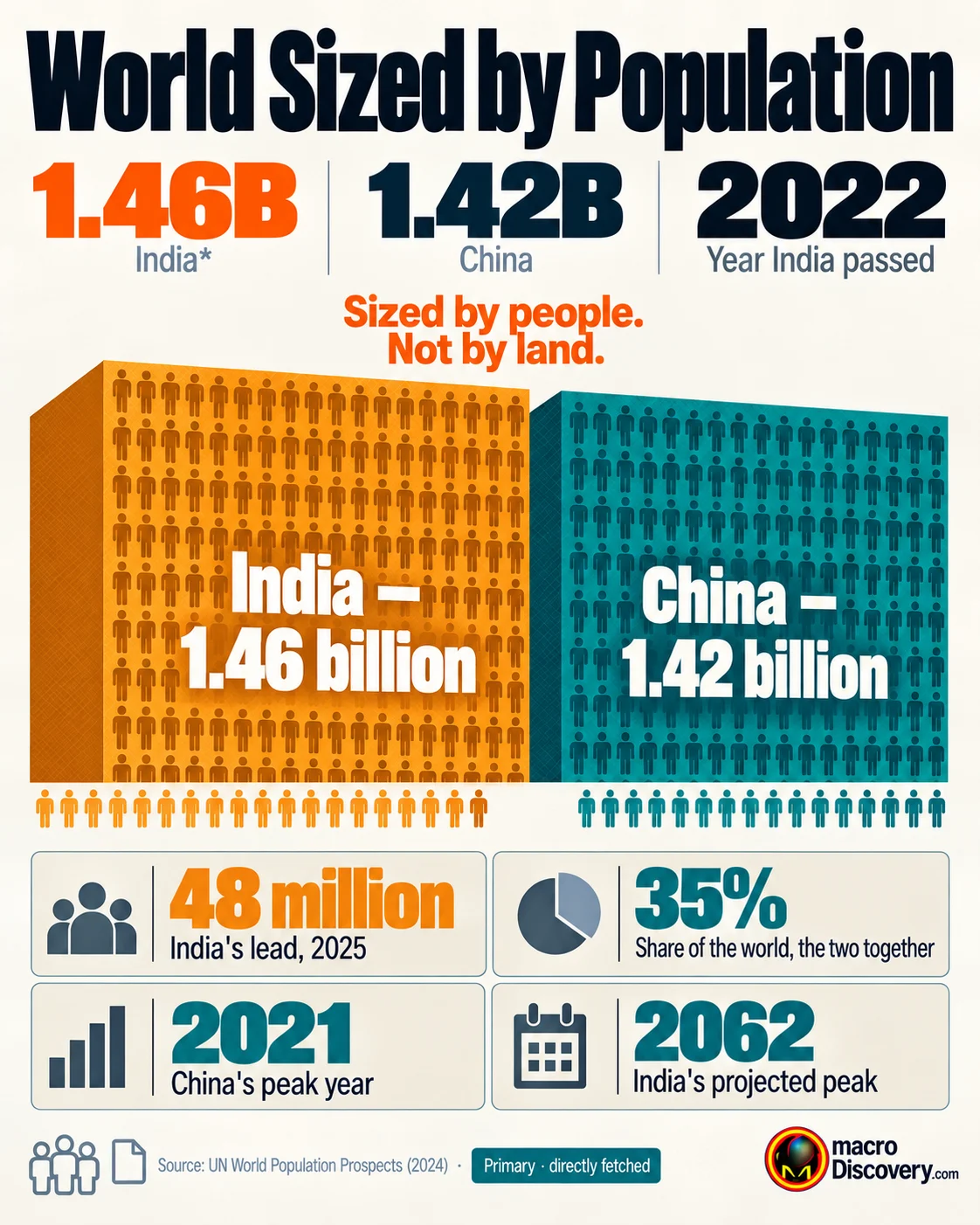
India is the largest, at about 1.45 billion. China is second. Together they are about 35% of the world, not half.
Three numbers
- 1.45 billion — India in 2024. The largest country. Source: UN World Population Prospects.
- 1.42 billion — China in 2024. India passed it in 2022. The gap was about 32 million. Source: UN.
- About 35% — India and China together, as a share of the world. About 60% of Asia. Source: UN.
What the data shows
A common claim is that a world sized by population is the real map, and that China still leads it. The fact is that India is largest, and the two together are about a third of the world, not half. The UN’s 2024 prospects put India at about 1.45 billion and China at about 1.42 billion. India passed China in 2022. The 2024 gap was about 32 million. China’s population peaked and fell. On this projection it keeps falling, and could be under 1 billion by 2070. India’s population is still growing, on this series until the early 2060s. A cartogram that still draws China as the largest block is a year behind the headcount.
The share is easy to inflate. India and China together are about 35% of the world population, and about 60% of Asia’s. Half the world would need the next countries as well. A map that paints the two as half has added area the count does not have. Fertility explains the direction. China’s rate is about 1.01 children per woman. India’s is about 1.96. In 1971 the two rates were nearly the same, about 5.5. The gap now is the reason one block shrinks and the other still grows.
People are not land, and not output. India has about 488 people per square kilometre. China has about 148. India is more than three times as dense, on a smaller territory. A population shape makes India large and Russia small. It does not move the border, and it does not move the dollar total. China’s economy in current dollars is still several times India’s. A cartogram is a count of residents. It is not a rank of income, and it is not a rank of power.
Together they are about 35% of the world. A cartogram that draws them as half has added people.
| Count | Figure | What it is |
|---|---|---|
| India, 2024 | 1.45 billion | Largest. Passed China in 2022 |
| China, 2024 | 1.42 billion | Peaked. Now falling |
| Gap | about 32 million | India ahead |
| Share of world | about 35% | The two together. Not half |
| Density | 488 vs 148 | People per km². India, then China |
How it was measured
The UN medium series is an estimate built from censuses, surveys, and birth and death records. A cartogram rescales each country’s area to its population. It keeps the neighbors and drops the square kilometres. The 1.45 billion and 1.42 billion figures are for 2024. A later revision can move the gap. It will not put China back in front on this series.
Density is people divided by land area. It ignores empty desert and crowded cities. Fertility is births per woman. A rate near 1 means the next generation is about half the last, before migration. China’s dollar economy is a different series and is not on this map.
What it means
It is settled that India is the largest country, at about 1.45 billion in 2024, and that India and China together are about 35% of the world. It is not settled that a population shape is the real size of a country. Use 1.45 billion for India. Use 1.42 billion for China. Use 35% for the pair. Do not draw them as half the world, and do not treat the shape as income.
Common misreadings
- China is no longer the largest. India passed it in 2022.
- The two together are about 35% of the world. They are not half.
- A population shape is people. It is not land, and it is not the dollar economy.
Where the numbers come from
How we built this
- Dataset: UN World Population Prospects 2024 for India, China, the share, density, and fertility.
- Scope: Headcount only. Dollar GDP and land area noted and not drawn as the same map.
- Figures: 1.45 billion is India. 1.42 billion is China. 35% is the pair. Half the world is treated as too high.