The Demographic Cliff
The demographic cliff nobody has priced in. The map says otherwise.
Sixty-three countries have already peaked. About 100 still have a working-age dividend. The growth drag is in the forecast.
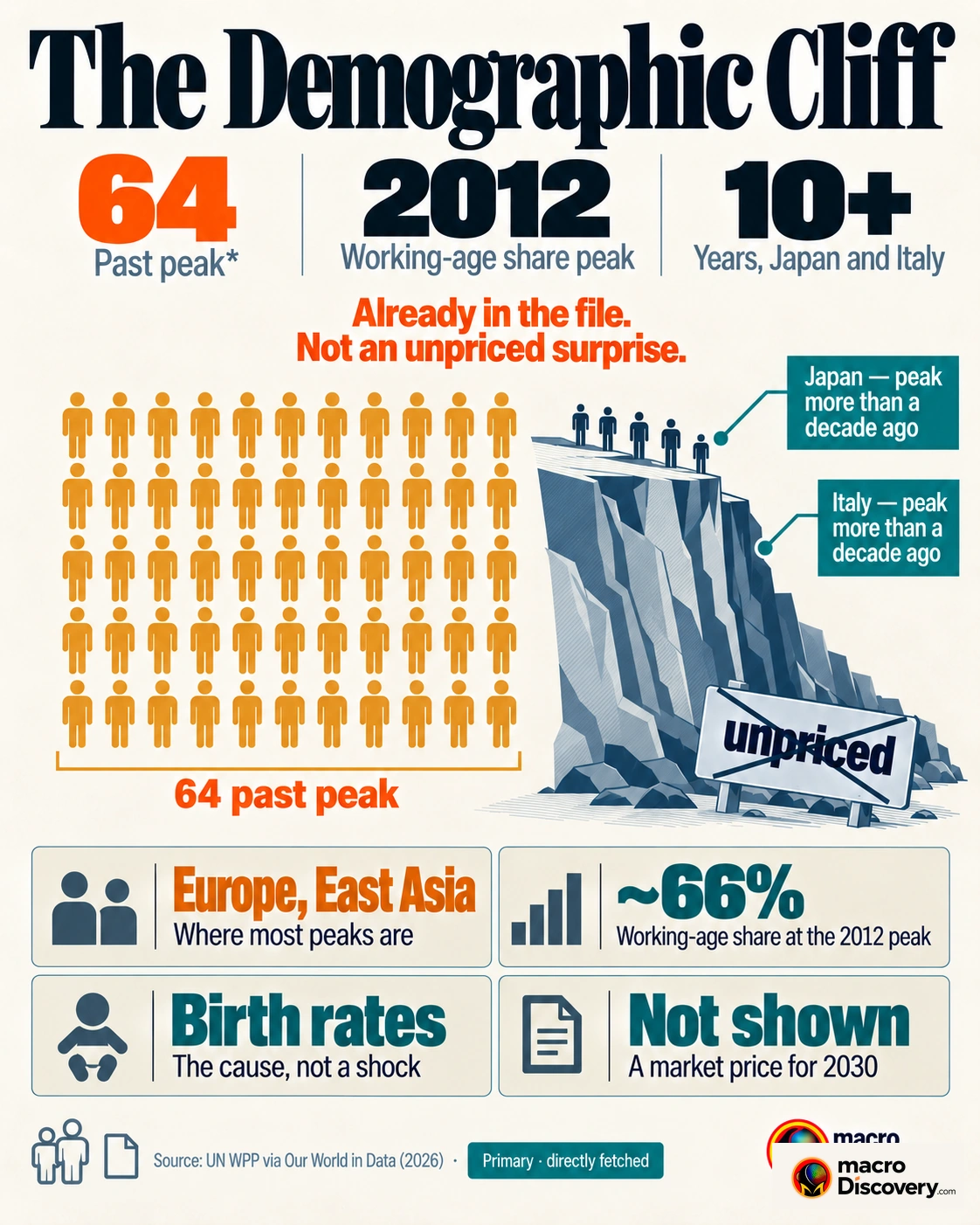
Three numbers
- 63 — countries and areas whose population had already peaked by 2024. They hold 28% of the world’s people. Source: UN.
- About 100 — countries where the share aged 20 to 64 still rises faster than the population through 2054. Source: UN.
- 1.1 points — how much slower global growth could be than pre-pandemic years if governments do nothing. Demography is most of it. Source: IMF.
What the data shows
A common claim is that a demographic cliff is coming and that nobody has priced it. The fact is that the peak is already on the map, and the growth effect is already in a forecast. The UN’s 2024 World Population Prospects say 63 countries and areas, with 28% of the world’s people in 2024, had peaked in population size before 2024. The list includes China, Germany, Japan, and Russia. One in four people lives in a country that is no longer growing. A cliff that includes the largest country in the set is not a secret.
The map is not one cliff. In about 100 countries the share of people aged 20 to 64 is projected to rise faster than the population through 2054. That is the dividend window. For nearly all countries that had already peaked by 2024, the UN says that window has closed. The IMF puts the timing in three bands. Advanced economies are already losing working-age share. The largest emerging markets reach the turn within the decade. The most populous low-income countries are projected to get there around 2070. A single global cliff erases the second and third bands.
The price is a number, not a blank. An IMF study says that if governments do nothing, global growth in 2025 to 2050 would be about 1.1 percentage points slower than in pre-pandemic years, with demography about three-quarters of the drag. Better health and later work could add about 0.4 point a year. Japan, furthest along, has public debt near 207% of GDP. The IMF says interest payments are set to roughly double from 2025 to 2031 as debt is refinanced, and that health and care spending rises with age. Yields there are no longer near zero. A refinancing path is a price. It is not an unpriced cliff.
The peaked group holds 28% of the world’s people. The dividend group is a count of countries, not of people.
| Count | Figure | What it is |
|---|---|---|
| Already peaked | 63 countries | 28% of world population, 2024 |
| Working-age window | about 100 | Share aged 20–64 still rising to 2054 |
| Growth drag | 1.1 points | If governments do nothing. IMF |
| Offset from later work | 0.4 point | A year, 2025–2050. A model |
| Japan public debt | about 207% of GDP | Interest bill set to rise |
How it was measured
A population peak is the year the UN’s medium projection has the headcount at its highest. It is not a working-age peak. A country can still be growing in total and already losing workers, or the reverse. The 20-to-64 share is the UN’s working-age window for the dividend. Other agencies use 15 to 64.
The 1.1-point drag is a model of growth if policy does not change, set against pre-pandemic years. It is not a forecast that output will fall. Japan’s debt ratio is a stock. The doubling of interest payments is a refinancing path, not a default call.
What it means
It is settled that 63 countries had already peaked by 2024, that about 100 still have a rising working-age share through 2054, and that the IMF has put a 1.1-point number on the growth drag. It is not settled that markets have ignored it, or that every country shares one cliff. Use 63 for the peaked set. Use 100 for the dividend set. Use 1.1 for the model drag. Do not call the shift unpriced.
Common misreadings
- Sixty-three countries have already peaked. The cliff is not in the future for them.
- About 100 countries still have a working-age dividend. The map is not one drop.
- A 1.1-point growth drag is in an IMF study. Japan’s debt path is already a price.
Where the numbers come from
How we built this
- Dataset: UN World Population Prospects 2024; IMF aging-and-growth note; IMF note on Japan’s debt.
- Scope: Peaked countries and the dividend window kept apart. The growth drag is a model, not a booked fall in output.
- Figures: 63 is the peaked set. About 100 is the dividend set. 1.1 is the model drag. The cliff is treated as already in the forecast.