Every Mass Extinction
in Earth’s History
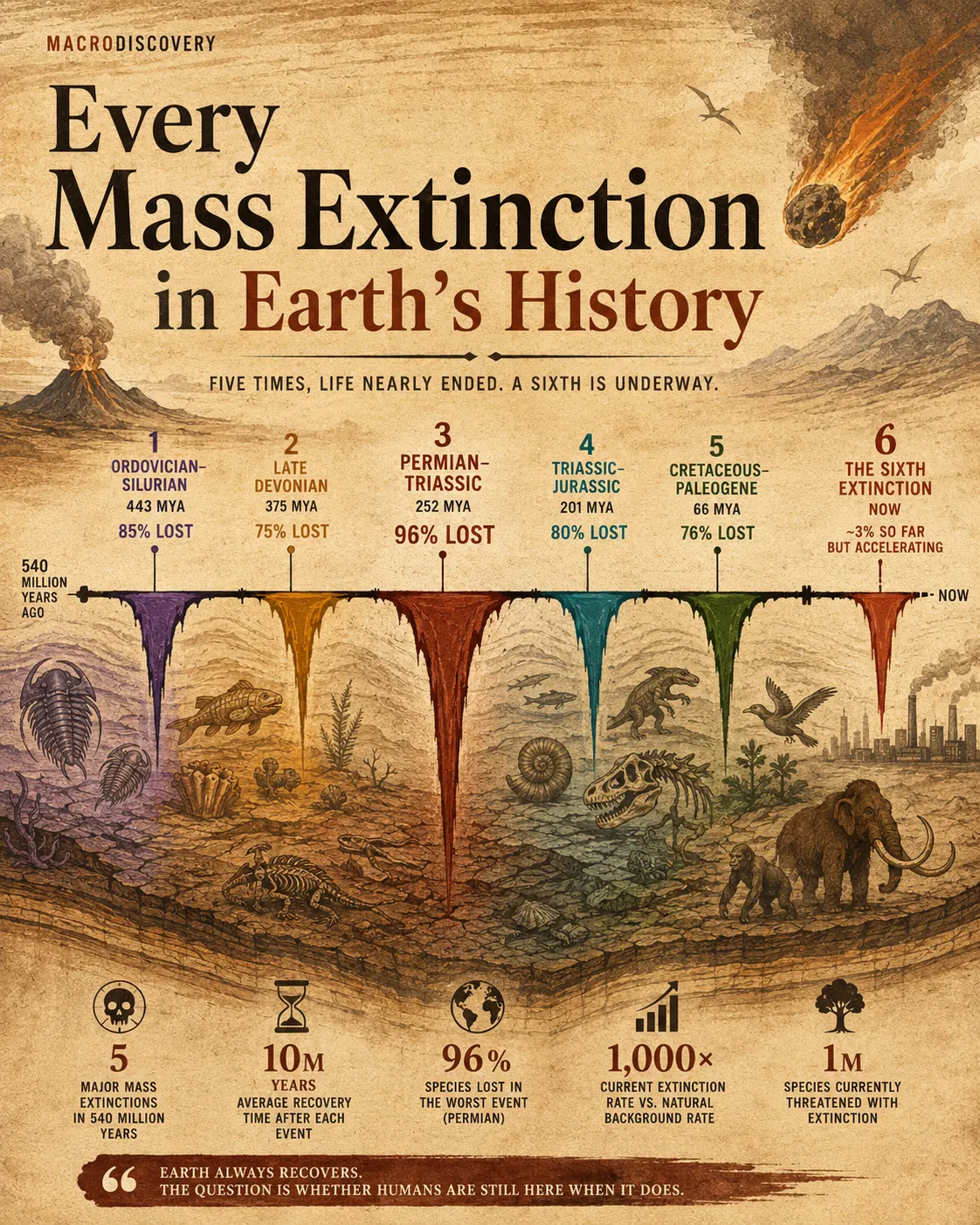
Five times in Earth’s history, life nearly ended. The worst killed 96% of all species. Recovery took 10 million years. A sixth extinction is now underway — caused not by asteroids or volcanic winters, but by a single species.
Estimated marine animal genera diversity over geological time. Each spike downward = a mass extinction event. Right edge = today. Source: Rohde & Muller 2005, Sepkoski 2002, Raup & Sepkoski 1982 — updated with modern paleontological data.
Estimated % of all species (marine and terrestrial) that went extinct in each event. Note: estimates vary by study; figures reflect scientific consensus ranges. Source: Raup & Sepkoski 1982, Barnosky et al. 2011, updated 2024.
Each mass extinction had a distinct kill mechanism. Understanding the pattern reveals what makes the sixth extinction structurally different.
Unlike all five previous extinctions, the sixth is not caused by volcanism, asteroids, or ice ages. It is caused by habitat destruction, overexploitation, invasive species, pollution, and climate change — all products of a single species.
Every Extinction Followed by an Explosion
Mass extinctions do not end evolution — they restart it, under radically different rules.
The most consistent pattern across all five extinctions is that the survivors inherit a world with almost no competition. The Permian extinction eliminated 96% of species — and the 4% that survived diversified into every ecological niche left empty. Crises create winners as much as they create losers.
- The Ordovician extinction cleared the ocean floor for the Silurian reef revolution
- The Devonian extinction eliminated fish competitors and enabled the first land vertebrates
- The Triassic extinction removed crurotarsans and unleashed dinosaur dominance
- The K-Pg extinction ended the dinosaurs and gave mammals 66 million years to produce us
Extinction is creative destruction at the planetary scale — but the timescale of recovery is longer than civilization has existed.
Why the Sixth Is Structurally Different
All previous extinctions had a single cause that ended. This one has five concurrent causes that are accelerating.
The Permian extinction — the worst in history — was caused by one mechanism: volcanic CO₂ warming oceans over 60,000 years. The sixth extinction is simultaneously driven by habitat destruction, climate change, overexploitation, invasive species, and pollution — five compounding stressors that reinforce each other.
The sixth extinction is the first in Earth’s history where the cause is aware of what it is doing.
The Tipping Point Window Is Now
Scientists estimate we are in the critical 20-year window to prevent irreversible mass extinction outcomes.
The IPBES (Intergovernmental Science-Policy Platform on Biodiversity) 2024 report identifies 2030 as a critical threshold — beyond which ecosystem collapse becomes self-reinforcing. The Kunming-Montreal Global Biodiversity Framework (2022) committed 196 nations to protecting 30% of land and ocean by 2030, but implementation is running years behind.
De-Extinction Changes the Equation
For the first time in Earth’s history, a species can deliberately reverse extinction.
Colossal Biosciences is advancing woolly mammoth de-extinction (target: 2028 birth). The thylacine, passenger pigeon, and dodo are all active de-extinction projects. This is genuinely unprecedented in 540 million years of extinction history — but critics argue it risks distracting from preventing current extinctions.
The Recovery Lesson From Deep Time
Earth always recovers. The question is whether humans are still here when it does.
Every previous mass extinction was followed by a recovery — but recovery took 3–10 million years. Human civilization is 10,000 years old. The geological record does not offer comfort on human timescales: if a sixth mass extinction proceeds to its logical conclusion, the world that recovers will be one that evolved without us as a reference point.