The Human Body
as a Data System
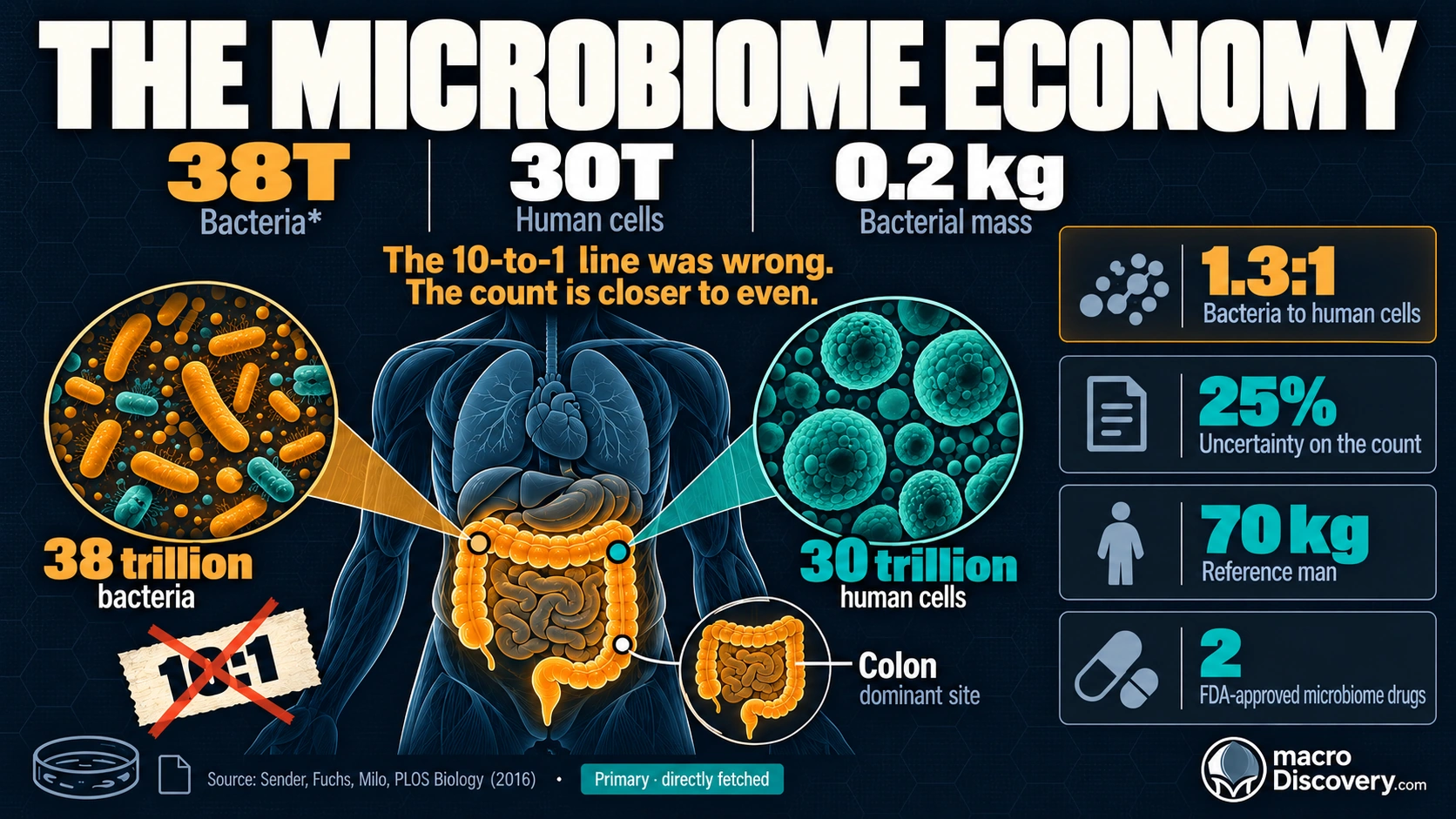
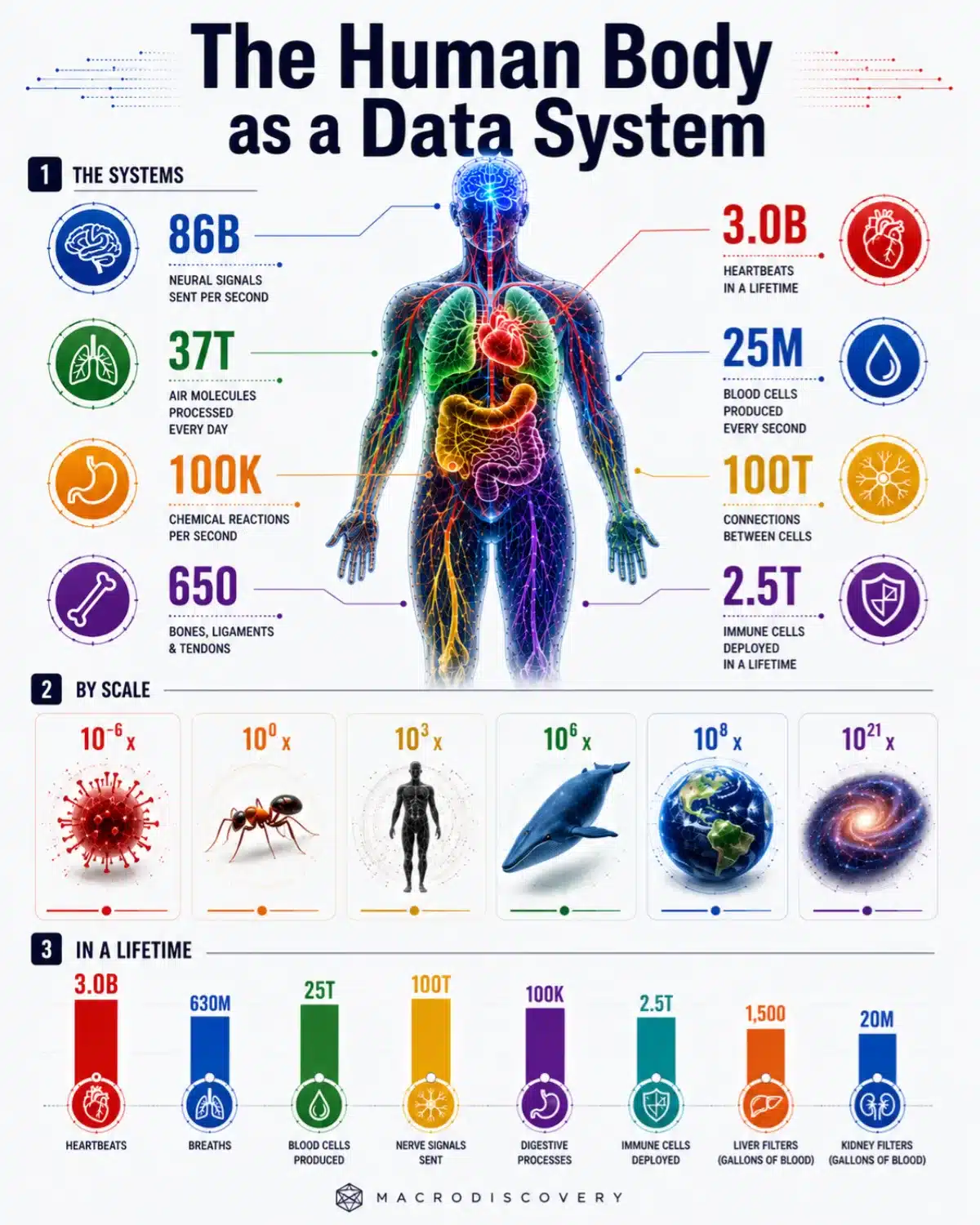
37 trillion cells. 86 billion neurons. 100,000 heartbeats per day. 2 million red blood cells produced every second. The human body is the most complex operating system ever constructed — and it runs without a manual.
Eight major body systems, each displayed as a live instrument panel with key operational metrics.
The body’s operating statistics are so large they require analogies to comprehend. Here is each one anchored to something tangible.
Cumulative lifetime output of each major body system, based on an 80-year lifespan.
| System / Metric | Per Day | Per Year | 80-Year Lifetime |
|---|---|---|---|
|
Heartbeats
|
~100,000 | ~36.5M | ~3 Billion |
|
Breaths taken
|
~23,000 | ~8.4M | ~672 Million |
|
Blood pumped (litres)
|
7,570 L | ~2.7M L | ~216M litres |
|
Red blood cells made
|
173B | ~63T | ~5 Quadrillion |
|
Skin cells shed
|
~840,000 | ~307M | ~24.5 Billion |
|
Food processed (kg)
|
~2 kg avg | ~730 kg | ~58,400 kg |
|
Air inhaled (litres)
|
11,000 L | ~4M L | ~320M litres |
|
Neural signals fired
|
Trillions | Quadrillions | Incalculable |
|
Immune threats neutralized
|
Billions | Trillions | ~Quadrillions |
|
Steps walked (average)
|
~8,000 | ~2.9M | ~216M steps |
No engineer has ever built anything close to the human body. Not in complexity, not in efficiency, not in the elegance of its solutions to the problem of keeping 37 trillion semi-autonomous units alive and coordinated simultaneously — for 80 years, without a single planned shutdown.
When you look at the body as a data system — treating its biological processes as operating metrics rather than medical facts — the numbers become difficult to process. Not because they are abstract, but because they are concrete and still incomprehensible. The cardiovascular system pumps 216 million litres of blood in a lifetime. The immune system neutralizes billions of threats per day. The brain fires trillions of signals before breakfast.
“The brain consumes 20% of the body’s total energy while representing just 2% of its weight. No computer in existence achieves this ratio of computational output to power consumption — not even close.”
The Cardiovascular System
The Nervous System
The Immune System
The Digestive System
The Body as Engineering Problem
What makes the human body remarkable from an engineering perspective is not any single system. It is the integration. The cardiovascular system delivers oxygen that the respiratory system captures to cells that the nervous system coordinates to perform work that the digestive system fuels while the immune system monitors every component for failure — simultaneously, continuously, for decades.
No human-engineered system achieves this level of integrated redundancy. The body has multiple backup systems for almost every critical function. The liver can regenerate up to 75% of its mass if damaged. Bone can heal. The brain can reroute neural pathways around damage through neuroplasticity. The immune system adapts to novel threats it has never encountered before.
The human body is the most sophisticated data system ever studied. It processes more information per second than any computer yet built, runs more parallel processes than any software ever written, maintains more complex feedback loops than any engineered system ever designed — and does all of this at approximately 37°C, on roughly 2,000 calories per day, for eight decades.
The data also reveals the body’s vulnerabilities. A system this complex has correspondingly complex failure modes. The same immune sophistication that neutralizes 1,000 cancerous cells per day can turn against the body itself in autoimmune disease. The same neural plasticity that allows the brain to recover from damage also makes it susceptible to addiction. Every adaptive feature has a corresponding failure mode — which is the defining characteristic of biological, rather than engineered, complexity.
Understanding the body as a data system — rather than just a medical subject — changes how you read its outputs. Every symptom is a signal. Every physiological response is feedback. The body is communicating constantly, in the only language it has: the language of biology.