AI Tech Gaming Future Automobile Top 10 Space Innovation Trending How To Reviews Discover

---Advertisement---

Visualized: The Device in Your Pocket Rewired Human Attention

Macro Discovery
On: June 27, 2026 3:06 PM
Follow Us:
---Advertisement---
The Device in Your Pocket Rewired Human Attention
The Device in Your Pocket Rewired Human Attention — MacroDiscovery
MacroDiscovery
Technology & Society · 8 min read · Current Data
NOW — Human Behavior · Technology · Neuroscience · 2024
Technology & Human Behavior

The Device in Your Pocket
Rewired Human Attention

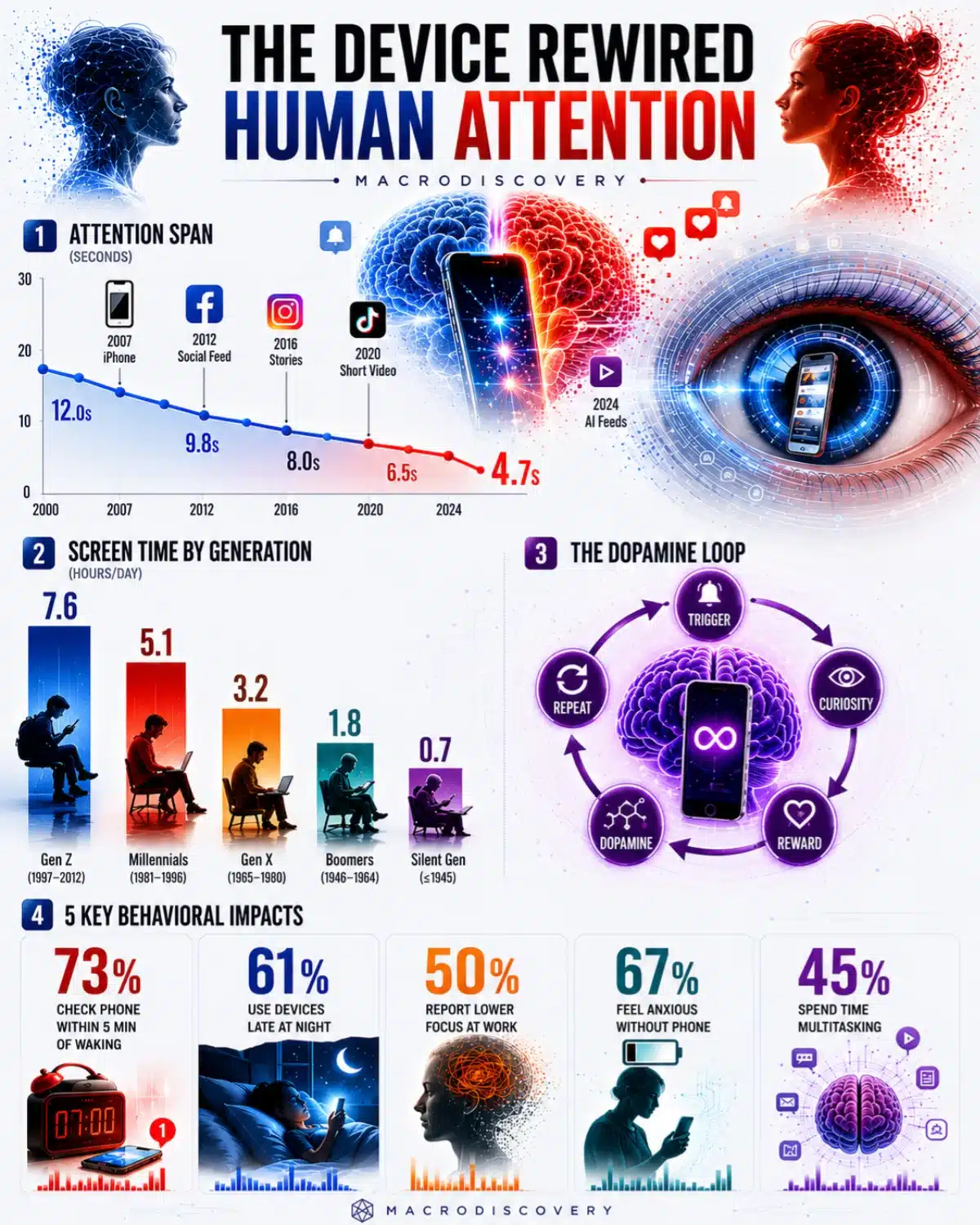
In 2000, the average human attention span was measured at 12 seconds. By 2015 it had fallen to 8 seconds — below the goldfish. The smartphone arrived in 2007. The timing is not coincidental. Here is the data on what happened next.

By MacroDiscovery
Sources: Microsoft · APA · NIH · Pew Research
Updated: 2024
4.6 hrs
Daily phone use — global avg 2024
8 sec
Average attention span — down from 12
96×
Phone checks per day — average adult
$600B
Global attention economy value
2007
The year everything changed
Visualization 01 — The Attention Collapse
Average Attention Span Since 2000 — and the Technology Events That Shaped It

Measured attention span in seconds for sustained focus tasks. Based on EEG and behavioral studies. The smartphone era began in 2007.

14s 12s 10s 8s 6s 2000 2004 2007 2012 2016 2020 2024 iPhone 2007 Social Peak TikTok 2016 12s ~7s Avg. attention span (seconds) Smartphone adoption trend Sources: Microsoft Human Factor Labs 2015 · APA · Statista 2024
2000
Pre-smartphone baseline
Average attention span: 12 seconds. Internet existed but was desktop-bound and slow.
2007
iPhone launches
The pocket computer arrives. The internet becomes ambient — always present, always accessible.
2012
Social media peaks
Facebook hits 1 billion users. Instagram launches. The notification economy begins in earnest.
2016
Short-form video era
TikTok launches. Content consumption fragments into 15–60 second units engineered for maximum dopamine response.
2024
Current state
Average daily phone use: 4.6 hours. 96 phone checks per day. Attention span: ~7–8 seconds.
Visualization 02 — Screen Time by Generation
Daily Phone Use — Every Generation, Every Hour

Average daily smartphone screen time by age group, 2024. Younger generations spend more time on screen than on school or work.

Born 2013+
Gen Alpha
(age 8–11)
7.2
hours / day
Mostly YouTube, gaming, TikTok
Born 1997–2012
Gen Z
(age 12–27)
6.5
hours / day
Social media, streaming, messaging
Born 1981–1996
Millennials
(age 28–43)
4.8
hours / day
News, social, email, streaming
Born 1965–1980
Gen X
(age 44–59)
3.8
hours / day
Email, news, social, video
Born 1946–1964
Boomers
(age 60–78)
2.5
hours / day
News, calls, Facebook, video
Visualization 03 — The Engineered Reward Loop
How Your Phone Was Designed to Be Irresistible

The dopamine feedback loop that makes smartphones compulsive — and why it was built this way deliberately.

Dopamine Reward Loop 01 TRIGGER Notification / Boredom / Habit 02 ACTION Open app / Scroll / Check 03 VARIABLE REWARD Like / message / nothing → uncertainty 04 DOPAMINE SPIKE Brief pleasure / craving begins 05 CRAVING Need to check again. Anxiety if no phone 06 SHORTENED ATTENTION Long tasks feel unbearable. Loop re-triggers faster Variable reward = slot machine psychology Sources: Fogg, B.J. (2003) Persuasive Technology · Eyal, N. (2014) Hooked · NIH Neuroscience
Visualization 04 — The Attention Economy
What Human Attention Is Worth — in Dollars

Annual revenue of the major platforms that monetize human attention. Ranked by revenue derived directly from selling access to human focus.

Meta (Facebook/Instagram/WhatsApp) Advertising revenue 2024
$135Bper year
Alphabet / Google (YouTube + Search) Advertising revenue 2024
$237Bper year
TikTok / ByteDance Global advertising revenue 2024
$23Bper year
Amazon (Advertising) Ad revenue 2024
$47Bper year
Netflix Subscription + ad revenue 2024
$39Bper year
Snapchat Advertising revenue 2024
$5Bper year
Twitter / X Advertising revenue 2024
$2.5Bper year
Visualization 05 — Compulsive Checking Behavior
The Numbers Behind the Habit

Behavioral data on how often and why people check their phones. Source: Asurion, IDC, Pew Research 2024.

📱
96×
Average daily phone checks for average adult
Once every 10 waking minutes. Many checks last under 30 seconds — just enough to re-trigger the reward loop.
47 sec
Average time before switching tasks on a computer screen
Down from 2.5 minutes in 2004. Once focus is broken, it takes an average of 23 minutes to fully regain deep concentration.
🌙
71%
Adults who sleep with their phone within arm’s reach
Among 18–29 year olds, the figure rises to 83%. Sleep quality declines measurably when the phone is in the bedroom.
😰
65%
People who feel “anxious” when their phone battery is low
Nomophobia — the fear of being without a phone — is now classified as a recognized anxiety condition in clinical literature.
🚶
23 min
Time needed to fully regain deep focus after a single interruption
Research by Gloria Mark at UC Irvine. With 96 phone checks per day, most people never achieve sustained deep focus at all.
👶
8 yrs
Average age of first smartphone ownership — down from 12 in 2015
Children who receive smartphones before age 10 show significantly different attention and impulse control development by adolescence.

The smartphone is 17 years old. In that time, it has become the most widely adopted consumer technology in human history — faster than electricity, faster than television, faster than the internet itself. Approximately 6.9 billion people now carry one. Most of them check it 96 times per day. Most of them feel anxious without it. Most of them cannot sit through a meeting, a meal, or a film without reaching for it at least once.

This did not happen by accident. It happened by design — and the design principles are now well documented, openly discussed by the engineers who built them, and increasingly regulated by governments that have concluded the outcome represents a public health problem rather than a consumer preference.

“We have created a world in which online connection has become primary — a world in which a constant stream of stimulation provides no opportunity for the mind to rest. The smartphone is the cigarette of the 21st century — completely normalized, highly addictive, and with long-term consequences we are only beginning to understand.”

The Attention Architecture

Attention Span · The 8-Second Problem
8 sec
Average human attention span fell from 12 seconds in 2000 to approximately 8 seconds by 2015 — the period that precisely coincides with smartphone adoption.
The Microsoft Human Factor Labs study, published in 2015, drew on EEG brain scans and behavioral surveys of 2,000 Canadians. It found not just a reduction in sustained attention but a bifurcation: people showed decreased ability to focus on a single task for extended periods, but increased ability to rapidly switch between multiple information streams. The smartphone did not simply shorten attention — it restructured attention around a different mode of processing. Whether this constitutes cognitive damage or cognitive adaptation remains an active scientific debate.
Source: Microsoft Human Factor Labs — “Attention Spans” (2015) · Haidt, J. & Rausch, Z. (2023) “The Teen Mental Illness Epidemic” — After Babel Substack · APA
Variable Reward · The Slot Machine in Your Pocket
Nir Eyal
“Hooked” — the 2014 book by product designer Nir Eyal — became the engineering manual for building habit-forming technology. Its principles are embedded in every major social platform.
The Hook Model — trigger, action, variable reward, investment — was developed explicitly to create compulsive product use. The variable reward element is the key mechanism: like slot machines, social media delivers unpredictable rewards (a like, a message, a viral post) at unpredictable intervals. B.F. Skinner established in the 1950s that variable-ratio reinforcement schedules produce the highest rates of behavioral response and the most resistance to extinction. Platform designers applied this directly to the attention economy. Former Google design ethicist Tristan Harris publicly described it as “a race to the bottom of the brainstem.”
Source: Eyal, N. (2014) “Hooked: How to Build Habit-Forming Products” · Harris, T. — Center for Humane Technology · Skinner, B.F. (1957) Schedules of Reinforcement
Adolescent Mental Health · The Data Arrives
150%
Rates of adolescent depression and anxiety in the United States rose by 150% between 2010 and 2020 — a period that precisely brackets the mass adoption of social media by teenagers.
Social psychologist Jonathan Haidt’s 2024 book “The Anxious Generation” synthesizes a decade of research on the correlation between social media adoption and adolescent mental health deterioration. The data shows that the decline in teenage mental health was not global uniformly — it was steepest in countries with the earliest and highest social media adoption rates, particularly among girls. The mechanism proposed: social media replaced in-person socializing, disrupted sleep, increased social comparison, and exposed adolescents to cyberbullying at scale. The correlation is robust. The causation debate continues.
Source: Haidt, J. (2024) “The Anxious Generation” — Penguin Press · Twenge, J.M. et al. (2018) “Increases in Depressive Symptoms” — Clinical Psychological Science · CDC Youth Risk Behavior Survey 2024
The Attention Economy · What Your Focus Is Worth
$600B
The global attention economy — platforms that monetize human focus by selling it to advertisers — generates approximately $600 billion in annual revenue.
The business model of the attention economy is structurally simple: the more time users spend on a platform, the more data is collected, the more targeted the advertising, and the higher the revenue per user. The incentive is therefore to maximize time-on-platform — and the most effective way to maximize time-on-platform is to trigger the dopamine loop described above as frequently and reliably as possible. This creates a structural misalignment between platform profitability and user wellbeing that market mechanisms alone cannot resolve. The product is free. The user is the product. Human attention is the inventory being sold.
Source: Statista — Digital Advertising Market 2024 · eMarketer — Global Ad Spend Report 2024 · IAB Internet Advertising Revenue Report 2024

The Counterargument — and Its Limits

The data above does not mean smartphones are uniformly harmful or that the pre-smartphone world was cognitively superior. Several counterarguments have genuine weight. Moral panics about new communication technologies are not new — the printing press, the novel, the telephone, and the television each generated similar concerns about cognitive and social deterioration. Most of those concerns were eventually moderated by adaptation.

The smartphone may be genuinely different in degree rather than kind — it is ambient in a way that previous technologies were not, it is interactive in a way that television was not, and it arrived in children’s lives at younger ages than any previous mass communication technology. But the evidence that it constitutes a categorical break from previous technology transitions rather than a large version of a familiar pattern is not yet settled.

What is settled is the structural fact: a technology optimized for engagement — not for wellbeing, not for productivity, not for attention — was distributed to 6.9 billion people in 17 years. The measurable consequences are only now becoming visible in longitudinal data. The full picture will take another decade to clarify.

MacroDiscovery Take

The smartphone is the most significant behavioral intervention ever deployed at civilizational scale. It was not designed as an intervention — it was designed as a product. But the behavioral consequences are of the scale and character that, in any other domain, would be classified as public health outcomes requiring regulatory response.

The attention economy’s business model creates a structural conflict of interest that individual choice cannot resolve. When the product is free and the monetization mechanism is time-on-platform, the incentive structure pushes every design decision toward engagement maximization — regardless of the cognitive or psychological cost to the user. This is not a conspiracy: it is the rational outcome of a market structure.

The coming decade will see the first generation — Gen Alpha — to grow up from birth with smartphones and social media reach adulthood. The longitudinal data on their cognitive development, attention capacity, and mental health outcomes will be the most important data in this space. The hypothesis being tested, at civilizational scale, is whether a technology optimized for engagement can coexist with sustained human attention — or whether the two are structurally incompatible.
Forecast Cards — Key Data Points
Technology & Behavior · Attention
8 sec
Average human attention span in 2024 — down from 12 seconds in 2000. The smartphone era accounts for most of the decline.
Microsoft Human Factor Labs, 2015 · APA 2024
Technology & Behavior · Usage
4.6 hrs
Average daily smartphone screen time globally in 2024. Gen Z averages 6.5 hours. Gen Alpha: 7.2 hours.
Data.ai State of Mobile 2024 · Statista
Technology & Behavior · Checking
96×
Average number of times an adult checks their phone per day — once every 10 waking minutes. Up from 30× per day in 2014.
Asurion Mobile Consumer Survey 2024
Technology & Economy · Attention
$600B
Annual revenue of the global attention economy — platforms that monetize human focus by selling it to advertisers.
eMarketer Global Ad Spend Report, 2024
Sources & Methodology
  • Microsoft Human Factor Labs — “Attention Spans: Consumer Insights” (2015)
  • Haidt, J. (2024) The Anxious Generation — Penguin Press
  • Twenge, J.M. et al. (2018) “Increases in Depressive Symptoms, Suicide-Related Outcomes and Suicide Rates” — Clinical Psychological Science
  • Eyal, N. (2014) Hooked: How to Build Habit-Forming Products — Portfolio/Penguin
  • Mark, G. (2023) Attention Span — Hanover Square Press · UC Irvine Research
  • Data.ai — State of Mobile 2024
  • Asurion — 2024 Mobile Consumer Survey
  • eMarketer — Global Digital Advertising Forecast 2024
  • CDC — Youth Risk Behavior Survey 2023
  • Pew Research Center — Mobile Technology and Home Broadband 2024
Macro Discovery

Sukh Dhaliwal

Sukh Dhaliwal is the founder of Macro Discovery, an independent digital publication covering AI, technology, science, future trends, and global innovation through visual storytelling and data-driven analysis.

Join WhatsApp

Join Now

Join Facebook

Follow us

Leave a Comment