The Science of Human Aging
Scientists can estimate a biological-age score from chemical tags on DNA. That score is not your birthday. It is also not a second, truer birthday hiding in a tube of blood.
GrimAge and DunedinPACE predict death and disease in large groups better than first-generation clocks. Two kits can disagree on the same person. A few years of change on a retest may be noise.
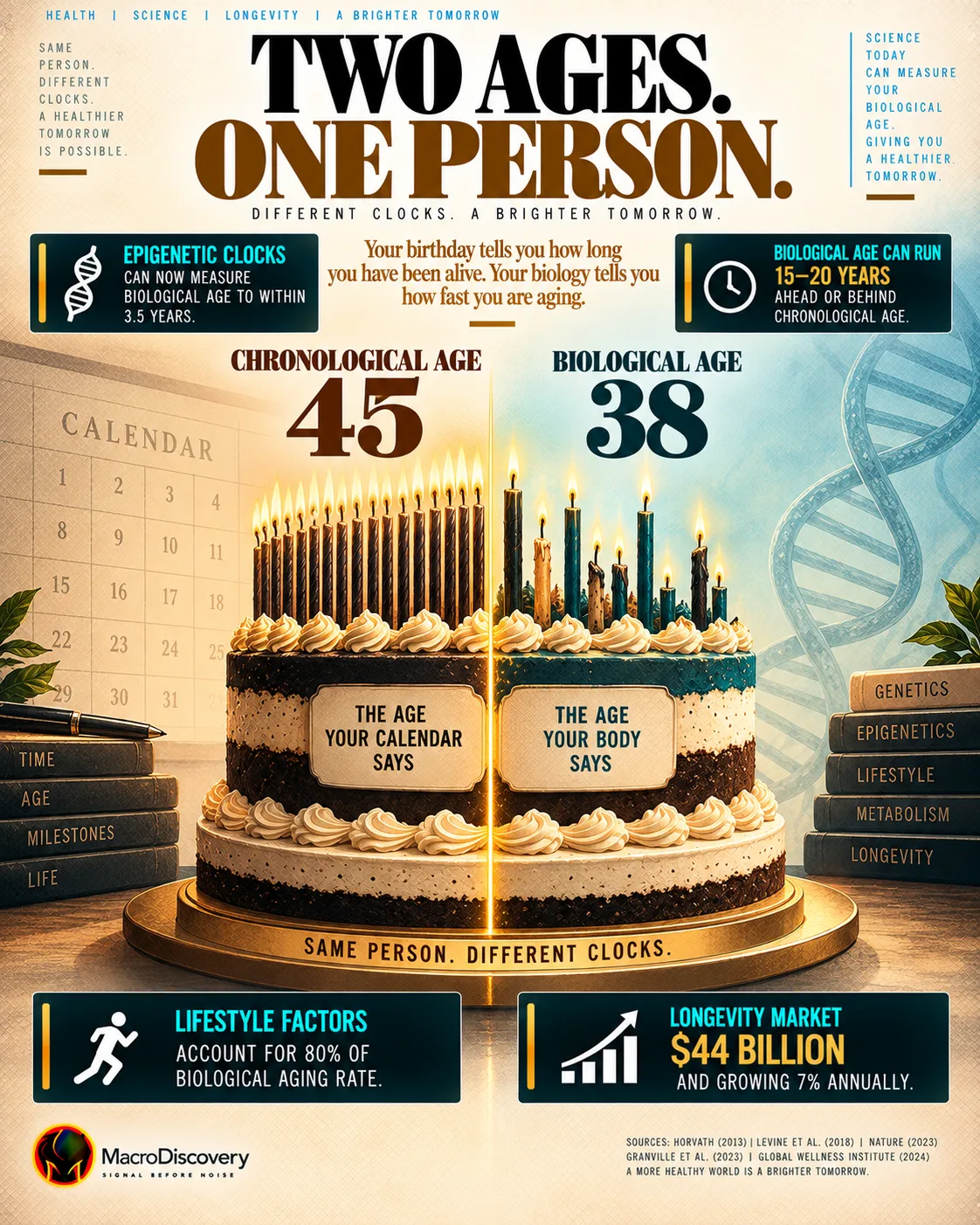
Your passport age is a count of Earth orbits. Your body does not keep that calendar. Some 50-year-olds have the arteries and lungs of a younger cohort. Some do not. For a decade, labs have tried to put a number on that gap by reading DNA methylation — chemical tags at CpG sites that drift in patterns as people get older.
Steve Horvath’s 2013 clock showed those patterns can estimate chronological age across tissues. Later clocks stopped trying to guess your birthday and started trying to guess your risk. That is the science. The consumer headline — “we measured your real age” — is a translation that the field itself does not fully endorse. Daniel Belsky, who helped build DunedinPACE, has put it plainly: there is no ground-truth biological age. The number is always relative to a model.
They are not one instrument
- 1Horvath / Hannum · 2013Guess calendar age from methylation. Good odometer. Weak on who dies next.
- 2PhenoAge · GrimAgeTrained on clinical age or time-to-death, proteins, smoking. Stronger on mortality in cohorts.
- 3DunedinPACE · 2022Not years old — years of aging per calendar year. A speedometer. Useful in trials.
A 2025 Nature Communications comparison in Generation Scotland (n ≈ 18,900) found second- and third-generation clocks beat first-generation clocks across 174 disease outcomes. GrimAge v2 was often the sharpest on death. No clock won every disease.
A model output. Not a blood type.
GrimAge (Lu et al., 2019, updated as GrimAge2) builds methylation stand-ins for plasma proteins and smoking pack-years, then aims at time to death. In cohort after cohort it tracks mortality, heart disease and cancer better than telomere length. DunedinPACE was trained on two decades of organ-system decline in one New Zealand birth cohort. A score of 1.0 means a year of aging per calendar year. 1.2 is faster. 0.9 is slower.
That is real epidemiology. It is not a clinic stamp. Split the same DNA and some clocks have come back years apart. Blood-trained algorithms misbehave on uncorrected saliva — Horvath has flagged that mix of immune and cheek cells. Companies sell kits for a few hundred dollars as laboratory-developed tests, not FDA-cleared devices. No study has shown that handing a person their number improves a health outcome.
Often strongest in head-to-heads
Includes a smoking surrogate. That helps respiratory predictions. It is also a feature, not a bug.
Rate, not years
Moved in the CALERIE calorie-restriction trial. PhenoAge and GrimAge in that trial did not move the same way.
Same sample, two runs
Replicates have differed by several years on some clocks. A “three-year reversal” can be the machine.
LDTs, not cleared devices
A research tool sold at retail. Bloodwork you already have still does more for care.
The clock can tell a cohort who is running hot. It cannot hand you a birthday the universe agrees on.Macro Discovery reading of the clock literature, 2013–2026
The useful product is a trial endpoint. The product on Amazon is a vibe.
Where these tools earn their keep is in groups: does this drug, this diet, this year of smoking cessation bend the slope? Nature Medicine in 2026 surveyed how clocks respond to interventions. DunedinPACE moved in more of them than most. That is why trialists like it. It is not why a 42-year-old should rearrange a life around one spit kit.
The birthday headline sells because people want a single number. Aging is grip, VO₂, kidneys, brain, arteries, and luck. A methylation algorithm compresses some of that into a score trained on someone else’s cohort. Keep the score. Keep the compression in view.
Editorial reading of published clock papers and 2025–26 comparison studies. Those labs did not write this box. This is not medical advice.If you remember two things
Second- and third-generation clocks predict risk in groups
GrimAge for mortality. DunedinPACE for pace. Better than guessing from the calendar alone.
There is no one biological age to measure
Clocks disagree. Retests jitter. A kit is not a diagnosis and has not been shown to improve your outcomes.
Short answers
Papers, not a kit brochure
- Clocks: Horvath 2013; Hannum 2013; Levine PhenoAge 2018; Lu GrimAge 2019 / GrimAge2 2022; Belsky DunedinPACE 2022.
- Head-to-head: Nature Communications 2025 (14 clocks, 174 outcomes, Generation Scotland); Aging Cell 2025 GrimAge vs others on mortality; Nature Medicine 2026 on intervention responsiveness.
- Limits: replicate noise (Higgins-Chen et al.); saliva vs blood (Horvath commentary); no consensus clinical validation (Moqri et al., Nat Med 2024); consumer tests as LDTs.