How Big
Is Space —
A Scale Visualization
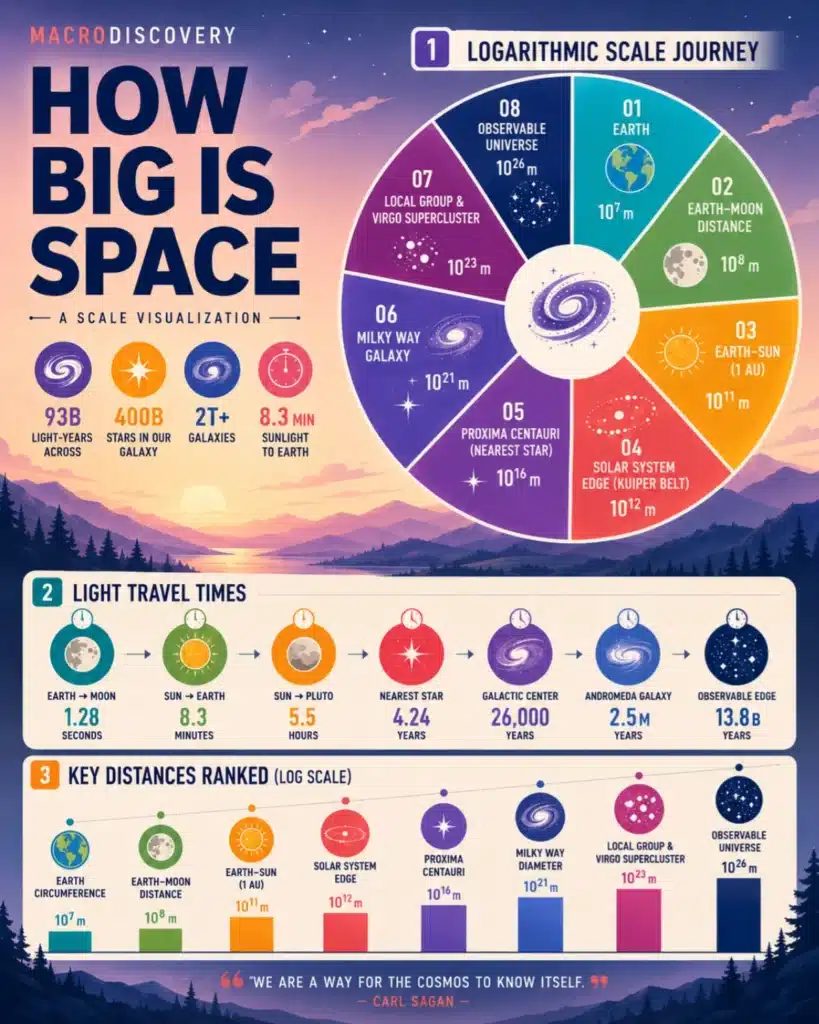
The observable universe is 93 billion light-years across. The Milky Way alone contains 400 billion stars. Earth, at galactic scale, is not a dot — it is beneath the resolution of any instrument that could measure it. A logarithmic journey from your feet to the edge of everything.
Each step on this scale is exponentially larger than the last. Note: distances shown on a log₁₀ scale — each row represents a 10× to 1,000× increase over the previous.
Astronomical distances resist human intuition. These analogies rebuild scale from objects you can hold.
Ordered from nearest to farthest. Log-scale bar shows relative magnitude — each row is orders of magnitude larger than the last.
| # | Object / Distance | Kilometers | Light Travel Time | Log Scale | |
|---|---|---|---|---|---|
| 01 | Earth CircumferenceAround the equator once | 40,075 km | 0.13 seconds | ||
| 02 | Earth to MoonAverage distance | 384,400 km | 1.28 seconds | ||
| 03 | Earth to Sun (1 AU)Average orbital distance | 149,597,871 km | 8.3 minutes | ||
| 04 | Edge of Solar SystemKuiper Belt / heliopause ~100 AU | ~15 billion km | ~14 hours | ||
| 05 | Proxima CentauriNearest star system to Earth | 40.1 trillion km | 4.24 years | ||
| 06 | Galactic CenterMilky Way core / Sgr A* black hole | 248 quadrillion km | 26,000 years | ||
| 07 | Milky Way DiameterEdge to edge of our galaxy | 946 quadrillion km | 100,000 years | ||
| 08 | Andromeda GalaxyNearest large galaxy — visible naked eye | 2.37×10¹⁹ km | 2.5 million years | ||
| 09 | Virgo SuperclusterOur supercluster — Laniakea — diameter | 4.73×10²¹ km | 500 million years | ||
| 10 | Observable UniverseEverything light has reached us from | 8.8×10²³ km | 13.8 billion years |
Light travels 299,792 km per second — the fastest anything in the universe can move. These are its journey times.
The core problem with understanding space is that human intuition is calibrated for distances between zero and roughly 40,000 kilometers — the circumference of Earth. Beyond that, our brains use the same word, “far,” for distances that differ by a factor of one trillion. The Moon is 384,000 km away. The observable universe is 93 billion light-years across. These are not “far” and “very far.” They are categorically different scales separated by 26 orders of magnitude.
The most instructive number is the speed of light: 299,792 kilometers per second. Nothing in the universe travels faster. Light circles Earth 7.5 times in a single second. Yet light takes 8.3 minutes to reach us from the Sun, 4.24 years to cross to the nearest star, and 100,000 years to traverse the Milky Way. At every scale, the universe reveals a new level of incomprehensibility. Voyager 1 — the fastest human-built object to leave the solar system — has been traveling since 1977. It would need 73,000 more years to reach Proxima Centauri.
“The universe is not only stranger than we imagine — it is stranger than we can imagine.”
What the logarithmic scale reveals is that each new threshold of cosmic distance is not an incremental increase but a complete reimagining of what “distance” means. The step from the solar system to the nearest star is a factor of 10,000 times larger than the step from Earth to the edge of the solar system. The step from the nearest star to the Milky Way’s diameter is another factor of 25,000. And the observable universe is 930 times wider than the Milky Way. At galactic scale, Earth has no visual representation — it is below the resolution of any instrument that exists.
The next decade will produce the most detailed map of cosmic structure ever assembled. The James Webb Space Telescope, now operational, is capturing light from galaxies formed fewer than 400 million years after the Big Bang — a direct window into the universe’s first era. The Vera Rubin Observatory, coming online in 2025, will survey 20 billion galaxies and fundamentally change our understanding of dark matter distribution.
Meanwhile, humanity’s practical exploration horizon remains confined to our own solar system. NASA’s Artemis program aims to return humans to the Moon by 2026. Mars crewed missions are targeted for the 2030s. The nearest star — 4.24 light-years away — remains a generational project: the Breakthrough Starshot initiative proposes laser-propelled nanoprobes reaching 20% of light speed, arriving at Proxima Centauri in roughly 20 years after launch. We are, by any cosmic measure, still local — and the universe is almost entirely unexplored.